

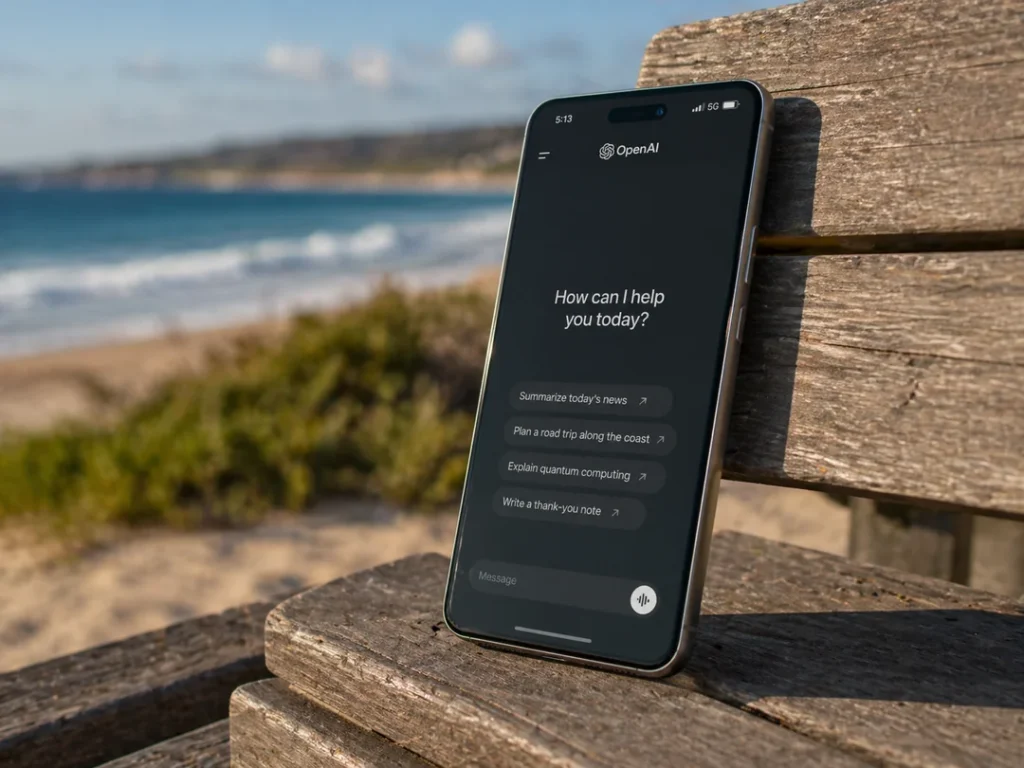
What if the future of smartphones didn’t rely on apps, but on artificial intelligence itself? According to multiple industry sources, OpenAI is reportedly developing a smartphone focused on AI agents, with production anticipated by 2027.
This initiative could significantly redefine our relationship with mobile technology.
A Strategic Push in Hardware
According to analyst Ming-Chi Kuo, known for his supply chain insights, OpenAI is accelerating its entry into hardware. The target is clear: to become less dependent on existing platforms (iOS, Android) and to control the entire chain—from silicon to user experience.
This shift aligns OpenAI with the strategies adopted by Apple and Google, where vertical integration becomes crucial for enhancing performance and experience.
A Smartphone Designed for AI First
In contrast to traditional smartphones, this project would feature a fully AI-oriented architecture:
- Double NPU (Neural Processing Unit)
- LPDDR6 RAM
- UFS 5.0 storage
- Advanced ISP for real-time visual perception
The processor could be developed in partnership with MediaTek, based on a future Dimensity 9600 platform, and manufactured by TSMC using its N2P process in the latter half of 2026. The hardware will be heavily geared toward AI-driven tasks, featuring a dual NPU architecture designed for layered computing.
Memory and storage could also see improvements with LPDDR6 RAM and UFS 5.0 to minimize bottlenecks during continuous AI workload processing. For imaging, an advanced image signal processor (ISP) is expected to enhance dynamic range (HDR), better enabling the device to interpret real-world environments visually.
The goal is not merely to run apps but to allow an AI agent to understand user context, anticipate actions, and perform complex tasks locally.
【產業調查更新】OpenAI 可能正加速首款 AI agent 手機開發,目標最快於 1H27 量產,考量原因或包括有利年底 IPO 敘述、AI agent 手機競爭加速等。目前聯發科更有可能獨家取得處理器訂單,該機預計採用基於天璣 9600 的客製版本,並於 2H26 由台積電 N2P 生產。ISP… https://t.co/EYEtbWf16X
– 郭明錤|Ming-Chi Kuo (@mingchikuo) May 5, 2026
The End of Apps? The Bet on AI Agents
This smartphone would embody a new philosophy: a shift from an “app-centric” model to a “task-centric” model. Today, users open an app to perform an action. Tomorrow, users will express an intention, and the AI will handle it.
This approach requires constant access to contextual data: location, usage habits, and real-time activity. This is fertile ground for OpenAI, which could blend embedded AI (fast, private) with cloud AI (more powerful, complex).
An Ongoing Industrial Battle
The project extends beyond a mere prototype. It reflects a significant industrial strategy:
- Partnerships with Qualcomm and MediaTek
- Potential production through Luxshare
- Objective: up to 30 million units between 2027 and 2028
This positioning places OpenAI in competition with established players… but also with an emerging category: “AI-native” devices.
Why Does OpenAI Want to Control the Device?
This initiative addresses several key challenges:
- Performance: reducing latency by processing AI directly on the device
- Privacy: limiting the data sent to the cloud
- Experience: offering seamless, frictionless interaction
Moreover, it aims to create a comprehensive ecosystem. One can envision a smartphone tied to an AI subscription, offering deep integration with OpenAI services for a unified experience from hardware to model.
This may signify a new smartphone battle… or a paradigm shift? OpenAI’s entry into hardware is significant. It represents a shift where AI is no longer just present in apps but becomes the heart of the product.
If this project succeeds, it could redefine user interfaces, diminish the role of traditional operating systems, and hasten the transition to autonomous devices.
A major unknown remains: are users ready to abandon apps?
After the Smartphone, the Rise of the Embodied Assistant
With this project, OpenAI is not just looking to launch a phone. The company aims to redefine what a personal device is—transforming it from a tool into an intelligent intermediary.
While Apple has turned the smartphone into a platform, OpenAI may endeavor to make it an agent. And in this race, the real challenge lies not in power or design, but in the ability to understand, anticipate, and act.



