

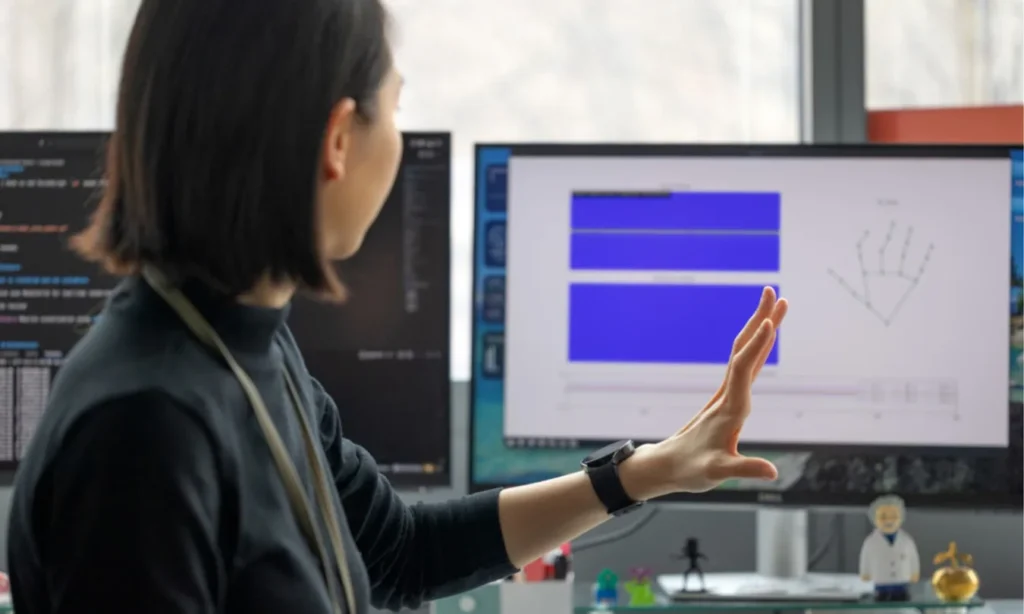
WatchHand: How to Turn Your Watch Into a 3D Sensor for Free?
What if your smartwatch could already track your fingers without any extra cameras or sensors? This is exactly the promise of WatchHand, a research project from Cornell and KAIST that repurposes the speaker and microphone of a standard smartwatch to map the hand in 3D in real-time.
A Simple Yet Ingenious Idea
WatchHand relies on a principle that is almost elegantly simple: the watch emits inaudible sound waves, which bounce off the hand and return to the built-in microphone.
A deep learning model then analyzes this “echo” to estimate the 3D pose of the hand and 20 finger joints directly on the watch. The researchers present WatchHand as the first continuous 3D hand-tracking system on a consumer smartwatch without additional hardware.
This is where the project becomes particularly interesting: it is not an exotic prototype with a special band or external module, but an approach designed for existing hardware. Cornell explains that the technology works with retail watches equipped with a simple speaker and microphone, potentially paving the way for software deployment on millions of devices.
A Smartwatch That Begins to Understand Your Gestures
Imagine practical applications such as gesture control for everyday computing, like moving a cursor, interacting with an interface without touching a trackpad, or using your hand as an input device. Researchers also mention applications in augmented and virtual reality, as well as assistive technologies for individuals with limited mobility or speech.
The paper goes even further: the team believes this foundation could eventually track typing, enrich wearable interfaces, or enable always-available interactions without relying on an external camera.
In essence, the watch could become more than just a secondary display on your wrist; it could serve as a full-fledged behavioral sensor.
Solid Results with Real Limitations
WatchHand has been evaluated on 40 participants across four studies totaling around 36 hours of gesture data. The tests covered various watch models, different hand orientations, numerous body postures, and noisy environments. In its inter-session testing with repositioning of the watch, the system achieves an average error of 7.87 mm per joint.

However, not everything is solved yet. The project currently works with Android smartwatches, but not with the Apple Watch, and performance can degrade in some cases, especially for users or gestures not seen during training. Cornell also notes the system struggles when the user is walking.
Researchers emphasize that slight fine-tuning can improve adaptation to new situations.
Why This Project Matters
The most exciting aspect of WatchHand is not just the demonstration itself, but the philosophy driving the project. In recent years, wearable innovations have often aimed to add more hardware—more sensors, cameras, and parts. Here, the team takes the opposite approach: they reinterpret what the watch already possesses.
This strategy is significant. If it proves robust in real-world usage, it could transform the smartwatch into a discreet, local gesture interface that respects privacy, as the pose data is processed on the device itself without mandatory cloud transmission. While it’s not yet a consumer-ready product, it’s exactly the kind of research that illustrates how wearables could become much more ambitious than previously thought.



