

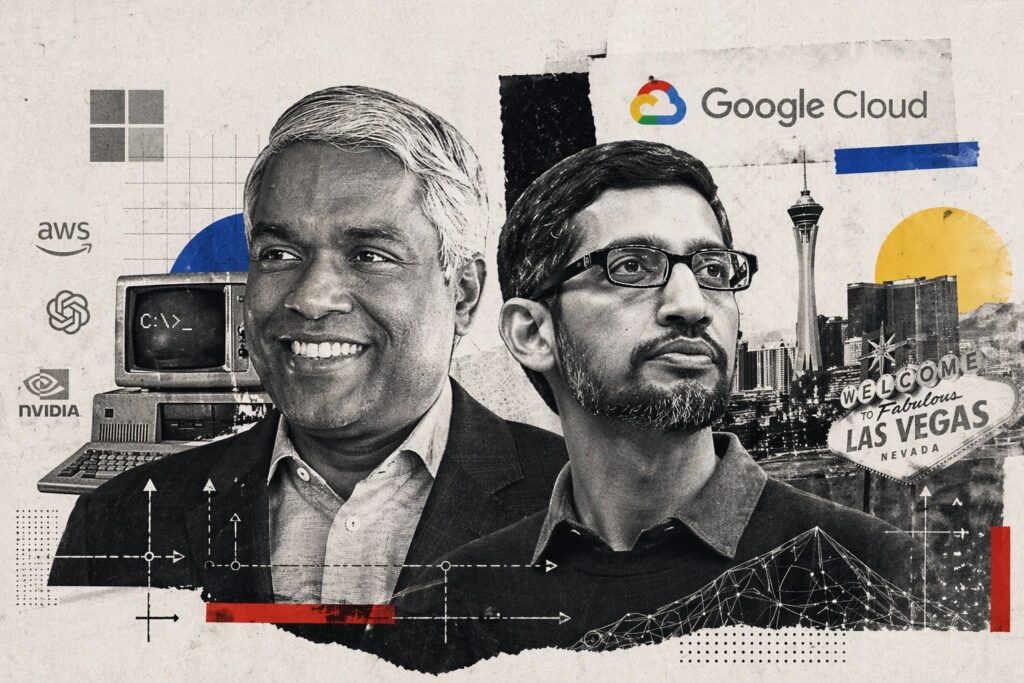
A Transformative Moment in Tech: Google Cloud Charts the Future of AI at Next’26
Forty years ago, a seemingly technical battle reshaped the computer capitalism landscape for two decades. As we approach 2026, the focus has shifted to the orchestration of AI agents—specifically, determining which models applications can access, the data agents can leverage, and the business processes they can execute. Against this backdrop, Sundar Pichai and Thomas Kurian took the stage at Google Cloud Next’26, addressing thousands of IT leaders to share their vision for the market.
In the early 1980s, an epic showdown shook the nascent PC operating system market, primarily revolving around DOS (Disk Operating System). The battle was for control over the system layer that booted computers and determined which programs could run on which hardware architecture. Three major players were vying for dominance: Microsoft’s MS-DOS, IBM’s PC-DOS, and the independent competitor DR-DOS.
Microsoft emerged victorious not because its OS was superior, but because it persuaded PC manufacturers to pre-install MS-DOS on their machines before users powered them on. IBM mistakenly believed it controlled the standard; in reality, it only owned the name. Whoever maintained control over the boot layer controlled the market.
As we look ahead to Spring 2026, we find echoes of that pivotal moment, though the disputed layer has evolved. Today, it pertains to the orchestration of AI agents—dictating which models applications can call, what data agents can use, and which business processes they can execute. Microsoft has embedded Copilot in every office, AWS has industrialized Bedrock, and OpenAI is advancing through ChatGPT. Unlike the past, there’s no IBM to impose a standard. Instead, innovations like the MCP protocol, A2A standards, and open-source frameworks such as LangChain are emerging as alternatives championed by developers, resisting vendor lock-in.
Fast forward forty years, and the cycle appears to be repeating. Kurian opened his keynote with a clear observation, stating, “When we gathered at Next last year, we discussed how generative AI was transforming organizations worldwide. Today, that future is in production. The agentic enterprise is real, deployed at a scale never seen before.” Google Cloud’s metrics support this claim—its models are now processing 16 billion tokens per minute via direct API, up from 10 billion the previous quarter. No fewer than 330 clients have each surpassed a trillion tokens in the last twelve months. The active paying users of Gemini Enterprise have surged by 40% quarter-over-quarter in Q1 2026. These metrics reflect production loads that are billed and integrated into the business processes of global organizations.
From Building Agents to Managing Thousands
This observation leads Kurian to pose a central question to his audience: “The conversation has shifted from ‘Can we build an agent?’ to ‘How do we manage thousands of them?’” He framed this ambition by defining Gemini Enterprise as “the end-to-end system for the agentic era—the connective tissue between your data, your people, and all your applications and agents, transforming all your processes into a single, intelligent flow.” Regarding the agentic platform, he added, “It provides the secure, full-stack connective tissue needed to build, deploy, govern, and optimize your agents with confidence. It’s a control room for the agentic enterprise.”
Hours later, Sundar Pichai took the stage, adopting a more personal and bold stance. Instead of relying on client references, he cited Google itself: “We are moving to truly agentic workflows. Our engineers are orchestrating fully autonomous digital task forces, deploying agents and achieving remarkable outcomes.” With this, Pichai positioned Google not merely as a vendor, but as a witness to its capabilities.
Google as the “Zero Customer” of Its Own Tools
Pichai’s core argument revolves around the concept of “zero customer.” “To be the best partner, we always want to be the ‘zero customer’ of our own technologies. This helps us envision, test, build, and deploy the best Google technologies for our cloud clients—today and tomorrow,” he explained. This industry norm gains particular significance when internal numbers become explicit selling points. Currently, 75% of new code produced at Google is AI-generated and validated by engineers, up from 50% in the fall of 2025. “A particularly complex code migration led by agents and engineers working together was completed six times faster than a comparable operation a year ago, done by engineers alone,” Pichai noted. Internally, the Antigravity agent development platform exemplifies this logic.
“For our recent Gemini app launch on macOS, the team built the initial version with Antigravity, transitioning from an idea to a native Swift prototype in just a few days,” Pichai added. In terms of security, the results are even more striking. “Our security operations center agents automatically process tens of thousands of unstructured threat reports each month, reducing remediation time by over 90%,” he asserted. The CodeMender agent autonomously identifies and fixes critical software vulnerabilities. These deployments are not mere laboratory demonstrations; they address the common concern among CIOs: can critical processes be entrusted to autonomous agents? Pichai’s empirical answer makes it difficult to dispute.
This “zero customer” positioning serves another, less obvious but strategically important function. The engineers developing the Gemini Enterprise Agent Platform are also its daily users. The friction they encounter, the gaps they identify, and the optimizations they discover directly inform product development cycles. In marketing, Pichai cited another example: “For the Gemini launch in Chrome, our marketing teams used our models to rapidly generate thousands of creative content variations, which historically would have taken weeks. Leveraging AI cut our turnaround time by 70% and boosted conversions by 20%.” While Microsoft can secure partnerships with OpenAI and AWS can assemble Bedrock services, Google asserts: we live with our platform on a scale no one else achieves, and we learn from it before you do.
An Integrated Stack: Maximum Consistency, But Dependency
Beyond the discourse of adoption, Pichai revealed a figure that should grab the attention of IT strategists. By 2026, more than half of Google’s total investment in machine learning computing will be directed toward the Cloud. This shift in capital allocation suggests that the capabilities Google is developing for its Gemini models and internal agents are now co-developed alongside the needs of its cloud clients. Components such as TPU 8t, TPU 8i, the Virgo Network, and Managed Lustre are being designed simultaneously for Google’s internal workloads and those of enterprise customers. For CIOs planning a three-to-five-year AI roadmap, this financial commitment sends a strong signal about the depth and durability of Google Cloud’s infrastructure investments moving forward.
Kurian succinctly enumerated the three reasons organizations choose Google Cloud: “A vertically integrated AI stack. A security-first foundation designed for the enterprise. And Gemini Enterprise, the gateway to AI for every employee and customer.” He emphasized this first point—vertical consistency—as Google Cloud’s differentiator. While Google touts a co-developed end-to-end stack, from TPU chips to agents deployed in Gemini Enterprise, other market players rely on service assemblies or external partnerships for their agentic offerings. This perspective, championed by Kurian, should be viewed for what it is: a marketing argument, not a neutral market assessment.
This positioning does carry a downside that CIOs must evaluate carefully. A vertically integrated stack maximizes consistency and performance when components are used together, but it also creates operational dependence, with exit costs increasing as integration deepens. The announced multi-model openness at Next’26, with the integration of Anthropic’s Claude Opus 4.7 alongside Gemini models, partially mitigates this risk at the model layer. However, the data, security, and orchestration infrastructure remains fully within the Google ecosystem. For European organizations, this dependence further exposes them to the U.S. Cloud Act, a consideration that should be integrated into today’s data governance decisions, well before transaction volumes hit critical levels.
Rhetoric of Urgency, Familiar in Tech Cycles
The proclamations of the end of the pilot era made by Pichai and Kurian serve as both a market description and a commercial injunction, urging organizations: if you’re not in production yet, you’re falling behind. This rhetoric of urgency is familiar in technology adoption cycles, capturing a structural truth. Companies that have deployed agents in production for twelve to eighteen months are accumulating refined processes and internal skills that their competitors cannot address with mere investment decisions. Competitive advantage in the agentic era is built over time through iteration.
For CIOs, Pichai and Kurian’s addresses at Next’26 present an operational question beyond mere vision. The Gemini Enterprise Agent Platform, with its agent governance capabilities, cryptographic identity for agents, and real-time observability, meets a genuine need for organizations already running agents and struggling with traceability and control. For those yet to reach that stage, these same governance capabilities provide a framework for responsible deployment. Google Cloud is marketing both a fleet management tool to early adopters and an acceleration ramp for those lagging behind. Both audiences find their solutions within the same platform, representing one of the most compelling business cases Thomas Kurian has presented since the inception of Google Cloud.



