

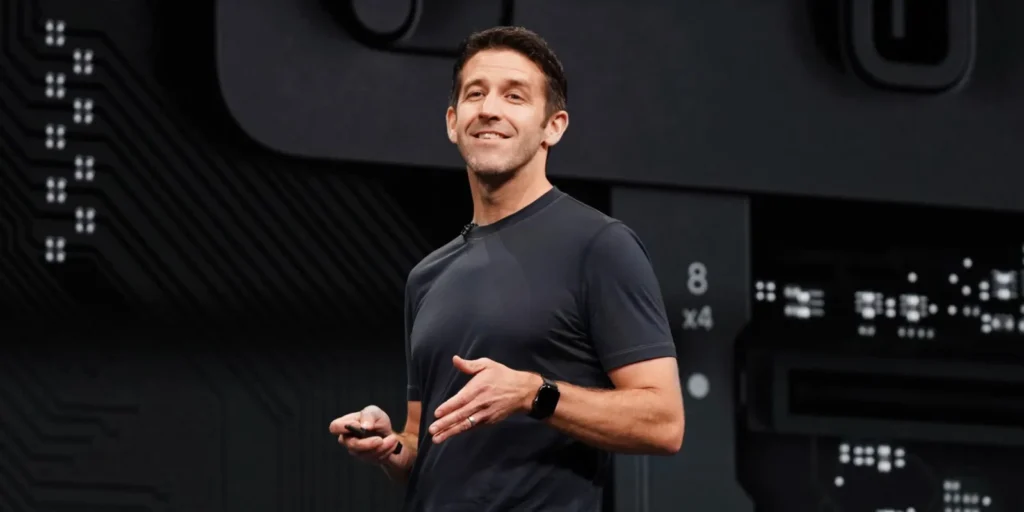
John Ternus Sets the Tone at Apple: More AI, Without Renouncing the Brand’s DNA
Apple is entering a new chapter in its history. Starting from September 1, 2026, John Ternus will officially take the reins of the company, while Tim Cook transitions to executive chairman—a change confirmed by Apple earlier this week.
In the wake of this announcement, the future CEO has already begun to outline his vision: to discuss artificial intelligence with greater ambition, without turning Apple into just another competitor.
John Ternus: A More Assertive Stance on AI
According to Bloomberg, during a general meeting held after the announcement of the succession, John Ternus informed employees that AI will create “almost limitless” potential for Apple and open new possibilities across its products and services. This statement marks a shift towards a significantly more aggressive approach than Apple’s traditionally cautious stance on the topic.
The signal is crucial. For several quarters, Apple has faced criticism for its perceived lag in AI compared to competitors such as Google, Microsoft, and OpenAI. By adopting a more enthusiastic tone from the outset, Ternus conveys a simple message: under his leadership, Apple will no longer keep AI in the periphery of its strategic communications.
No “AI-First” Shift Like Competitors
However, the future head of Apple does not appear to aim for a hollow “AI-first” slogan. According to Bloomberg, he also emphasized that design will remain central to the company’s approach, and that certain fundamentals “cannot and will not change,” particularly privacy, security, and environmental commitments.
This is perhaps the most revealing aspect of his stance. Ternus is not promising a drastic transformation of Apple into an “AI-first” company. Instead, he seems to advocate for a distinctly Apple interpretation of artificial intelligence: AI as an enhancement layer to user experience, not as a replacement identity.
In other words, the company aims to innovate while still retaining the elements that have defined its success for years: the integration of hardware, software, industrial design, and data protection.
A Logical Successor, But Under Scrutiny
The choice of John Ternus is hardly unexpected. Apple presents it as the result of a long-term succession process validated by the board of directors. As the senior vice president of Hardware Engineering, he embodies a product-focused profile, contrasting with Tim Cook’s emphasis on execution, operations, and industrial diplomacy.
This appointment also reflects Apple’s current priorities. As Bloomberg summarizes, the board sends a clear message: Apple remains, first and foremost, a product company. In a time when Silicon Valley is reorganizing around AI models, agents, and platforms, this choice can be seen as an attempt to reaffirm a more distinctive trajectory.
Apple Seeks Balance, Not Imitation
The real question is not whether John Ternus will talk more about AI than Tim Cook; that’s already the case. The question is how Apple intends to weave AI into its narrative without diluting its brand identity.
And this is precisely where his initial statements are significant. By promising immense potential while reiterating Apple’s historical pillars, Ternus aims to navigate a central tension for the company: convincing stakeholders that Apple can be ambitious about AI without appearing to chase after Google or OpenAI.
For both investors and users, the message is twofold. Yes, Apple wants to accelerate. But no, it does not want to become a copy of its competitors. In a sector where many players seem to be speaking the same language, this nuance could become one of the most strategic markers of the Ternus era.



