

WhatsApp Calls: The Secret of the New Noise Cancellation Feature
It’s not a visual revolution, but rather an enhancement that directly impacts daily usage. With its latest Android beta, WhatsApp is testing an integrated noise cancellation feature for voice and video calls.
A subtle evolution, but potentially essential as messaging becomes an indispensable real-time communication tool.
WhatsApp: An Improvement Made for Real Life
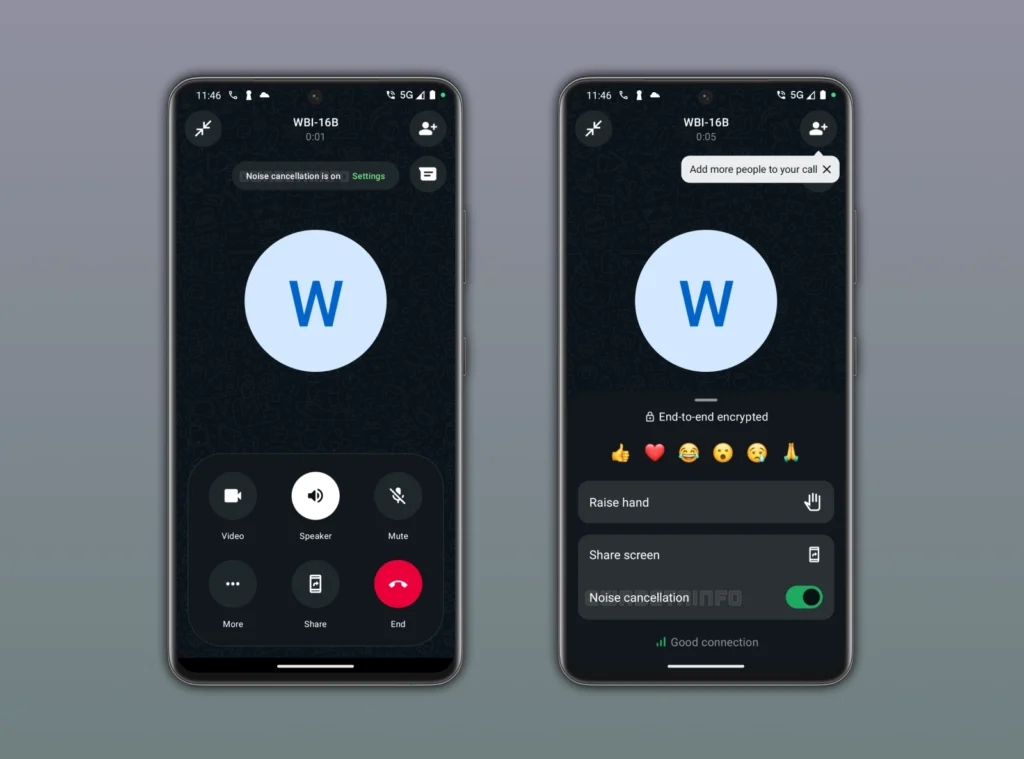
Spotted in Android beta version 2.26.14.1, this feature aims for a simple objective: to make your voice clearer, even in noisy environments.
In practice, the system filters ambient noises (traffic, crowds, wind), isolates the user’s voice, and enhances the perceived quality for the other party. This type of improvement may be invisible on paper but is immediately noticeable in use.
According to information shared by WABetaInfo, the noise cancellation is enabled by default and can be turned off at any time through the call settings.
This is an important choice. While the audio processing enhances clarity, it may slightly alter the natural sound of the voice. Allowing user control prevents an experience that feels overly “filtered.”
A Significant Limitation to Understand
The functionality remains unidirectional. If you activate noise cancellation, your voice is cleaned up for the other person, but you won’t hear your interlocutor any better. In other words, each user must enable the function on their side to benefit from a complete improvement.
This new feature fits into a broader trend. Communication apps—from Zoom to Google Meet—already incorporate advanced noise suppression systems.
With this update, Meta strengthens WhatsApp in a key area: call quality, which is often underestimated compared to visual or social innovations.
The Battle Now Lies in Experience, Not Features
WhatsApp no longer needs to focus on multiplying spectacular features. The app is already installed on billions of devices. The priority has shifted to reliability, audio/video quality, and user comfort. This noise cancellation illustrates this evolution perfectly. It may not be a “visible” innovation, but a background optimization that brings WhatsApp closer to professional standards.
And importantly, it addresses a real-world use case: calls from the street, in transit, at cafés, or in open spaces—contexts where audio clarity makes all the difference.
For now, the feature is limited to certain users in the Android beta program. No specific timeline has been confirmed for a global rollout. But as is often the case with WhatsApp, useful features tend to arrive swiftly in stable versions once tests are validated. In summary, WhatsApp is not changing its interface… but improving what truly matters: being heard clearly, everywhere, all the time.



