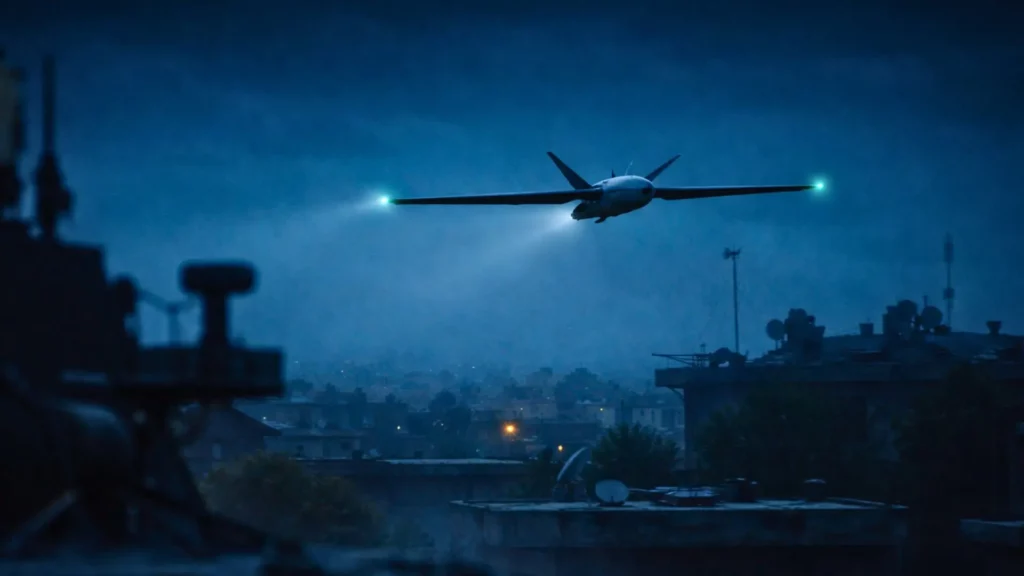
The Shahed-101, equipped with an electric motor, is making its mark in various war zones. More discreet on approach, it becomes significantly harder to hear, especially at night. This Iranian drone is already prompting militaries to reconsider their detection methods.
Why The Shahed-101 Electric Is Already Raising Concerns On The Ground With An Almost Silent Approach At Night
The key change lies in its propulsion. Earlier versions announced their presence with a scooter-like noise, but this time, the electric motor significantly reduces sound signature. This detail becomes crucial in the field, particularly during nighttime or low-altitude attacks.
Analysts have reported sightings of such devices in various conflicts, notably in the Middle East. Hezbollah has already been linked to electric-powered Shahed-101 drones. Consequently, the acoustic alert becomes less effective when the drone emits only a faint hum.
How This Simple And Mobile Drone Presents A Concrete Threat With Silent Strikes From Small Ramps
The Shahed-101 does not rely on extreme sophistication. It maintains a lightweight design, featuring fixed wings and a V-tail. Most importantly, it can launch from a mobile ramp. This flexibility allows for rapid deployment and complicates the localization of launch teams.
Available estimates describe a compact drone designed for striking fixed targets. Its payload is around eight kilos, and its speed remains moderate. However, the low cost and simple preparation give it a formidable advantage in protracted conflicts.
Another critical point is that several studies highlight the use of components readily available on the civilian market. This industrial approach reduces costs and speeds up assembly. For targeted forces, the low-cost mass becomes as dangerous as a more sophisticated system.
Why Sound Sensors Are Losing A Key Advantage As Radars And Cameras Must Now Take Over
For years, many local defenses relied on the noise of drones to gain a few minutes of warning. With a discreet propulsion system, this instinct has become less reliable. Now, acoustic networks risk detecting threats too late, especially in already saturated areas.
As a result, armies must enhance other detection tools. Radar remains central, but small drones often pose a challenge at low altitudes. Thermal cameras are also helpful. However, multi-sensor detection is more expensive and requires a denser network.
What The Rise Of The Shahed-101 Reveals About Modern Warfare In Terms Of Saturation, Surprise, And Forced Adaptation
The real signal goes beyond a single model. This Shahed illustrates the rise of low-cost weapons that are easy to deploy and sufficiently precise to impact the front lines. In simple terms, tactical surprise no longer relies solely on sophisticated aircraft or expensive missiles.
Furthermore, this evolution forces military organizations to reassess their priorities. There is a need to improve detection, tracking, and sometimes interception at a very low cost. Otherwise, traditional defenses risk being overwhelmed by repeated, dispersed, and hard-to-predict attacks.
Finally, the introduction of this electric version highlights a clear trend. Attack drones are becoming more discreet, more adaptable, and still relatively affordable. For you, this changes the understanding of conflict: visible innovation no longer makes the loudest noise.