


Chrome on Android faster than Safari? Google’s bold new bet
Google recently showcased a bold claim: according to the company, Chrome on the latest Android smartphones now offers the fastest mobile browsing experience, surpassing Safari on iOS.
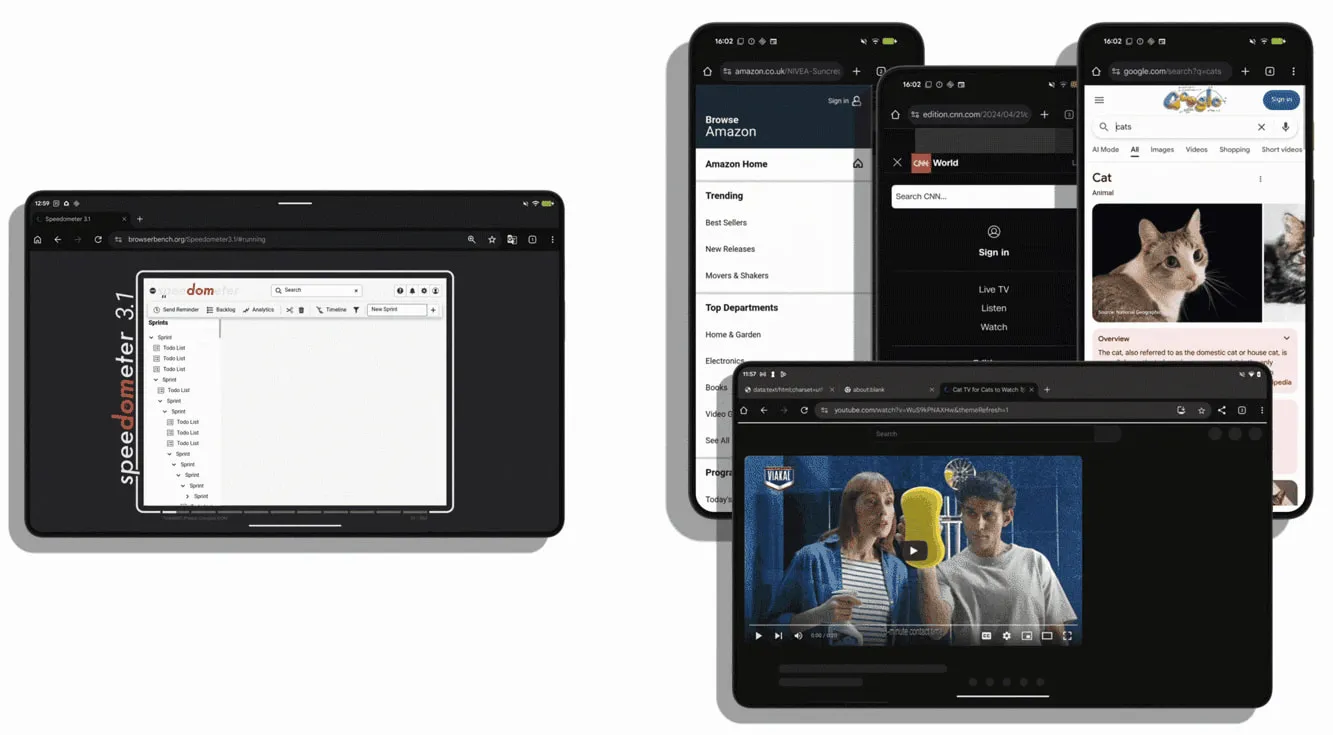
To support this assertion, Google references two distinct benchmarks: Speedometer 3.1, a well-known public benchmark in the browser world, and LoadLine, a newer test developed by the Chrome and Android teams in collaboration with hardware partners.
Two benchmarks telling the same story
The first, Speedometer 3.1, measures the responsiveness of web applications by simulating realistic interactions, such as clicking, scrolling, typing, or manipulating lists. This open-source test is developed collaboratively among major browser engines, lending it methodological credibility. The higher the score, the more fluid a complex site is expected to feel.
The second, LoadLine, is more directly focused on the perceived loading time of a page after a click. Google describes it as a simulation of the complete process of opening a real site, featuring popular destinations such as news, e-commerce, or search.
Unlike Speedometer, LoadLine is a benchmark created by Google and its partners, making it useful for measuring a specific product direction but less neutral in its governance.
The figures presented by Google
In its official announcement, Google claims that recent Android flagships achieve scores 20% to 60% higher over the past year based on the measured scenarios, resulting in pages that load 4% to 6% faster and “high percentile” interactions that are 6% to 9% quicker. In a chart shared by the company, three unnamed recent Android smartphones average 48.2 on Speedometer 3.1, compared to 43.8 for a “competing mobile platform,” clearly alluding to the iPhone. On LoadLine, Google reports figures of 276.3 against 207.4, and mentions up to a 47% advantage over non-Android competitors in certain cases.
Google attributes these gains to deeper vertical integration between hardware, Android, and the Chrome engine. The company also explicitly recommends its Android partners to evaluate and optimize their devices using Speedometer and LoadLine, indicating that these scores are not just observations but targets as well.
What this means, and what it doesn’t fully prove
Fundamentally, the announcement is not absurd. Chrome had already reported significant gains on Speedometer 3.1 in 2025, and the progression of high-end Android SoCs makes it plausible that mobile browsing has improved. However, it’s important to be rigorous: a benchmark never fully encapsulates the actual experience of a browser. It measures performance within a defined framework, not the entire gamut of daily user sensations.
This is particularly true here as Google does not officially name the three tested Android devices in its public post, and LoadLine is not an independent benchmark governed by multiple parties, as Speedometer is. In clear terms, while Google’s argument is valid, it is also a demonstration crafted according to its own criteria.
Perhaps the most intriguing aspect is not the Chrome versus Safari rivalry, but how Google is transforming web speed into a platform advantage. By asking its partners to optimize devices for these tests, the company is indicating that browser performance has become a topic encompassing the entire ecosystem, including chipsets, OS, rendering engines, and OEM settings. The mobile browsing experience is no longer solely the concern of the browser; it now encompasses the entire technical stack.
Google aims to make fast web performance a key selling point for Android
This announcement comes at a time when premium smartphones are increasingly indistinguishable in terms of obvious use cases. In this context, web speed is becoming a strategic area: it’s one of the few domains where all users can immediately feel the difference, without needing expert use cases. Google seems to want to transform a technical improvement into a much broader message: Android is not only flexible and powerful; it is now also becoming the best place to browse the mobile web.
In summary, Google presents a credible but not definitive case. Yes, Chrome on Android appears faster according to the highlighted benchmarks. No, this is not sufficient to close the debate on the actual experience compared to Safari. However, one thing is certain: the mobile browser war is now fought as much in silicon as in the interface.



