

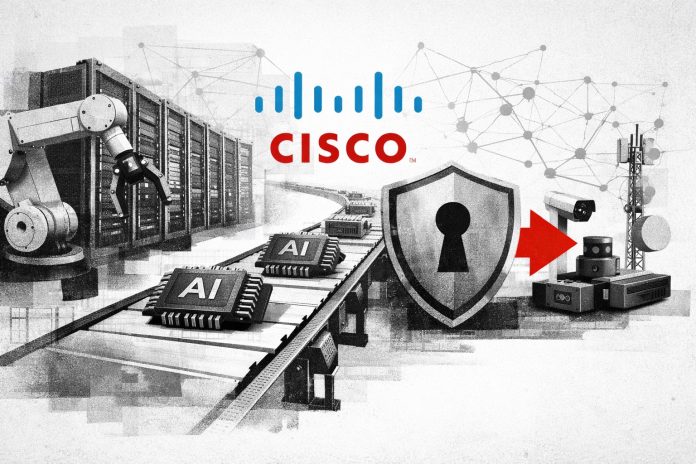
Cisco Expands Its Secure AI Factory Partnership with Nvidia, Bringing AI Inference to the Industrial Field and Operator Networks. Announced during the Nvidia GTC event, this new architecture aims to cover the entire processing chain from hyperscale AI factories to critical edge sites. Central to this initiative is security, integrated at every layer, from silicon to autonomous agents.
<p>For several years, AI inference has been portrayed as a centralized workload, primarily hosted in vast data centers equipped with GPU clusters. However, this model is becoming increasingly inadequate. Use cases such as production line quality control, real-time analysis of medical imagery during surgeries, and surveillance of moving vehicles demand real-time decision-making at the point of data generation, devoid of latency from traveling to a distant data center. This observation is the driving force behind Cisco's expansion of its Secure AI Factory in collaboration with Nvidia.</p>

<p>The architecture now extends from data centers to distributed edge sites. Two primary vectors characterize this extension: enterprise edge, which includes support for Nvidia GPUs on Cisco's UCS and Cisco Unified Edge platforms; and operator edge, facilitated through the Cisco AI Grid with Nvidia— a reference architecture combining Cisco's Mobility Services Platform with Nvidia's RTX PRO Blackwell series GPUs, aimed at telecom operators looking to deliver managed AI services at the edge.</p>

<h4><strong>Two Validated Switching Architectures for AI Factories</strong></h4>

<p>At the level of large-scale AI factories, Cisco has organized its offerings around two distinct switching architectures, both now validated for large-scale AI deployments. The first complies with the Nvidia Cloud Partner (NCP) program, relying on Nvidia Spectrum-X switching silicon paired with a Cisco operating system. The second is based on Cisco Silicon One, with new generations—G300 for scale-out architectures and P200 for scale-across architectures—targeting the most demanding workloads.</p>

<p>The latest Cisco N9100 switch, boasting 102.4 Tbit/s and based on Nvidia Spectrum-6 Ethernet silicon, rounds out the product lineup. The integration of Cisco Nexus Hyperfabric with Cisco Nexus One enhances automated management for these switches, promising to streamline complex multi-vendor integration into a simplified full-stack solution and reducing deployment times from several months to just a few weeks. Chuck Robbins, Cisco's Chairman and CEO, highlights the problem this architecture addresses: "Most organizations understand AI's transformative potential for their operations, but they are still searching for ways to deploy this technology safely and at scale."</p>

<h4><strong>Hybrid Mesh Firewall Integrated with BlueField DPUs</strong></h4>

<p>Among the most significant technical advancements in this announcement is the enhancement of physical infrastructure security, extending to the silicon level. Cisco is expanding its Hybrid Mesh Firewall to include Nvidia BlueField DPUs integrated within GPU servers connected to Cisco Nexus One factories. Security policies are applied at the server level before data flows reach the organization’s databases, aiming to block threats as close to the execution surface as possible without compromising performance on AI workloads.</p>

<p>According to Jensen Huang, founder and CEO of Nvidia, this is as much an architectural as it is a commercial consideration: "AI factories are transforming every sector, and security must be integrated at every layer—from silicon to software—to protect data, applications, and infrastructure." Cisco's AI Defense integration with Nvidia NeMo Guardrails—a component of the Nvidia AI Enterprise suite—extends this protection to models deployed at the edge, incorporating automated vulnerability testing mechanisms and specific safeguards for distributed environments.</p>

<h4><strong>OpenShell and Securing Autonomous Agents</strong></h4>

<p>This announcement also introduces aspects particularly relevant to Chief Information Security Officers (CISOs) dealing with the deployment of AI agents in production settings. Cisco AI Defense will support Nvidia’s OpenShell runtimes, which are part of the Nvidia Agent Toolkit. This integration adds controls and safeguards to monitor the actions of agents and the tools they invoke, ensuring continuous oversight and validation of every tool and action executed by an agent.</p>

<p>This capability addresses a challenge identified by security teams: in multi-agent architectures, interactions between edge-operating agents and those within the core infrastructure create new attack surfaces that are difficult to protect with traditional security tools. Cisco positions AI Defense as the governance mechanism for these interactions, ensuring reliable operation of autonomous systems without stifling their operational capability.</p>

<p>The Cisco-Nvidia architecture demonstrates notable stack coherence, from the network switch to the DPU, from the firewall to the safeguards of the agents. However, it remains partially aspirational, as the announcement explicitly states that many features described are still under development and will be made available at Cisco's discretion based on availability timelines.</p>


