

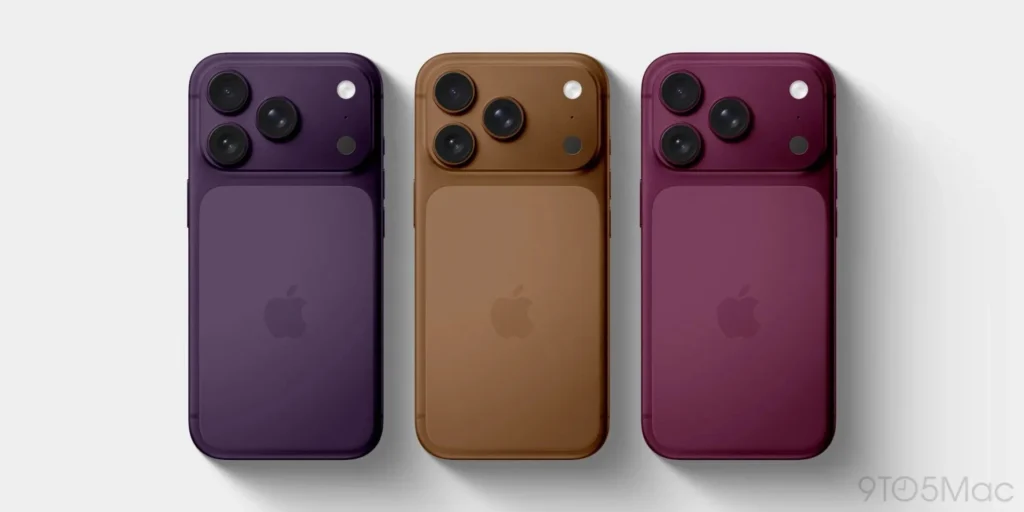
iPhone 18 Pro: Apple May Keep Prices Stable Despite Rising Component Costs
Just as the iPhone 17 is launched, observers are already shifting their focus to Apple’s next premium offerings. Early rumors surrounding the iPhone 18 Pro and iPhone 18 Pro Max suggest a reassuring scenario: despite rising component costs, Apple may avoid increasing prices for its upcoming high-end models.
If confirmed, this perspective would further highlight the company’s ability to absorb industrial pressure without weakening its commercial position.
iPhone 18 Pro: Prices Expected to Remain Stable in the Pro Lineup
According to several analysts, Apple is considering keeping prices similar to the current generation. Ming-Chi Kuo predicts that the iPhone 18 Pro might debut at around $1,099, while the iPhone 18 Pro Max remains at $1,199, aligning closely with the pricing of the previous series.
This hypothesis is surprising in context, as costs related to memory, chips, and certain key components continue to rise. However, it fits Apple’s well-known strategy: securing its supply chain early to negotiate better terms and absorbing some of the added costs instead of immediately passing them onto consumers.
Jeff Pu supports this view, mentioning the agreements with Samsung and SK Hynix regarding memory chips, as well as Apple’s efforts to lower expenses in other critical areas, including camera modules and displays.
An Industrial Strategy That Protects Margins Without Hurting Demand
This price maintenance would not merely be a commercial gesture; it would also reflect a highly calculated approach. Apple recognizes that the premium segment remains profitable but becomes increasingly sensitive to consumer price thresholds.
By keeping prices stable for its Pro models, the brand could maintain the attractiveness of its flagship lineup while continuing to protect its margins through more precise management of its purchases and volumes.
This strategy also enhances clarity. In a market where price increases have become common, price stability can itself become a strategic asset, almost a form of rational luxury.
A Potentially Fragmented Launch Timeline
Another change highlighted by analysts is that Apple may revise the launch cadence for its future iPhones. The iPhone 18 Pro and Pro Max might arrive in the second half of 2026, while standard models like the iPhone 18 and a potential iPhone 18e could be pushed to 2027.
This separation would allow Apple to give more media and commercial space to its most profitable models. It is also a way to clarify its premium strategy as features related to artificial intelligence are expected to play an increasingly prominent role in product discussions.
In other words, Apple wouldn’t just be launching a new generation of iPhones on a fixed date but rather a lineup segmented by the strategic value of each model.
The Foldable as the New Pinnacle of the Lineup?
Simultaneously, rumors surrounding a potential first foldable iPhone are intensifying. Apple is reportedly preparing a model priced starting around $2,000 for the 256 GB version, with higher models at $2,199 for 512 GB and $2,399 for 1 TB.
These high figures, while significant, align with the brand’s historical logic. When Apple introduces a new category, it rarely does so through the mid-range. Therefore, the foldable would be regarded more as a flagship showcase rather than an alternative iPhone, aimed at establishing a technological and price pinnacle above the Pro lineup.
If this positioning holds true, it could also assist Apple in maintaining more stable prices for the iPhone 18 Pro. Essentially, the foldable would take on the ultra-premium aspect, leaving the Pro models as a more “accessible” high-end reference.
A Generation Potentially More Reassuring Than It Appears
At this stage, all of this remains in the realm of early leaks and analyst projections. However, the general direction seems coherent. Apple aims to enrich its premium offerings, more finely segment its timeline, and maintain the price equilibrium of its most important models.
For consumers, the signal is quite positive. In an industry where prices regularly increase, seeing Apple keep prices for the iPhone 18 Pro would send a strong message. It would also indicate that at Apple, innovation is not solely about visible features but also about managing costs without compromising perceived value.
Ultimately, the real novelty of this upcoming generation might not only lie in the technical specifications but also in how Apple subtly reshapes its product hierarchy among standard models, Pro versions, and the future foldable iPhone.



