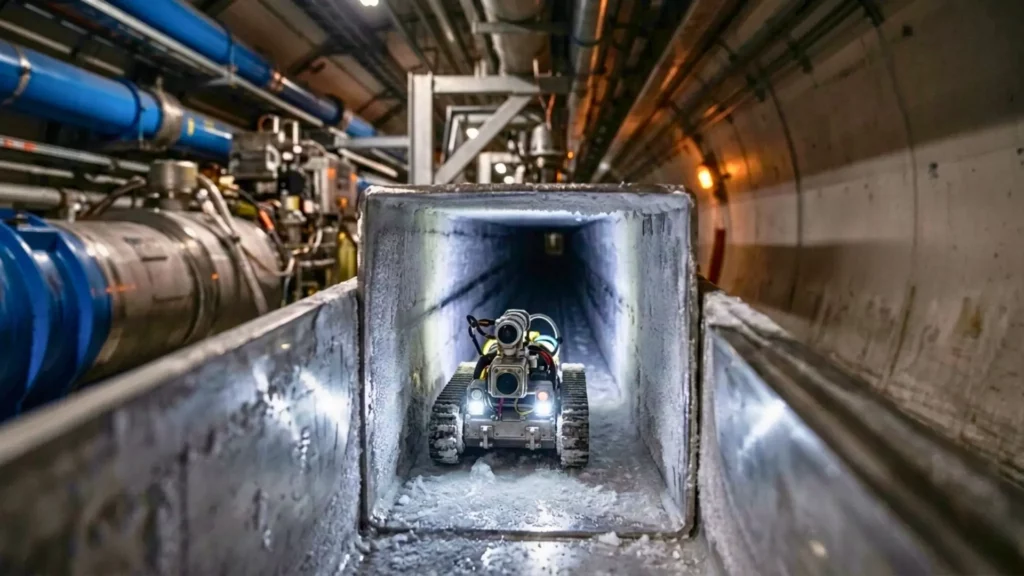
At CERN, the PipeINEER robot is entering a decisive phase. Designed in collaboration with UKAEA, it is set to autonomously inspect the LHC’s pipes at -271.3 °C. Its clear objective is to quickly identify invisible defects and prevent lengthy, costly, and risky downtime.
Why a tiny defect in the LHC can cause everything to shut down despite the machine operating in extreme cold
Under the Franco-Swiss border, the Large Hadron Collider stretches over 27 kilometers. This machine accelerates particles to very high energies. However, its weak points are minuscule. In its beam lines, a slight deformation can sometimes disrupt complex and costly experiments.
The issue primarily arises from the about 2,000 PIM modules installed in the beam. These components absorb the effects of thermal expansion. However, at 1.9 kelvin, or -271.3 °C, some internal contacts can occasionally twist, creating invisible obstacles.
PipeINEER advances where humans previously struggled, and its 6 kilometers of autonomy changes the scale
To inspect these areas, teams previously had to disassemble entire sections and use a manual endoscope. This method was time-consuming, resource-intensive, and required extreme precision. With PipeINEER, CERN now aims to inspect the interior without unnecessarily opening such a sensitive infrastructure.
The robot is only 20 centimeters long and can navigate through a passage of 3.7 centimeters in width. This compact size allows it to access conduits that traditional solutions cannot reach, thereby limiting the risk of obstruction within the system.
Another significant advancement is its battery life, allowing it to operate for up to 6 kilometers on a single charge. In such tight spaces, this range is transformative, enabling coverage of long sections of the LHC during a single mission. This also reduces power consumption and lightens logistical demands.
Embedded intelligence detects anomalies in real-time and returns autonomously if a critical defect is identified
PipeINEER is not just about movement. As it progresses, it captures detailed images of each module. An AI trained on real views of the LHC then compares these observations to known defects. Thus, it can alert operators to a potentially critical millimeter-sized anomaly at an early stage.
This autonomy also enhances safety. If the robot detects a major issue or if its performance declines, it autonomously retraces its path. It then transmits a precise location of the defect, allowing engineers to target the correct area without immobilizing entire sections.
Testing on 60 kilometers in 2026, production at the end of the year, followed by training at CERN in early 2027
The project brings together CERN and the RACE center of UKAEA, a specialist in challenging environments. This collaboration has already been recognized with the Collaborate to Innovate award, demonstrating a concrete transfer of expertise between nuclear fusion and fundamental particle research.
The next step is scheduled for 2026, with teams set to test the robot’s performance over a cumulative 60 kilometers of operation. After that, the final units are expected to be manufactured by the end of the year. This timeline marks the transition from a promising prototype to a credible maintenance tool.
In early 2027, CERN operators will learn how to deploy these robots within the tunnel. The stakes exceed mere inspection; by minimizing disassemblies, costs, and human exposure, this targeted maintenance could prolong the LHC’s operational availability while enhancing safety during interventions.