

Google Finally Updates Its AI Overviews: Links More Visible… Without Real Fixes For Publishers
The AI Overviews have made Google Search faster — but at the cost of breaking an implicit agreement with the web: fewer clicks, less traffic, and consequently, lower revenues for sites whose content is repurposed by AI.
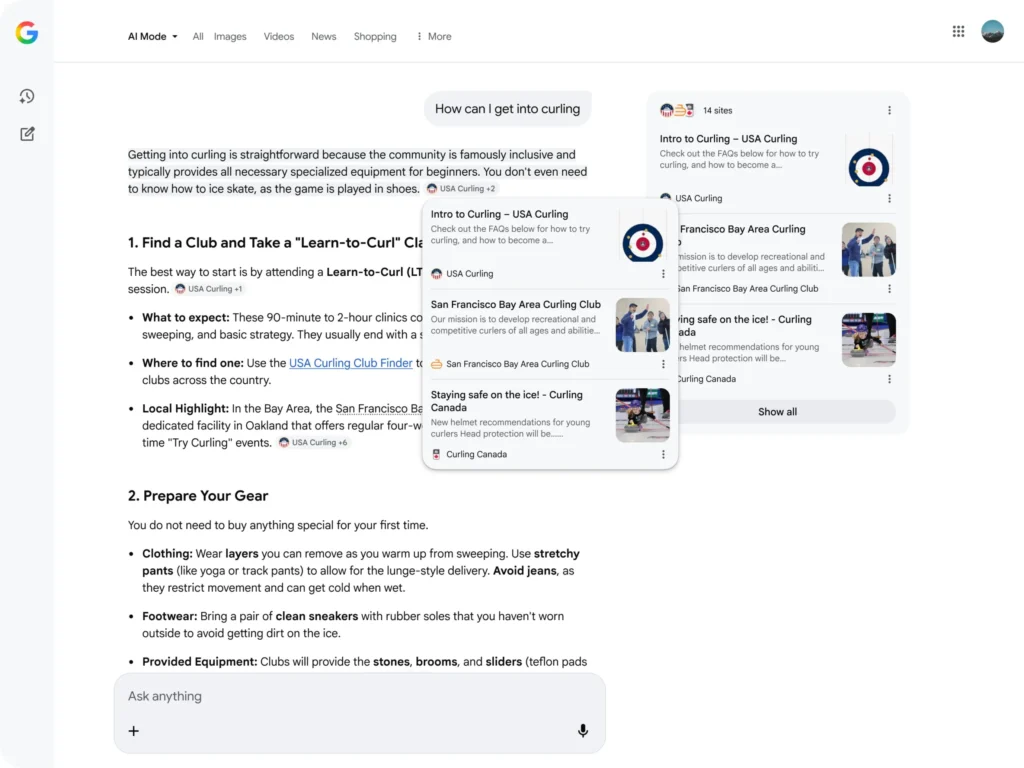
Google has just announced a user interface adjustment aimed at addressing one of the main criticisms: making the sources of AI Overviews more visible and clickable. However, the scope of this correction is, so far, largely cosmetic.
What’s Changing: A Source Pop-Up On Hover
On desktop, Google is now testing an experience where hovering over the citation/source bubble in an AI Overview (and also in AI Mode) triggers a pop-up window that lists links — sometimes with descriptions and images to guide clicks.
On mobile, Google is also making links “more obvious” through more visible icons and anchors.
The official argument, summarized by Robby Stein (VP Product, Google Search), is that this UI will be more engaging and will help more users access the “right content on the web.”
New on Search: In AI Overviews and AI Mode, groups of links will automatically appear in a pop-up as you hover over them on desktop, so you can jump right into a website to learn more. And we’ll show more descriptive and prominent link icons within the response across both… pic.twitter.com/VUTtHUCwgG
— Robby Stein (@rmstein) February 17, 2026
What Doesn’t Change (Yet): The Zero-Click Economy Remains Intact
Even with a better-presented pop-up, the structure remains the same:
- The answer appears before the user needs to click,
- The links are an addition, not a necessity.
In other words, Google is not restoring a “default” traffic flow to publishers; it is improving the ergonomics of the links, hoping that usage will follow. It’s a step, but not a reversal.
This adjustment comes at a tense time: on one side, publishers and the SEO community are decrying the drop in clicks; on the other side, the Overviews continue to face criticism for inaccuracies — including on sensitive subjects. Therefore, the question of “link” is not just a revenue debate: it is also a matter of responsibility (reading the source, verifying, contextualizing).
An Interface Fix, Not a New Contract With the Web
Yes, a source pop-up is clearer than a discreet micro-carousel. Yes, more “present” links may increase the likelihood of a click — especially on longer responses where the user scrolls and loses sight of the source area.
However, for many sites, the main pain point remains elsewhere: the overview “answers,” thus the incentive to click decreases. For the impact to be truly measurable, either less “conclusive” snippets would be needed (which encourage further exploration), a stronger incentive to consult the source, or new redistribution/partnership mechanisms.
Google claims to have been working since late 2025 to “support the web” through features and partnerships, but this update on links seems more like a UX adjustment than a new economy.



