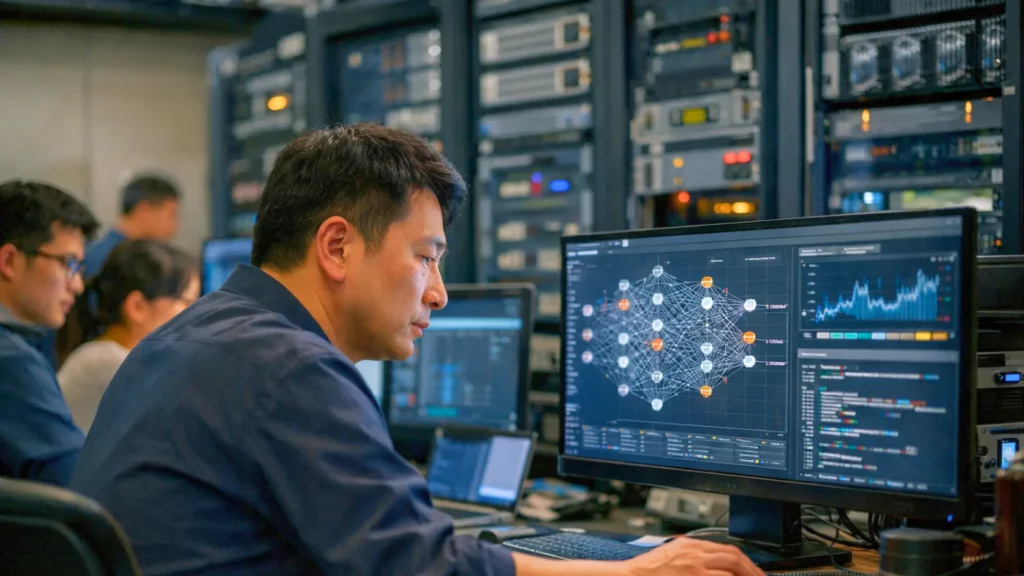
In response to U.S. restrictions on semiconductors, Chinese artificial intelligence companies have accelerated innovation. Through open source, resource optimization, and new multimodal models, China is reshaping the global balance in the AI race.
How U.S. Chip Sanctions Forced China to Completely Rethink Its Artificial Intelligence Development Model
When the United States restricted the export of advanced chips, the objective was clear: to curb China’s rise in artificial intelligence. Yet, deprived of certain strategic components, local companies had to immediately reassess their priorities, redesign their architectures, and, most importantly, optimize every available computational cycle.
As a result, this constraint acted as a catalyst. Instead of multiplying energy-intensive data centers, Chinese players gradually invested in algorithmic efficiency, model compression, and more frugal training techniques. Consequently, they developed high-performing systems capable of competing with American benchmarks, even with limited resources.
The Strategic Bet on Open Source and Open-Weight Models to Accelerate Innovation and Attract International Markets
Furthermore, one of the most notable choices has been the massive adoption of open source and open-weight models. By publishing their weights or code, several Chinese companies not only encourage local experimentation but also allow for customization and enterprise integration without relying on external APIs.
This approach fundamentally alters the economic landscape. Organizations can now deploy their own generative AI solutions in-house, gain control over their sensitive data, and simultaneously reduce operational costs. In a context where digital sovereignty is becoming strategic, this technical freedom is therefore a decisive argument.
A Surge of New Multimodal, Video, and Intelligent Agent Models that Prove Chinese Technological Maturity
Additionally, the new generation of Chinese models extends beyond text. Recent solutions incorporate vision, audio, video, and advanced reasoning into multimodal architectures. These systems can understand images, analyze video sequences, and interact with complex digital interfaces.
Moreover, some models employ techniques such as mixture of experts or sparse attention, activating only the necessary sub-networks for each task. This results in reduced computational power requirements while maintaining a high level of accuracy, illustrating particularly optimized engineering.
Finally, another key element is training on local chips, especially semiconductors developed in China. Consequently, this technological independence enhances the resilience of the ecosystem. It also demonstrates that a constrained environment can ultimately foster alternative solutions capable of supporting a strong national ambition.
Towards a New Global Balance: Why the Gap with American Giants is Narrowing and What It Means for Businesses
Today, international benchmarks indicate a minimal gap between certain Chinese models and American leaders. Particularly in programming, reasoning, and multimodal understanding, performance is closely approaching. Thus, competition is no longer solely about sheer power but about optimization and specialization.
For businesses, however, the ability to run a model locally without extensive data transfer becomes strategic. Indeed, this addresses concerns around confidentiality, regulatory compliance, and budget control. Therefore, the argument is not merely technological; it is also legal and economic.
Ultimately, far from slowing down China’s dynamic, the tech embargo has helped structure a more agile ecosystem. Gradually, political pressure has transformed into a driver of innovation. In the great global AI race, adversity has become an unexpected accelerator.