

German Startup Ubitium Announces Tape-Out of Its First 8nm RISC-V Processor
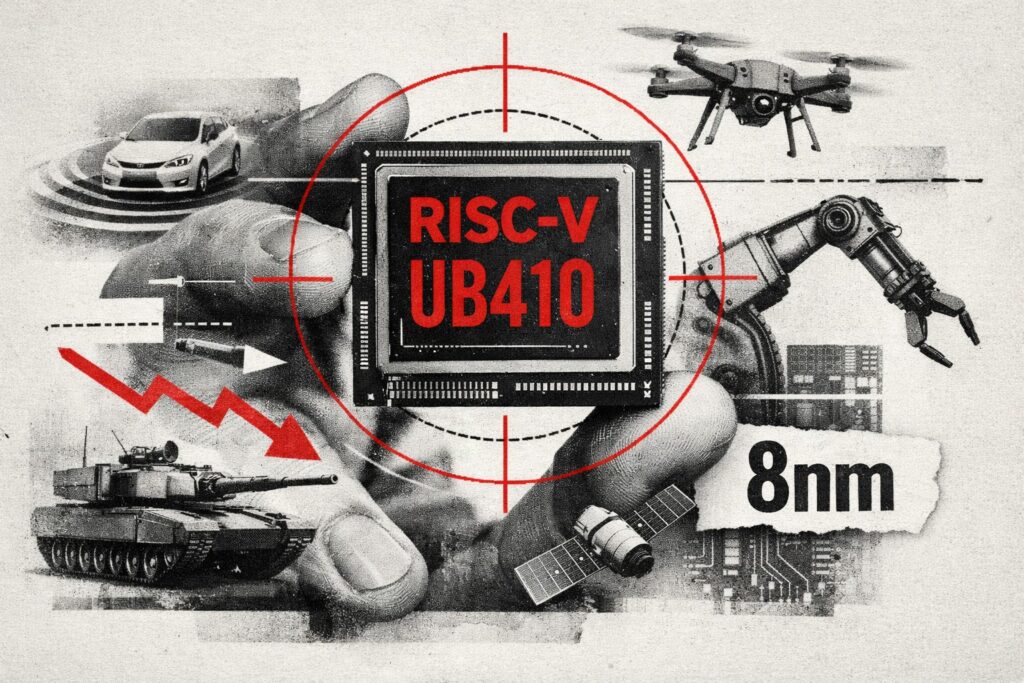
Ubitium, a German startup, has officially completed the tape-out of its inaugural chip— the UB410— based on Samsung Foundry’s 8nm process. Finalized in December 2025, this universal RISC-V processor aims to replace the myriad of specialized processors— including CPUs, DSPs, GPUs, and FPGAs— that currently dominate embedded systems across automotive, robotics, industrial, and defense applications.
Tape-out marks the critical end stage of integrated circuit design, where the design files are submitted to the foundry for the fabrication of the first photomask. This is a pivotal point in the silicon development cycle: once the files are dispatched, no modifications can be made until the initial physical samples are delivered. The UB410 represents the first physical silicon validating Ubitium’s Universal Processing Array architecture, which the company has developed since its inception in July 2024.
The embedded computing market is valued at $115 billion according to Ubitium’s data, and the company describes it as grappling with a “complexity crisis.” A modern vehicle contains over 200 processors, compared to just two in the 1980s, leading to a proliferation of toolchains, proprietary software stacks, and separate qualification cycles. With the rise of physical AI technologies such as robots, drones, and autonomous industrial machines, Ubitium identifies this architectural fragmentation as a more pressing constraint than raw performance itself.
A Reconfigurable Processor Without Co-processors
The UB410 is built on the Universal Processing Array architecture, which enables it to switch seamlessly between three distinct operational modes: an out-of-order sequential mode akin to traditional CPUs, an acceleration mode for signal processing and neural network inference, and a parallel execution mode for irregular algorithms and LLM training. According to the company’s specifications, this mode-switching occurs without context-switching penalties or offloading to external accelerators.
Supporting both Linux and a Real-Time Operating System (RTOS) concurrently, the processor is compatible with standard RISC-V toolchains and LPDDR5 memory interfaces, allowing it to maintain software compatibility with the existing RISC-V ecosystem—currently deployed in billions of chips worldwide. Martin Vorbach, Ubitium’s Chief Technology Officer, commented, “This tape-out transforms a long-term thesis into silicon. Embedded workloads have surpassed the architectures that the industry currently relies on. Consolidation is no longer optional; it is inevitable.” Vorbach previously developed PACT XPP, one of the first commercial reconfigurable processors, and holds over 200 architecture-related patents.
An Industrial Partner Ecosystem for Silicon Advancement
The tape-out was made possible through collaboration with three industrial partners. Samsung Foundry provided the 8nm manufacturing process, while Siemens Digital Industries Software offered hardware-assisted verification tools, including the Veloce CS system, to validate system behavior prior to the first silicon—an approach known in the industry as shift-left verification. ADTechnology managed the backend processing, including timing closure, power management, and signoff on the Samsung process.
Jean-Marie Brunet, Senior Vice President of Hardware-Assisted Verification at Siemens Digital Industries Software, noted that Ubitium’s use of the Veloce CS system demonstrates how early validation can mitigate integration risks and expedite convergence toward the first silicon. Jun-Kyu Park, CEO of ADTechnology, confirmed that his company supported Ubitium throughout the implementation process leading up to the 8nm tape-out. Notably, Ubitium’s timeline is ambitious: founded in July 2024, the company achieved its first tape-out just 17 months later, with a second tape-out already scheduled for 2026 and mass production expected by 2027.
Mitigating Supply Chain Dependencies as a Selling Point
In addition to architectural consolidation, Ubitium promotes its universal processor as a solution to the vulnerabilities in the electronic components supply chain, exposed during crises from 2020 to 2022. An embedded system relying on multiple specialized processors from different suppliers accrues numerous potential points of failure within its supply chain. By consolidating functions into a single chip, Ubitium argues that it can reduce the bill of materials (BOM) costs, simplify PCB designs, and streamline product qualification cycles—especially critical in sectors like automotive, defense, and aerospace.
Ubitium has identified four target market verticals: defense and aerospace (emphasizing adaptability, resilience, and low latency), consumer electronics (focusing on rapid feature deployment and audio-video quality), automotive and industry (aiming for cost advantages and reduced latency), and space (highlighting in-orbit reconfigurability and low power consumption). Current funding partners include Runa Capital, KBC Focus Fund, and Inflection, with a Seed round in progress at the time of the tape-out according to the company’s roadmap.



