

Mitel Expands Communications Portfolio for High-Criticality Environments with AI Integration
Mitel is enhancing its communications offerings for high-criticality environments by incorporating artificial intelligence. The company is zeroing in on sectors where any service disruption is operationally unacceptable—such as healthcare, industry, emergency services, and retail—introducing three key development areas: automated critical alert management, native integration with business workflows, and AI-enhanced mobility for field workers.
In high-criticality settings, general collaboration tools often hit their structural limits. For hospitals, industrial supervision centers, and emergency command posts, any interruption in communication, even momentary, can have dire consequences. This reality underpins Mitel’s announcement on March 4, 2026, to broaden its vertical solutions portfolio. As a global player in enterprise communications with a presence in over 100 countries and 70 million users, Mitel is committed to addressing these critical needs.
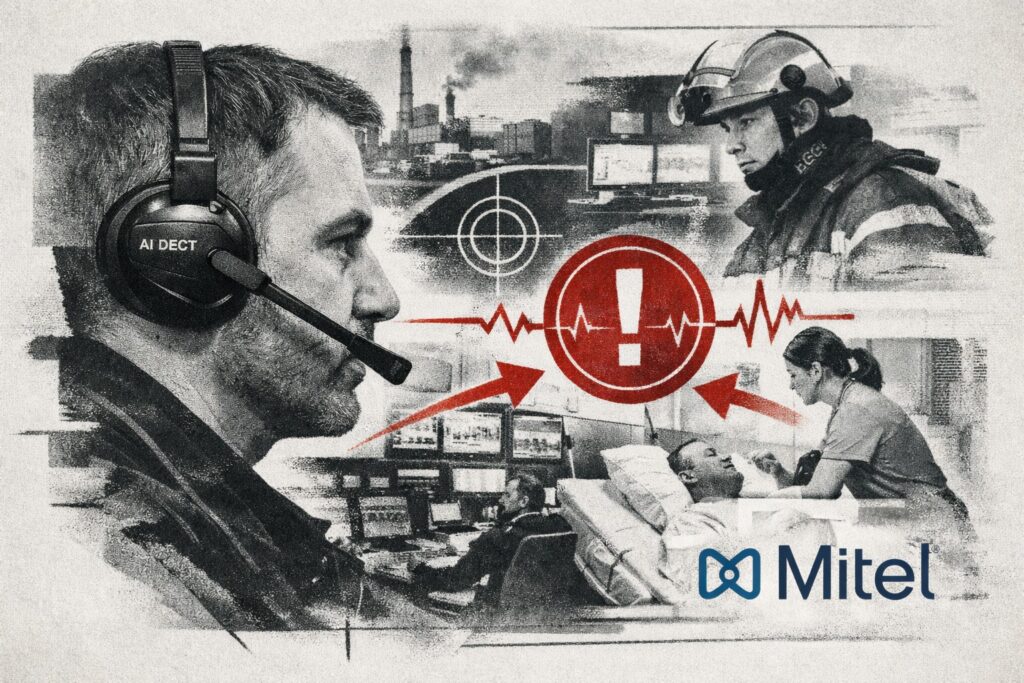
The announcement revolves around a three-layer functional architecture rather than a single product. The solutions included—Mitel Event Manager, Mitel Xpert, Mitel CEM, OpenScape Health Station HiMed, and the H60 AI DECT headset—span a range from real-time incident management to augmented mobility for field agents. The H60 AI DECT, a cornerstone of this offering, is slated for release in the third quarter of 2026.
Streamlining Critical Alerts in Under 60 Seconds
The first pillar of this new offering centers on managing communications in extremely high-criticality environments. Mitel Event Manager automates the routing of alerts from nurse call systems, fire safety systems, and production supervision to mobile teams, ensuring a guaranteed response time of less than 60 seconds. For a CIO at a hospital or an industrial site manager, this metric is crucial; it directly impacts the organization’s ability to meet continuity obligations and comply with regulatory requirements regarding personnel safety.
Complementing this framework is Mitel Xpert, which allows a single operator in trading rooms or command centers to monitor hundreds of communication channels from one terminal. Mitel CEM (Critical Event Management) offers end-to-end management of the incident lifecycle—from early detection to intervention coordination—complete with automated alert mechanisms and continuous traceability. “In sectors where communication is vital and any interruption is unthinkable, organizations require more than just generic collaboration tools,” remarked Martin Bitzinger, Senior Vice President of Product Management at Mitel.
Integrating Patients into Healthcare Communication Flows
The second pillar focuses on the native integration of communications with sector-specific business processes. In healthcare, the OpenScape Health Station HiMed connects patients directly to medical teams, clinical information, and digital services from their hospital beds. The dual objective for hospital CIOs is to minimize communication breakdowns between departments while also curtailing the proliferation of heterogeneous equipment that is difficult to maintain and secure.
This work process integration, rather than a layered approach, is becoming an increasingly significant differentiator in healthcare procurement and critical infrastructure operation bids. It reduces interfaces between systems, which inherently lowers exposure to technical incidents and security vulnerabilities. For IT teams, this translates to a more coherent architecture and simplified service contracts.
Connecting Field Agents to Business Tools via Voice Commands
The third pillar addresses mobility for field workers in high-density operational environments—such as factories, logistics centers, hospitals, and transport hubs. Mitel has announced the upcoming launch of the H60 AI DECT headset in the third quarter of 2026. This voice-centric, hands-free device offers one-touch access to Mitel’s voice assistants and AI agents through Workflow Studio, seamlessly linked to CRM, inventory management systems, and other business tools.
The operational advantage for decision-makers lies in eliminating recurring friction: field agents no longer need to interrupt their physical activities to access system information. Instant group communication at the touch of a button further reduces latency in decision-making processes. “In hospitals, emergency response centers, or logistics hubs, teams must rely on the right tools to stay connected during critical moments,” emphasized Bitzinger. Zeus Kerravala, Principal Analyst at ZK Research, confirmed the underlying market analysis: “A one-size-fits-all approach to unified communications fails in critical environments like healthcare or emergency services, where consumer-grade tools quickly reach their limits.”
The solutions—Event Manager, Xpert, CEM, and HiMed—are available now, while the H60 AI DECT will be launched in the third quarter of 2026. Looking ahead, CIOs will need to navigate the integration of these devices into often heterogeneous existing IT architectures, alongside Mitel’s ability to demonstrate measurable ROI in scenarios where migration costs are considerable.



