

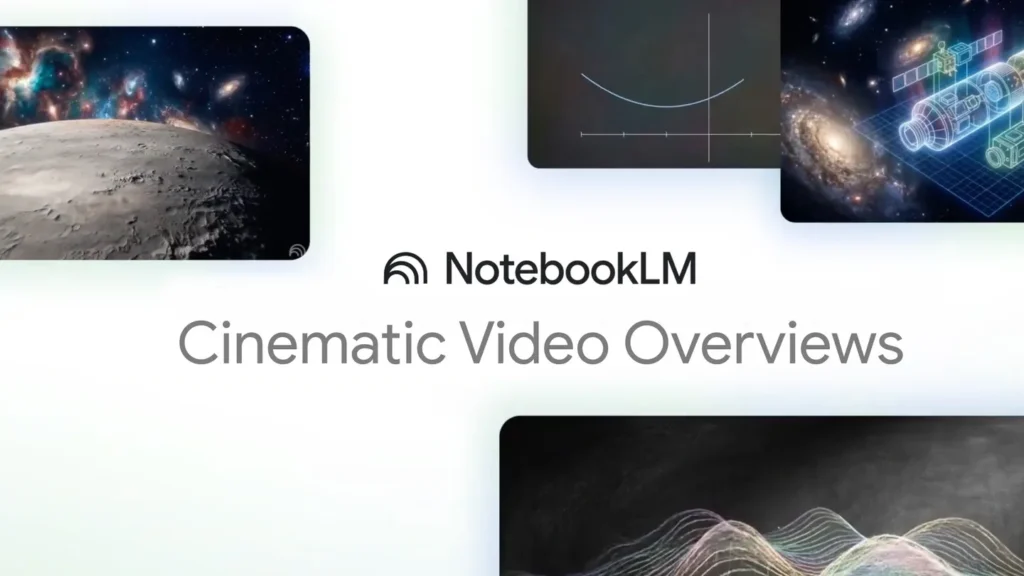
NotebookLM Revolutionizes Your Notes: Generate Real Films with Cinematic Video Overviews
NotebookLM is no longer just a strong player in the realm of “intelligent summarization.” Google has recently announced a much more ambitious version of its video overviews: “Cinematic Video Overviews” capable of generating actual animated sequences rather than just narrated slideshows.
The outcome is a new framework: your sources are transformed into a mini-educational film, complete with staging, pacing, and visuals generated on the fly.
From Slideshow to Animation: What Changes Biblically
Previously, the “video” aspect of NotebookLM resembled a narrated presentation. Now, Google promises smooth animations and richer visuals generated from the user’s notes and documents.
The key element is the multi-model orchestration:
- Gemini 3 acts as the “director”: selecting the narration, visual style, format, and “editing” to maintain overall coherence.
- Nano Banana Pro aids in generating visual elements (images/assets).
- Veo 3 is responsible for producing the final animated video output.
In other words, NotebookLM is not just “summarizing” anymore; it is formatting.
A Coherent Strategy: Google Accelerates on AI Video
This announcement fits into a busy period for Google: enhancements to Veo, the rise of Flow (video generation tool), and demonstrations of prototypes like Project Genie (interactive worlds).
The logic is clear: Google wants the natural output of a search/report to be more than just text… but a multimodal deliverable (audio, slides, video).
Availability: Ultra, English, 18+, and Daily Quota
Currently, this premium feature is available today in NotebookLM, exclusively in English, for users aged 18+, and requires a subscription to Google AI Ultra, with a limit of 20 “cinematic” videos per day.
The promise is powerful for three profiles:
- Students/Researchers: Transforming a corpus into an explanatory video,
- Professionals: Delivering an internal video brief without a motion team,
- Creators: Prototyping a narrative from sources.
However, this leap also raises a fundamental question: the more cinematic the output becomes, the more certainty is needed regarding fidelity to sources. The risk is no longer just an approximate summary; it’s a convincing video… that could smooth over nuances or amplify errors.



