

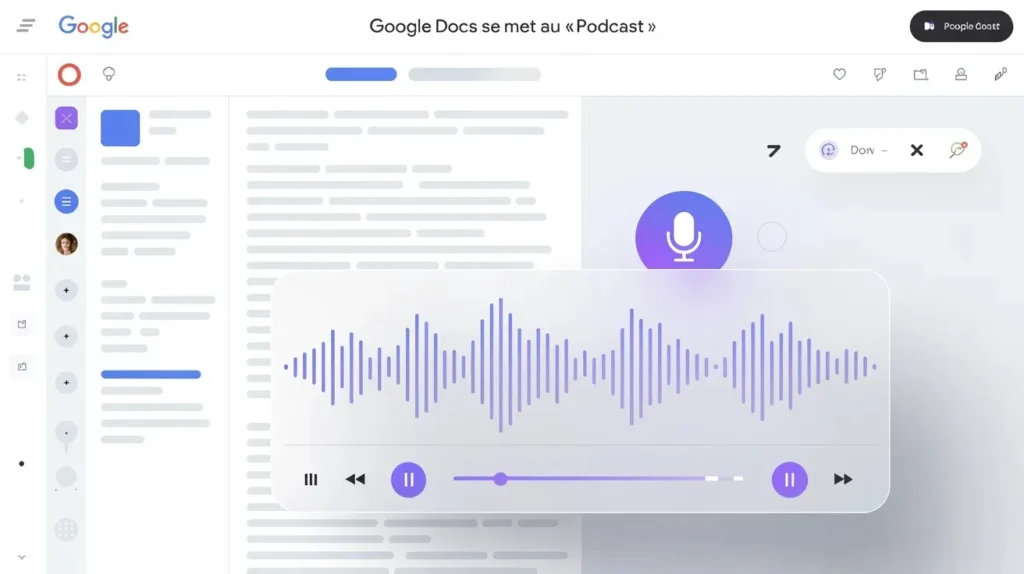
Google Docs gets a podcast feature: Gemini generates audio summaries to listen to your documents.
Google is taking the concept of a “post-screen” workspace a step further. With the audio summaries powered by Gemini, Google Docs can now transform lengthy documents—such as reports, user manuals, and quarterly reviews—into brief audio recaps that you can listen to like a podcast.
The objective is clear: to save you time, even when your eyes are occupied elsewhere.
A New Audio Layer in Google Docs: Summary + Full Reading

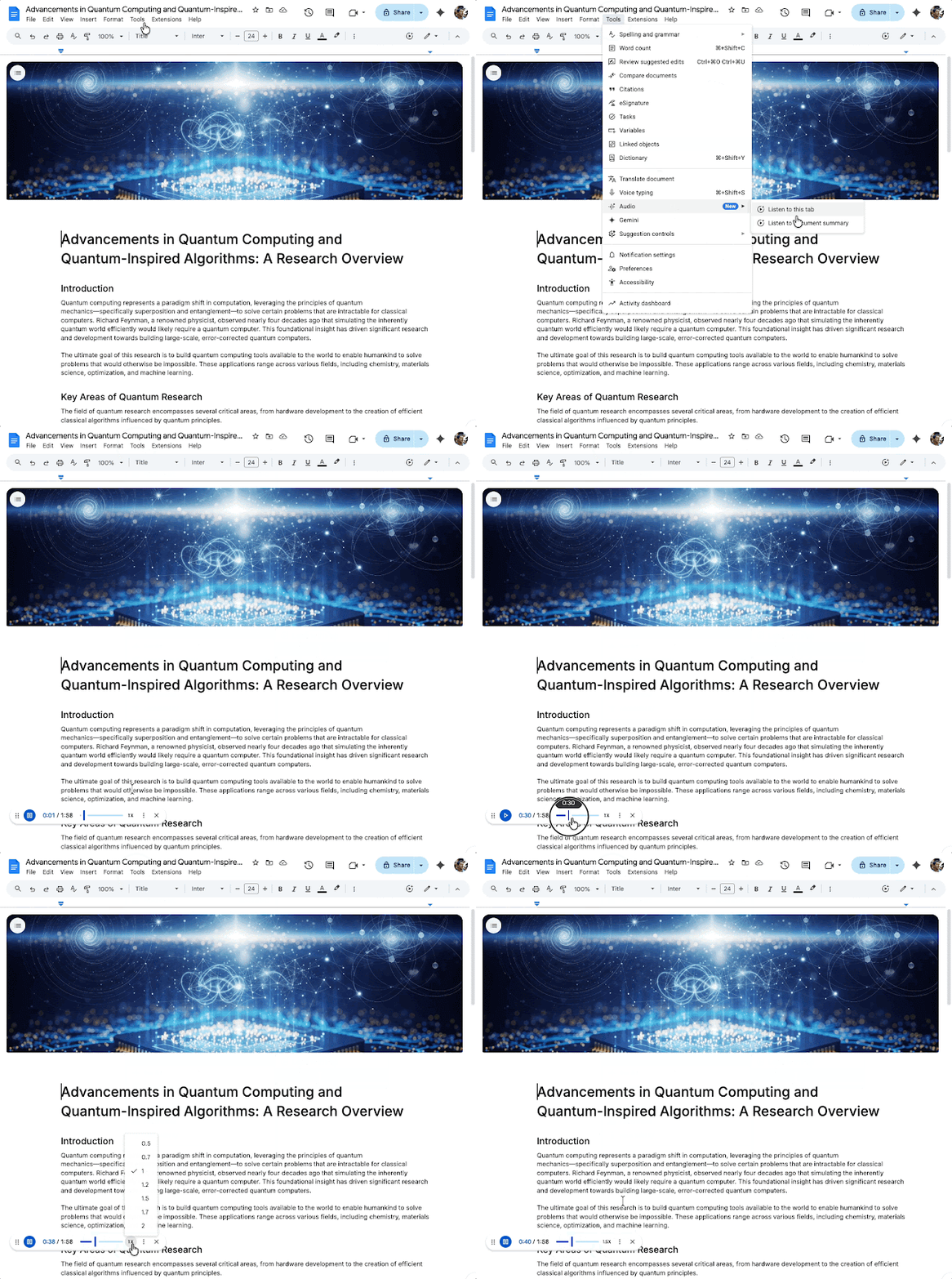
This feature can be accessed in Google Docs on the web by going to Tools > Audio > Listen to Document Summary. Once activated, Gemini analyzes the document and produces a narrated summary, usually “within a few minutes.” In the same menu, Google also offers a “Listen to Tab” option, which reads the entire content of the page/tab for those who want a complete audio version, rather than just key points.
In terms of use, Google specifically targets “in-between” moments: walking, commuting, cooking, exercising—essentially anything resembling a normal day in 2026.
Google emphasizes a “natural” output (in line with Gemini voices) and classic playback controls: pause, resume, navigation, and playback speed. Some articles also mention various voice styles (e.g., narrator, coach, etc.), indicating that Google aims to make this format genuinely “listenable,” not just utilitarian.
Availability: Gradual Rollout, Limited to Paid Users
This is the anticipated turning point: Audio summaries are not aimed at the free general public, at least initially. The rollout is gradual, and the feature is expected to be available for eligible Google Workspace and Google AI subscriptions (depending on the plans/add-ons).
In plain terms: this is a premium “add-on,” designed for organizations and power users—precisely where Google aims to monetize Gemini on a daily basis.
AI That Changes Form, Not Just Content
It might be easy to dismiss this as a mere gimmick. That would be a mistake. With audio, Google is transforming Google Docs into a consumable format, not just a production tool. This marks a strategic shift: internal documentation, reports, meeting notes are becoming multimodal objects—readable, resumable, and listenable.
However, there is a structural downside: a summary is never neutral. It selects, prioritizes, and simplifies. And when an AI performs this task, the risk isn’t just forgetting a detail—it’s inventing one or misinterpreting a nuance (numbers, decisions, legal context). Google, in its communications, reminds users that these tools should be employed judiciously.
The best approach, particularly in a business context: listen to the summary for orientation, then return to the original passage to validate.



