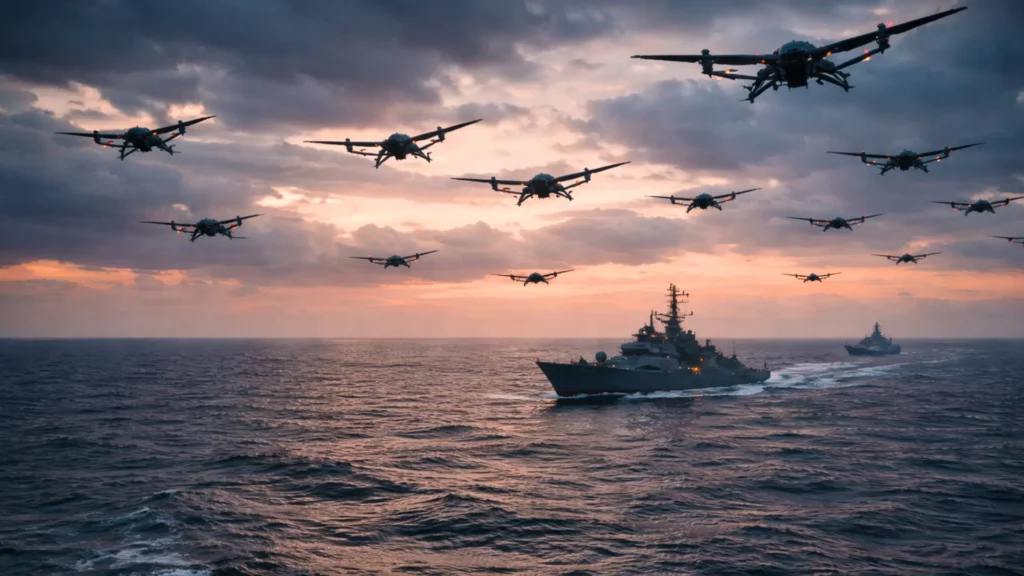
SpaceX and xAI are embarking on an ambitious project for the Pentagon. Their goal: to create swarms of autonomous drones controlled by voice commands. This major technological challenge, backed by $100 million, sees Elon Musk facing off against rivals in a confidential competition that could revolutionize modern military operations.
A confidential bid to coordinate drone fleets by simple human voice command
SpaceX and its subsidiary xAI are vying for a strategic contract with the Department of Defense. The challenge is to coordinate complex maneuvers of drones at sea and in the air. These devices must respond instantly to human voice commands to achieve their targets without operational delay.
This advancement far exceeds the current capabilities of simultaneous piloting. The software must ensure complete autonomy of the group on mission. To achieve this, xAI is recruiting highly skilled engineers with top-level security clearances to work on these advanced military systems.
Elon Musk’s shift on autonomous weapons, from past statements to industry realities
This program represents a clear break from the billionaire’s previous statements. In 2015, Elon Musk signed an open letter against killer robots, warning against the risks of entrusting algorithms with making lethal strike decisions without direct human oversight.
Today, the context appears significantly different for the American entrepreneur. His companies play a central role in the United States defense apparatus. SpaceX already provides strategic satellite infrastructure, while xAI offers its chatbot Grok to assist military personnel. Industrial realism seems to now take precedence.
This repositioning raises several significant ethical questions. Anthropic, another player in the field, strongly criticizes this potential direction. An ideological divide is emerging within Silicon Valley regarding the use of automated lethal weapons based on artificial intelligence.
A strategic race between SpaceX and the OpenAI alliance to set standards in U.S. defense
Elon Musk is not alone in this technological competition. OpenAI supports the bid of Applied Intuition for the same federal contract. Sam Altman’s company provides the tools capable of converting verbal commands from commanders into actionable software instructions.
However, a technical distinction separates the competing approaches. OpenAI specifies that its solutions will not be used directly for targeting or firing. The stakes remain high: determining who will establish their technological standards in the conduct of future conflicts between these two groups.
Major technological challenges to synchronize a swarm without collision or loss of signal during operations
Perfect coordination is the primary challenge of this ambitious program. Each drone must accurately locate its neighbors in real time. A single failure could trigger a chain reaction, destroying the swarm before it reaches the target designated by the human operator.
Voice command introduces an additional layer of complexity to the system architecture. The artificial intelligence must filter out ambient noise typical of combat zones. It must interpret instructions in an unstable and noisy environment, requiring significant embedded computational capacity.
This $100 million contract represents an initial step. Its successful implementation would demonstrate the operational capability of AI on the battlefield. A new phase could open up where conflicts are organized through algorithmic proxies.