

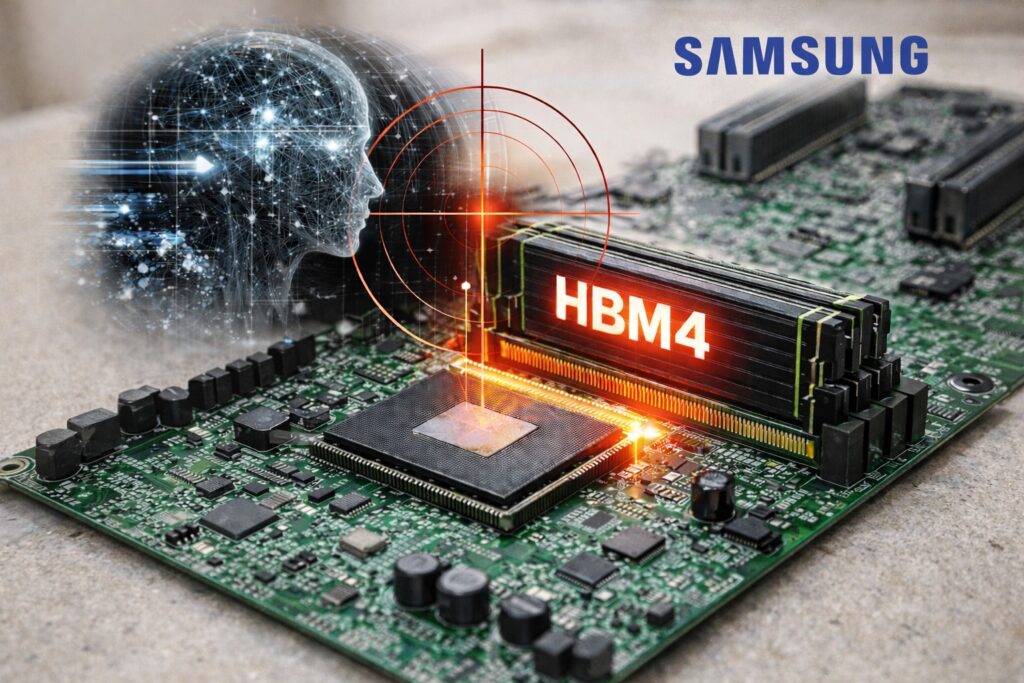
Samsung has recently announced the inaugural commercial delivery of HBM4 memory to a client, marking a significant milestone in the production of this new generation of high-bandwidth memory designed specifically for high-performance artificial intelligence accelerators. This development highlights the crucial role that memory bandwidth plays in enhancing AI infrastructure performance and reshaping specialized server architectures.
This first delivery comes at a time of soaring demand for accelerators designed for training and inference of large-scale models. Graphics processors and specialized circuits have evolved to incorporate tens of thousands of cores capable of executing massive matrix operations simultaneously. In these setups, the primary bottleneck lies in maintaining a steady data throughput between computation and memory. Insufficient bandwidth can lead to waiting cycles, which ultimately diminish the effective utilization of computational units.
HBM4 addresses this challenge by significantly increasing the bus width and physically positioning memory closer to the accelerator. As a result, AI system performance is measured in terabytes per second of usable throughput and core utilization rates, both of which are directly tied to the cost per training cycle.
### A 3D Stacked Architecture Closely Coupled with the Accelerator
HBM4 leverages a vertically stacked configuration of DRAM matrices, consisting of 8 to 16 layers interconnected via Through-Silicon Vias (TSVs). Each stack is mounted on a silicon interposer situated as close as possible to the graphics processor or specialized chip. This proximity reduces the physical distance between memory and compute elements to just a few millimeters, enhancing signal integrity and stability during high-speed transfers.
Each stack features a bus width of 1,024 bits, with the possibility of aggregating multiple stacks around a single accelerator. The reported speeds exceed 11 gigabits per second per pin, resulting in a bandwidth greater than 3 terabytes per second per stack. The memory controller is integrated directly into the accelerator, managing dozens of independent channels to optimize massively parallel access. The standard for HBM4 is defined by the JEDEC consortium.
### Distinct Engineering Models: HBM4 vs. DDR5
DDR5 SDRAM utilizes DIMM modules inserted into sockets, featuring a 64-bit bus per channel and high frequencies to enhance throughput. However, signals traverse lengthy traces on the motherboard, which increases electrical constraints and power consumption as frequencies rise. This architecture prioritizes total installed capacity and cost per gigabyte, qualities well-suited for general-purpose servers and virtualized environments.
Conversely, HBM4 employs a design that emphasizes massive bus width and physical proximity. The increased number of input and output lines enables high throughput without solely relying on frequency increases. This results in better energy efficiency per bit transferred, a critical factor for data centers facing thermal density challenges. HBM4 is optimized for sustained bandwidth and performance density per watt.
### Direct Impact on AI Workload Efficiency
Training large models involves simultaneous read and write operations on substantial data volumes. High bandwidth ensures a consistent supply to computing units, stabilizing processing times. HBM4 enhances the effective utilization rate of accelerators, reducing training cycle durations and improving predictability of production performance.
Competition in the industry is intensifying around this new generation of memory. SK Hynix and Micron are also developing their own HBM4 solutions, while Samsung seeks to solidify its position in this strategically important segment for industrial AI.
The integration of HBM4 is transforming the design of specialized servers. Architectures are now organized around the accelerator and its co-packaged memory subsystem, influencing energy density, cooling solutions, and the topology of internal interconnections. Memory thus becomes a direct lever for enhancing AI infrastructure productivity and a key competitive factor for data center operators.



