

Ericsson Unveils Groundbreaking 5G Router and Extensible Modem for Mobile Environments
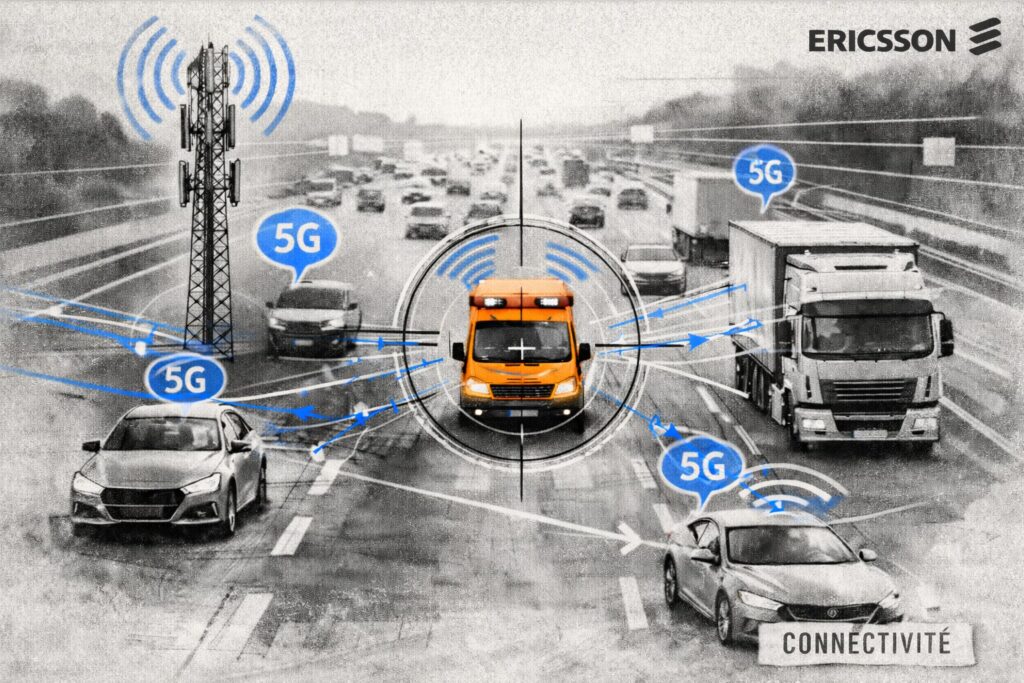
Ericsson has announced the launch of its new embedded 5G router and extensible modem, specifically engineered for mobile environments. Featuring innovative Dual SIM/Dual Standby technology on a single modem, centimeter-level geolocation, and a 2.5-fold increase in edge computing power, this equipment is aimed at sectors including emergency services, public transport, fleet management, and autonomous vehicles.
As communication infrastructures become a central component of post-automation architectures, the anticipated rise of local inference, real-time supervision, and autonomous systems necessitates connectivity capable of managing continuous video streams, massive telemetry exchanges, and stable latency requirements. The Cradlepoint R2400 embedded router leverages standalone 5G Release 17 and network slicing mechanisms to differentiate critical use cases.
The device supports up to five simultaneous cellular connections, along with low Earth orbit satellite links. This multi-link architecture ensures reliable bandwidth and availability in rural or low connectivity areas, crucial for live video transmission, mobile team coordination, and the orchestration of connected fleets. According to the Verizon Frontline Study 2025, 46% of emergency services anticipate daily use of AI within the next five years, while 48% foresee daily drone usage. Furthermore, the National Academies Autonomous Transit Survey 2024 reveals that 84% of transport operators are considering or evaluating autonomous buses within a three to five-year timeframe.
Faster Dual SIM Switching on a Single Modem
The R2400 incorporates a Dual SIM/Dual Standby (DSDS) technology, which Ericsson claims to be a first in the industry. This architecture enables a single 5G embedded router to integrate two active SIM cards on a single radio modem, while remaining registered on their respective networks. Ericsson reports that the operator switch is approximately ten times faster than previous solutions, significantly minimizing communication interruptions during critical missions or on continuously operating transport lines. For CIOs and CISOs, this reduction in switch-over time diminishes the risk of application downtime during network incidents or cell changes.
Service continuity is further supported by compatibility with public safety networks and slicing services. Network slicing allows for the dynamic allocation of dedicated radio resources to prioritize critical use cases, stabilizing latency and reducing congestion. Remote monitoring architectures and vehicle-infrastructure communications demand this level of assurance when autonomous systems exchange critical data.
Centimeter-Level Geolocation for Autonomous Fleets
The router is equipped with Real-Time Kinematics (RTK) technology combined with dead reckoning, enhancing positioning accuracy from one to three meters down to approximately one centimeter. While metric precision suffices for overall fleet tracking, centimeter-level accuracy enables lane-by-lane identification and precise positioning at complex intersections. This level of granularity meets the demands of autonomous buses and advanced driver-assistance vehicles, whose routes must correlate with high-definition mapping.
Improved accuracy reduces the error margin between calculated and actual positions, enhancing the correlation between video feeds, onboard sensors, and supervisory systems. Autonomous transport platforms can thus associate events with exact geographical locations, making centimeter precision a directly relevant technical parameter for the safety of maneuvers and regulatory compliance in trials.
2.5 Times Increased Edge Computing Power
Ericsson boasts a 2.5-fold increase in edge computing capabilities compared to previous generations, aimed at local AI inference, computer vision, and executing containerized applications. Local inference reduces latency by avoiding the systematic round trip to a remote data center. This mechanism stabilizes response times in scenarios such as obstacle detection, real-time video analysis, or drone coordination, even under varying network quality.
The extensible RC1250 modem allows for gradual network capacity expansion for applications like live video streaming, avoiding the need for a complete router replacement during technological upgrades. Reed Perryman, Vice President of Sales and Marketing at RCN Technologies, notes that “this flexible and scalable approach eliminates costs associated with complete equipment replacements.” This targeted upgrade mechanism reduces investment cycles and enhances budget planning for operators.
Doubled Throughput for SASE and Zero Trust Architecture
The announcement also highlights that throughput dedicated to NetCloud SASE, Zero Trust architectures, and SD-WAN has been doubled. This technical attribute enables the simultaneous activation of encryption, inspection, and access policies without degrading application performance. Autonomous and semi-autonomous fleets are managing increasing volumes of sensitive data, and maintaining throughput under security constraints sidesteps trade-offs between protection and quality of service.
Centralized management through NetCloud encompasses AIOps dashboards capable of identifying anomalies before they impact service. Jason Leigh, Senior Research Manager for 5G & Mobile Services at IDC, emphasizes that “vehicles are becoming the nerve center for information, coordination, and incident response,” noting that this evolution “demands more reliable, adaptable connectivity tailored for real-time, data-driven use cases.” AI-assisted monitoring aims to shorten incident detection times and optimize the operation of distributed mobile infrastructures.
While the technical specifications of the R2400 align with the requirements for partially or fully autonomous vehicles, the announcement does not explicitly state this ambition. However, the centimeter-level precision, multi-link resilience, and enhanced computing power prepare mobile architectures for the gradual autonomy of fleets. Consequently, enterprise clients will have the technical elements necessary to anticipate the integration of onboard AI and autonomous systems into their critical infrastructures.



