

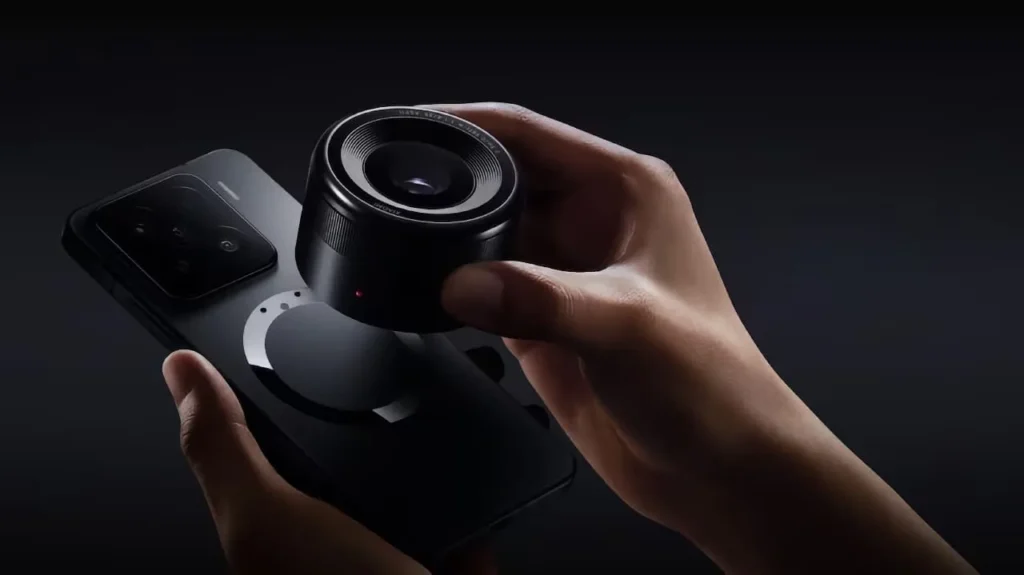
Xiaomi MOS: The 100 Megapixel Modular Camera Starts Production for 2026
Smartphones have largely replaced traditional cameras for most purposes. However, Xiaomi aims to do the opposite by providing true optical capabilities when needed, without requiring a bulky camera bump for everyday use.
Initially introduced as a concept at MWC 2025, Xiaomi’s Modular Optical System (MOS) has resurfaced through a leak, indicating that magnetic lens modules have reached a stage of “mass production planning,” with potential availability as early as “this year”—though this remains unconfirmed by the company.
What Are We Talking About: The MOS, A New Generation “Snap-On Camera”
The MOS is not merely a Bluetooth accessory or an external camera that operates independently. Xiaomi’s vision involves an optical module that magnetically attaches to the back of a compatible smartphone, exchanging data and energy almost instantaneously, integrating seamlessly with the phone’s camera as if it were a native sensor.
This concept is detailed in Xiaomi’s official presentation, and various media outlets have observed it during the prototype demonstration.
What sets it apart is LaserLink: a proprietary optical communication system that transfers data from the module to the phone at speeds of up to 10 Gb/s, allowing for RAW image processing without noticeable latency, while the smartphone handles the core processing (ISP + photo calculations).
Production on the Horizon, but Timeline Unclear
The rumor comes from posts attributed to Digital Chat Station and echoed by several sites, suggesting that “magnetic lens modules” have entered mass production planning, potentially releasing as soon as this year (to be taken with caution).
The post does not explicitly mention Xiaomi, but the company is currently the only well-known consumer brand pursuing this magnets plus laser data link combination, as showcased at MWC.
Why This Could Be a Game Changer for Mobile Photography?
Xiaomi Tackles the Issue at Its Core: Optics, Not Illusion
In recent years, smartphone photography has primarily “improved” through AI enhancements like aggressive noise reduction, super-resolution, and simulated bokeh. Xiaomi offers an alternative approach: a large sensor combined with genuine optics, but only when required. In essence, it maintains the phone’s compactness while switching to “camera mode” whenever the moment calls for it.
The Biggest Promise: Enhanced Quality Without a Permanent Camera Bump
Wired aptly summarized the intention: to eliminate the camera bump… while also offering more natural outputs (bokeh, low-light performance) compared to approximate Portrait modes. The module can conveniently fit in a pocket, allowing the phone to return to a “normal” state the rest of the time.
A Broader Platform Beyond Photography
From its inception, Xiaomi suggested that LaserLink could be utilized for other modules (not limited to photography). If the MOS becomes a reality, the question arises: is Xiaomi launching an isolated accessory… or the beginnings of a proprietary magnetic ecosystem?
Several critical factors will determine its success:
- Hardware Compatibility: The prototype was built on a modified phone (like the Xiaomi 15). If the MOS is released, it will be essential to know how many models can support it, and whether Xiaomi will restrict the feature to specific lines.
- Cost and Usability: A serious optical module (wide sensor, glass, mechanical components) can quickly become expensive. To achieve mainstream adoption, it must not fall into the trap of being a niche premium accessory.
- Magnetic Reliability: Alignment, stability during movement, one-handed usage, cases… The “plug-and-play” experience must be flawless; otherwise, the magic will fade.
While Apple and Samsung have refined computational photography, they remain constrained by the physics of integrated modules. Xiaomi is exploring a bold compromise: separating optics from the phone, without compromising the overall experience. If mass production is confirmed, Xiaomi could gain an advantage, offering not “more AI,” but “more camera” when you choose.
The real challenge will be transforming the prototype into a product suitable for everyday use. This is where the MOS will be evaluated: based on simplicity, consistency… and whether people genuinely want to carry it, just as they would a pair of headphones.



