

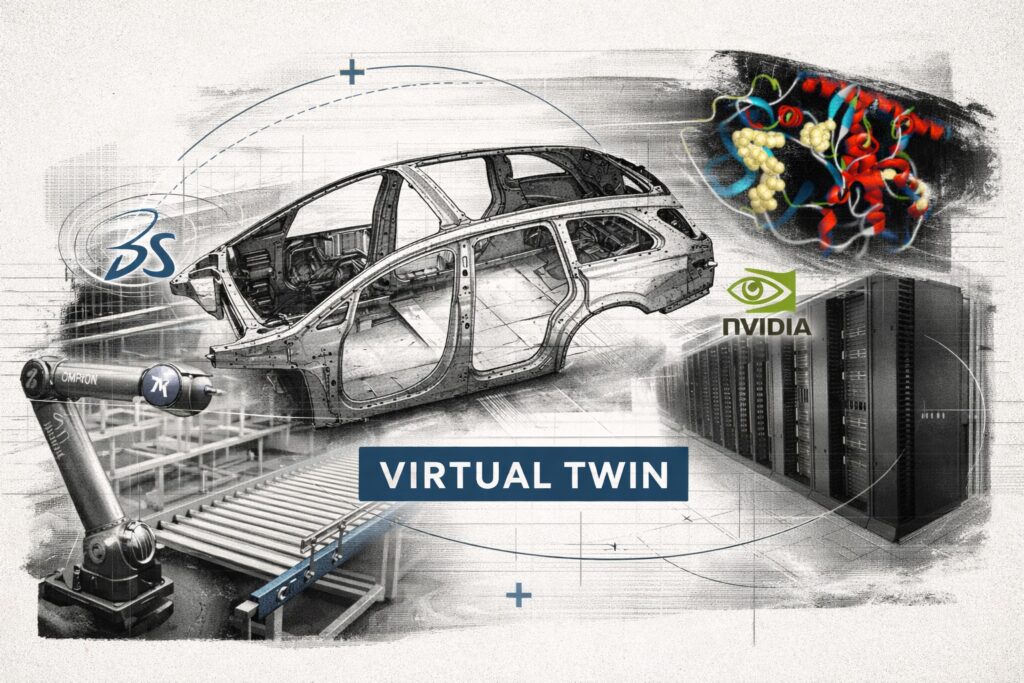
Dassault Systèmes Partners with Nvidia to Launch AI-Driven Virtual Twin Platform
Dassault Systèmes has announced a long-term industrial partnership with Nvidia aimed at developing a sophisticated AI platform centered around “virtual twins.” This initiative will merge simulation engines, accelerated computing, and dedicated infrastructures, transforming traditional engineering tools into a robust operational foundation for physical AI, industrial automation, and business agents utilized in design, production, and R&D.
The term “virtual twin” for Dassault is more than a simple rebranding of “digital twin”; it represents a strategic evolution to position scientifically validated virtual models as the operational heart of industrial AI. Functionally, the French software provider aims to anchor its platform within an integrated multifunctional environment. This approach entails creating a comprehensive chain for managing “world models” that can accurately represent a product, factory, or complex system, simulate their physical, chemical, or biological behaviors, and directly inform decisions, automation, and optimization. The joint announcement with Nvidia solidifies this trajectory.
From an architectural standpoint, Dassault’s goal is to evolve the 3DEXPERIENCE platform into an agent-driven industrial AI solution, moving beyond a traditional PLM (Product Lifecycle Management) system. This translates to a vertically oriented execution layer focused on actionable outcomes, distinguishing it from many players still relying on generic assistants disconnected from operational realities. Engineering teams will benefit from an increasingly automated feedback loop between design, validation, and manufacturing, with decisions being derived from reproducible simulations rather than mere statistical inferences.
Integrating Dassault Software with Nvidia’s AI Stacks
The partnership hinges on the direct integration of Dassault’s simulation solutions with Nvidia’s AI stacks. Products like SIMULIA, used for physical simulations (mechanical, thermal, aerodynamic), DELMIA, focused on modeling industrial processes and production chains, and BIOVIA, which emphasizes chemistry, biology, and materials science, will all serve as foundational components of this new architecture. On Nvidia’s side, Omniverse will provide a real-time 3D environment for physical AI, while tools like BioNeMo will accelerate molecular research, CUDA-X will offer GPU computing libraries, and Nemotron will enhance generative and agent-based AI functions. These components will convert physical models into executable references capable of simulating mechanical, thermal, or chemical behaviors and injecting these results into design and manufacturing processes, which ultimately shortens iteration cycles and enhances predictive accuracy in engineering decisions.
Pascal Daloz, the CEO of Dassault Systèmes, articulated this technological shift, stating, “We are entering an era where artificial intelligence is no longer limited to prediction or generation; it now comprehends the real world.” He further emphasized that both companies are building “industrial World Models that integrate virtual twins with accelerated computation.” These “world models” are grounded in scientifically validated simulations, positioning Dassault’s virtual twins as the foundation for industrial AI, which replaces purely statistical approaches with operationally actionable deterministic models for molecule discovery, component optimization, and digital validation of complex systems.
A Focus on Sovereignty and Governance
Notably, the architecture assembled by Dassault and Nvidia reflects an intentional focus on sovereignty and governance over digital assets. This partnership aims to provide European industry with a credible alternative to hyperscalers for critical applications, offering end-to-end control from the virtual twin to AI execution.
Jensen Huang, Nvidia’s founder and CEO, describes “physical AI” as the “next frontier of artificial intelligence, grounded in the laws of the real world.” He highlighted that the confluence of Omniverse and AI platforms enables millions of engineers and researchers to operate within virtual environments synchronized with physical constraints. This integration of simulation and AI is poised to transform digital prototypes into direct production levers.
As the 3DEXPERIENCE platform continues its evolution towards an agent-driven architecture, it now introduces virtual companions linked to virtual twins and industrial data. This innovation allows engineering teams to initiate simulations, compare design alternatives, and orchestrate contextual decision-making directly from their work environments. These agents serve not merely as generic assistants but as operational extensions of physical models, automating certain feedback loops between design, validation, and manufacturing processes. Shawn Ehrstein, director of emerging technologies at the National Institute for Aviation Research at Wichita State University, noted that these tools “accelerate the design of compliant virtual aircraft twins from the outset while reducing certification efforts and preserving data sovereignty.”
AI Factories Spanning Three Continents
From an infrastructural perspective, Dassault is deploying “AI factories” across three continents through its Outscale platform. These environments host models, handle intensive calculations on Nvidia GPUs, and ensure data confidentiality alongside intellectual property protection. Concurrently, Nvidia is adopting Dassault’s model-based systems engineering to design its own AI infrastructures, starting with the Rubin platform integrated with Omniverse DSX Blueprint, aligning software and hardware stacks around virtual twins as a central orchestration point. This marks a shift away from traditional “black box” AI by leveraging deterministic models (such as SIMULIA, DELMIA, BIOVIA), allowing Dassault to position its approach as “reliable by design,” contrasting with purely statistical methods.
Several industrial players are already on board with this initiative. Cécile Béliot, CEO of Groupe Bel, stated that this collaboration brings “the computational power necessary to model and optimize our products at scale.” Motohiro Yamanishi, president of industrial automation at OMRON, noted an accelerated transition “from design to deployment” through the combination of Nvidia’s physical AI and Dassault’s Virtual Twin Factories. Vivek Attaluri, vice president of vehicle engineering at Lucid, expressed that AI-driven physics exploration could “speed up the transition from concept to production without compromising predictive accuracy.”
With approximately 370,000 active clients on the 3DEXPERIENCE platform, Dassault is transforming its PLM scope into a comprehensive industrial AI architecture. Users now have a single repository that links physical models, business agents, and computing infrastructures, facilitating quicker design timelines, increased predictive reliability, and gradual automation of processes under continuous digital control. For industrial enterprises, this integrated stack redefines AI governance, as simulation becomes the source of truth, with accelerated computation acting as a direct lever for operational performance.



