

Aluminium OS: The Secret Timeline Of The Android-ChromeOS Merger Unveiled
Google has long dreamed of unifying its two ecosystems — Android and ChromeOS — but Project Aluminium (or Aluminium OS) appears to be a gradual transition rather than an imminent launch.
According to documents and communications cited by The Verge, the “fastest route” for Aluminium OS could involve limited testing by the end of 2026, followed by a broader release in 2028.
Aluminium OS: A Beta For “Trusted Testers,” Then 2028 For The Official Launch
The key takeaway is the internal timeline outlined in court filings: Google aims for “commercial trusted testers” by late 2026, followed by a public/sector release in 2028 — specifically targeting businesses and educational institutions, two traditional strongholds of ChromeOS.
While Google has already leaked an initial glimpse of Aluminium OS in action (through a bug report), these images mainly confirm that the project is real, not that it is ready.
ChromeOS Cannot Disappear “Cleanly”
The obstacle is not only technical; it is also contractual and logistical: Google has committed to up to 10 years of updates for existing Chromebooks, and the cited documents indicate that Aluminium OS will not be compatible with all existing devices.
The result is that ChromeOS will need to be maintained at least until 2033 to honor these commitments, with a phase-out mentioned around 2034.
In other words, even if Aluminium “works,” Google must manage a lengthy coexistence, potentially lasting until the early 2030s.
Avoiding Fragmentation Between “ChromeOS” And “Android-PC”
Two operating systems, two partner strategies, two user expectations…and a pressing question: what are we selling to OEMs and schools in the meantime?
- ChromeOS remains deeply embedded in the education sector.
- Aluminium OS aims to provide a more modern desktop experience, built on Android.
This coexistence may create a confusing period: app compatibility, developer priorities, support promises, and even “what OS at what price”. This is precisely what The Verge describes as “messy and controversial.”
Software Distribution Becomes A Chess Piece
The documents cited by The Verge also link Aluminium OS to issues around packages and distribution rules (Play Store, browser, Google services) under regulatory scrutiny. In other words: even if an OS is ready, it can be politically explosive depending on how Google packages and promotes it in the market.
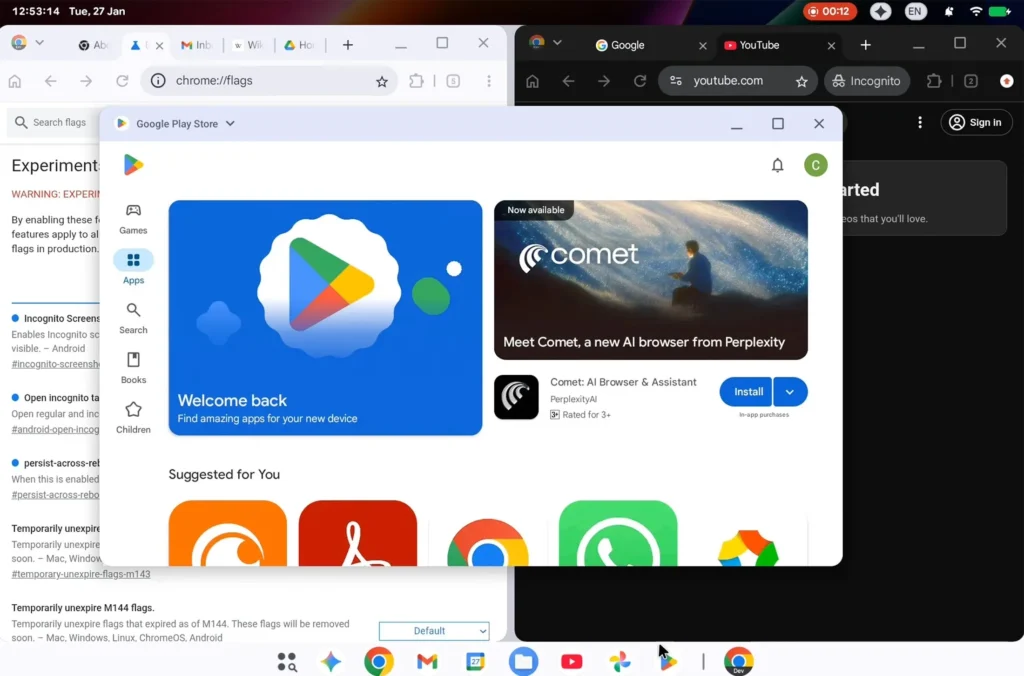
Meanwhile, more concrete signals are emerging: an app called “Desktop Camera” spotted on the Play Store is described as a camera tool “for desktop,” with an interface reminiscent of the Pixel/ChromeOS DNA — another clue that Google is preparing apps tailored for larger screens.
What To Keep In Mind If You’re Buying A Chromebook Today
- Do not expect an “Android laptop” in 2026: the most credible scenario points to 2028 for significant availability.
- ChromeOS will remain the primary platform for years, with extended support.
- Aluminium OS appears to be a decade-long evolution, not an overnight replacement.



