

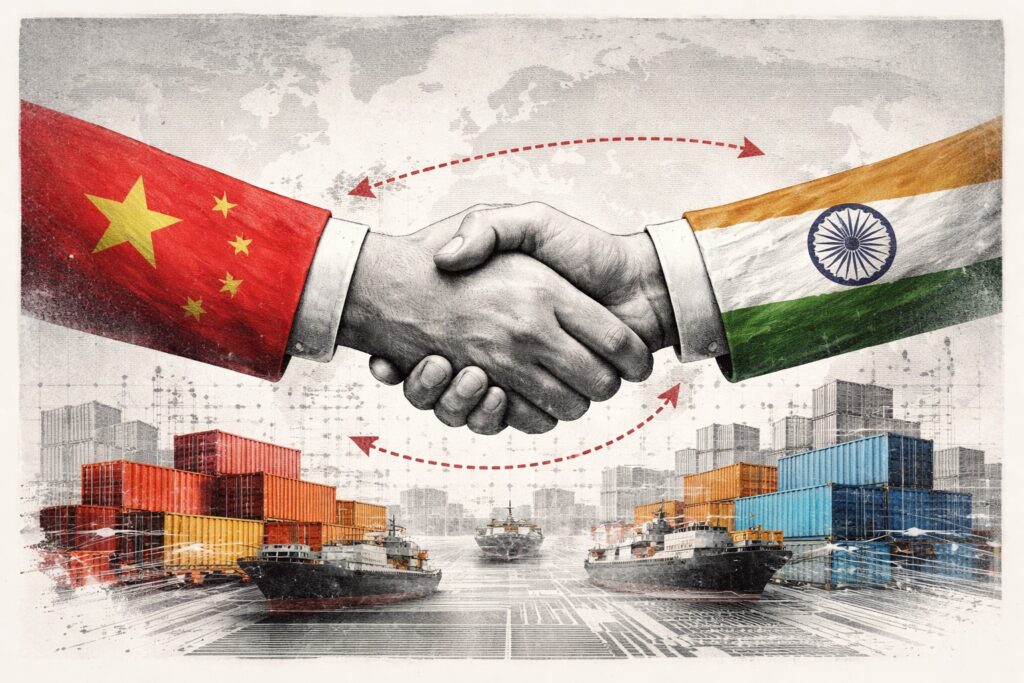
China Offers Support to Indian Exporters Amid U.S. Tariff Pressures
China has explicitly offered assistance to Indian exporters impacted by the tightening of U.S. tariffs, as reported by Nikkei Asia. This gesture comes as various Indian sectors, heavily reliant on the American market, begin to assess the repercussions of the latest tariff measures imposed by the United States. Background trade data further indicates a partial reshaping of trade flows, particularly in the IT services sector.
In recent years, international trade relationships have evolved under the influence of tariffs, which are increasingly used as economic leverage. With India now at the center of the global digital services economy, any barriers introduced by its largest export market could significantly disrupt its trade dynamics.
According to data from India’s Ministry of Commerce and Industry, Indian exports to the United States reached approximately $86.5 billion in the fiscal year 2024-2025, making the U.S. its top trading partner. This dependency is especially concerning, given that about 55% of these exports are estimated to be affected by the enhanced tariffs implemented during the Trump administration—an amount nearing $48 billion.
These figures provide tangible evidence of a debate often addressed in abstract terms. They illustrate that India faces a commercial constraint on a substantial portion of its exchanges with its primary trading partner.
IT Services: A Significant Vulnerability
India’s exposure is not limited to manufactured goods. Data from the Reserve Bank of India shows that service exports reached approximately $387 billion during the fiscal year 2024-2025, with IT services, software engineering, and digital outsourcing comprising more than half of this amount—between $190 and $200 billion.
This structure explains why any lasting disruption in trade relations with the United States directly impacts global IT value chains. A significant portion of American and European companies relies on Indian capabilities for application development, information systems support, and software engineering.
Decline in Indian Exports to the U.S.
Initial data reflecting the impact of the tougher tariff measures is emerging in recent statistics. The Global Trade Research Initiative, an Indian organization specializing in trade analysis, reports that Indian exports to the U.S. fell by 37.5% over the four months following the announcement of these measures. This data, sourced from national customs statistics and covered by the Indian economic press, illustrates a rapid shift in trade flows.
While this decline cannot be attributed solely to tariffs, it confirms that ongoing trade tensions are producing measurable effects, even in technology-heavy segments. In this context, China has stepped up its support for Indian exporters. Indian Ministry of Commerce data reveals that exports to China surged by 67% in December 2025, reaching approximately $2.04 billion for the month, propelled by electronics and certain industrial components.
Although these volumes remain incomparable to U.S. trade flows, their rapid increase signals a significant shift. China’s proposal does not represent an immediate strategic pivot but rather reflects a trade dynamic increasingly substantiated by the numbers.
A Pragmatic Gesture of Asian Solidarity
China’s offer of support to Indian exporters extends beyond a bilateral framework. It highlights a broader trend of reactivating regional interdependencies in response to geo-economic tensions fueled by the United States. While it does not resolve underlying Sino-Indian rivalries, this gesture showcases Asia’s capacity to foster forms of commercial, industrial, or technological solidarity under certain circumstances.
In this specific instance, China’s initiative serves to spotlight the diminishing legitimacy of multilateral frameworks. It demonstrates that border disputes, mutual restrictions, and diplomatic blockages can temporarily give way to industrial logic and converging economic interests. China emphasizes that Asia has autonomous spaces to organize its economic complementarities, independent of dominant Western models.
Such initiatives reinforce the notion that value chains are not solely dependent on bloc logics. They can also be reconfigured through asymmetric alliances, timely opportunities, and industrial negotiations between regional powers. In this context, Asian solidarity is transactional rather than institutional, based on mutual recognition of productive capacities, logistical needs, and shared commercial challenges in the face of a common systemic disruptor.
For European decision-makers, this sequence invites a re-evaluation of binary perspectives on technological decoupling. It reminds us that Asia is not merely an adjustment variable in the Sino-American confrontation but a strategic space where hybrid regional responses to global tensions are crafted. Hence, Asian solidarity emerges as a factor in the indirect reorganization of global digital value chains. For companies utilizing Indian IT services, this reconfiguration necessitates anticipation of new sourcing, compliance, and operational continuity strategies in an environment where geopolitical decisions now directly influence IT architectures.



