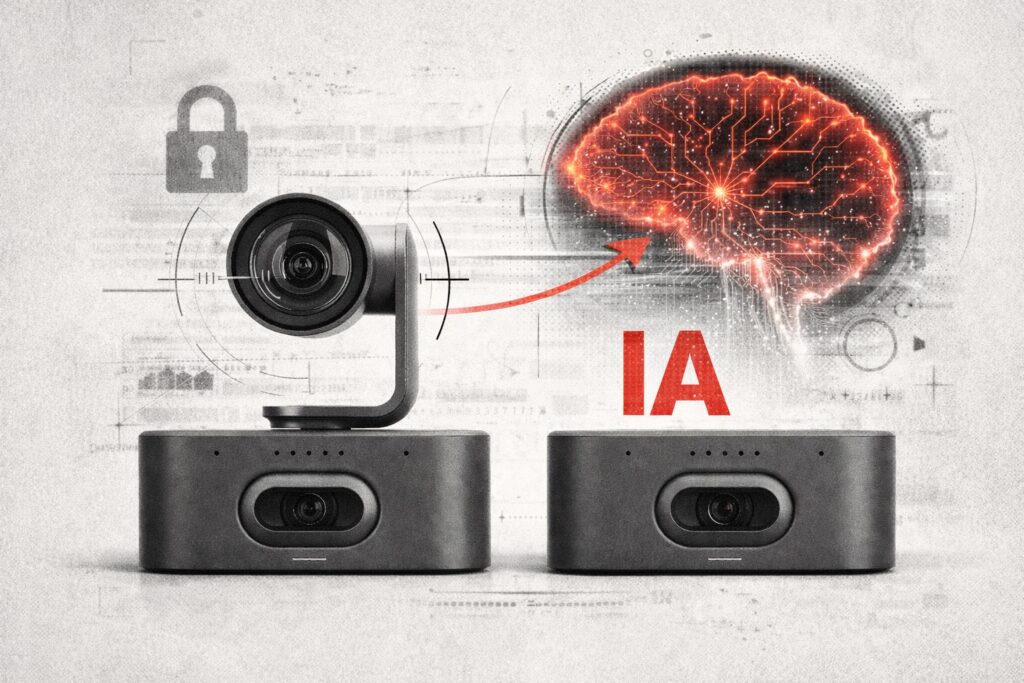
<p><strong>Logitech's new Rally AI range introduces intelligent framing, presence detection, and room usage analytics. While designed for large hybrid environments, these cameras raise questions about the origins of AI processing, data governance, and the competition posed by video conferencing pure players against integrated platforms from hyperscalers.</strong></p>

<p>With the Rally AI lineup, Logitech aims to redefine the role of video conferencing cameras as advanced sensors for the digital workspace. The vision is to merge optical quality, contextual interpretation, and IT oversight into a single device. However, as this ambition unfolds, critical questions remain for IT decision-makers: Where is the data processed, by what technical means, and with what level of client-side control?</p>

<p>The Rally AI Camera and Rally AI Camera Pro models feature a dual optical module with a one-inch sensor and a 15x hybrid zoom for the Pro version. These specifications position the devices for large meeting rooms, offering a 115° field of view, high sensitivity in low-light conditions, and 4K resolution at 60 frames per second. Nevertheless, it is the software aspect where Logitech emphasizes its differentiating narrative.</p>

<p>RightSight 2 technology dynamically frames participants by alternating between several modes (active speaker, facial grid, overview). According to the manufacturer, this functionality relies on continuous scene analysis, but it never clarifies whether the processing is done on the camera, offloaded to a local server, or transmitted to a cloud service. Additionally, there is no mention of an inference engine, neural processor, or vision AI model in the technical specifications, making it difficult for security or compliance teams to assess the offering.</p>

<h4><strong>Usage Metrics Sent to Logitech Sync</strong></h4>

<p>Beyond video capture, the Rally AI cameras collect data on room occupancy, participant counts, and meeting durations, which feeds into the Logitech Sync management platform. This platform provides IT teams with a comprehensive view of workspace utilization, promising to optimize room management and even automate actions like freeing up unoccupied rooms or detecting excessive occupancy rates.</p>

<p>However, this promise raises a series of unanswered questions. Are the data anonymized locally before transmission? What data flows are sent to Logitech's servers, under what legal framework, and in which data centers? Is there an edge processing option for clients wishing to prohibit external transfers? The lack of documentation on these issues hampers integration of the solution within regulated environments, particularly in public sectors, healthcare, or defense, where sovereignty and traceability requirements are stringent.</p>

<h4><strong>Problematic Grey Areas for Cybersecurity</strong></h4>

<p>The transformation of cameras into smart devices fundamentally alters the nature of audiovisual equipment. They are no longer merely video input devices but cognitive perception systems capable of continuously capturing, processing, and interpreting human signals. In this context, security officials expect full transparency regarding software architecture, data paths, integrated analysis modules, and possibilities for disabling or isolating components.</p>

<p>Currently, Logitech provides no information on video stream encryption, the granularity of administrable permissions, or the auditability of AI processing. There are no security certifications or GDPR documentation available, despite the intended use cases involving strategic, confidential meetings that can be legally sensitive. This lack of technical and regulatory details creates a dissonance between the product positioning and the demands of the European professional market.</p>

<h4><strong>Pure Players Disrupted by Hyperscalers</strong></h4>

<p>This tension around transparency is part of a broader trend: the reallocation of value chains around cloud giants. Microsoft, Zoom, and Google are now pushing vertically integrated offerings, where video intelligence is directly embedded into their collaboration platforms. Microsoft Teams Rooms with Intelligent Speaker and Front Row, Zoom Smart Gallery, and Google Meet Series One establish a new standard: native coupling between software, hardware, and contextual cognition.</p>

<p>As this evolution unfolds, specialized manufacturers like Logitech, Jabra, and Poly must reinvent their roles to avoid becoming interchangeable. They're banking on optical quality, modularity, differentiated intelligent features, and management platforms (like Logitech Sync and Jabra+ for Admins) to maintain their relevance among IT services. However, without clarification regarding the origins of AI components, data governance, and managed deployment options, their standing in tenders—especially from large enterprises or public administrations demanding robust guarantees—may become precarious.</p>

<h4><strong>Embedding Products in New Use Cases</strong></h4>

<p>The Rally AI range exemplifies Logitech's clear intention to upscale and align its products with the evolving demands of hybrid workspaces. By integrating behavioral analytics, presence detection, and contextual oversight, these cameras transcend the realm of mere audiovisual equipment, venturing into the collection and processing of operational data. This functional shift subjects them to the same requirements as software overseen by compliance and cybersecurity departments. To navigate this transition credibly, Logitech must document its cognitive architecture, clarify the processing modules—whether embedded or remote—trace data flows, and provide robust contractual guarantees.</p>

<p>Without these commitments, hardware specialists like Logitech or Jabra risk being sidelined by closed software ecosystems, similar to those led by Microsoft and Google. In contrast, Zoom, maintaining its position as a pure software player, is developing a hybrid approach by integrating native AI capabilities while relying on an open network of hardware partners. In this landscape, differentiation will hinge as much on functional quality as on the ability to demonstrate transparent technological governance.</p>