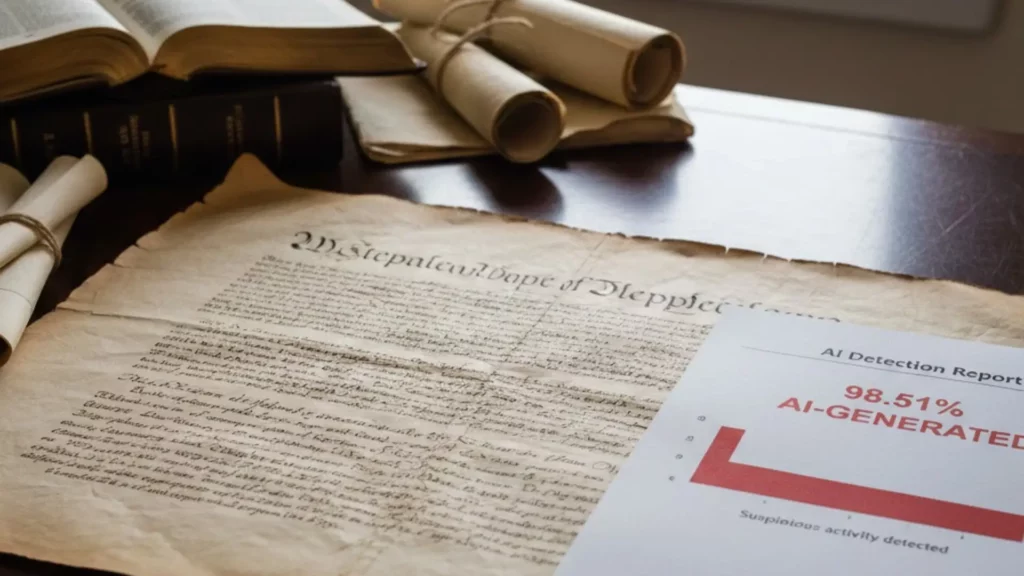
An artificial intelligence detector recently claimed that historical texts like the American Declaration of Independence or even the Bible originated from AI. This absurd error highlights a concerning gap in our trust towards these technologies.
Why An AI Wrongly Accuses The Declaration Of Independence Of Being Written By A Machine
The information is quite surprising. An AI analyzed a text from 1776 and claimed that another AI wrote it. This algorithm, designed to detect the origin of texts, attributed the American Declaration of Independence with 98.51% likelihood to a machine.
However, this founding document of the United States dates back several centuries before computers existed. This egregious error has real consequences. This case highlights the limitations of the reliability of detectors that are already being integrated into education, journalism, and justice.
The Bible, Court Decisions, Student Copies: What AI Detectors Misidentify
Other sacred or historical texts—the Bible, certain court rulings from the 90s—face the same fate. These tools classify them as AI-generated content, even though these technologies didn’t exist at the time.
By challenging the authenticity of ancient texts, these tools also jeopardize contemporary works. They mistakenly attribute some student copies, news articles, or manuscripts by authors to AIs. Such confusion undermines careers, reputations, and even grades.
This issue worsens in sensitive environments like educational platforms, academic verification systems, or moderation software. An erroneous detection can lead to serious sanctions, deny a genuine recourse, and foster a broad distrust towards technology.
Human Or Artificial Writing: A Blurred And Challenging Line
Today, language models like ChatGPT generate texts that are so convincing they blur the line with human writing. The real challenge lies in the gap between this quality of imitation and the shortcomings of the still flawed detectors.
In the past, an author was recognized by their ink, style, and handwriting. Today, the screen homogenizes everything. The human style becomes malleable, easily imitated and manipulated. A question as simple as “Is this text mine?” struggles to find a clear answer.
Does It Really Matter If A Text Is Written By An AI Or A Human?
A researcher interviewed on the topic argues that what truly matters may not be the author, but the content. According to her, it doesn’t matter whether a human or a machine wrote the text, as long as it conveys something useful. This notion, both daring and concerning, opens the door to many potential pitfalls.
Intellectual property, trust in information, and the symbolic value of a text are dependent on its origin. If we blur this line, what will remain as a reference point? Times are changing, certainly. But by allowing machines to control our narratives, we risk losing our bearings.