

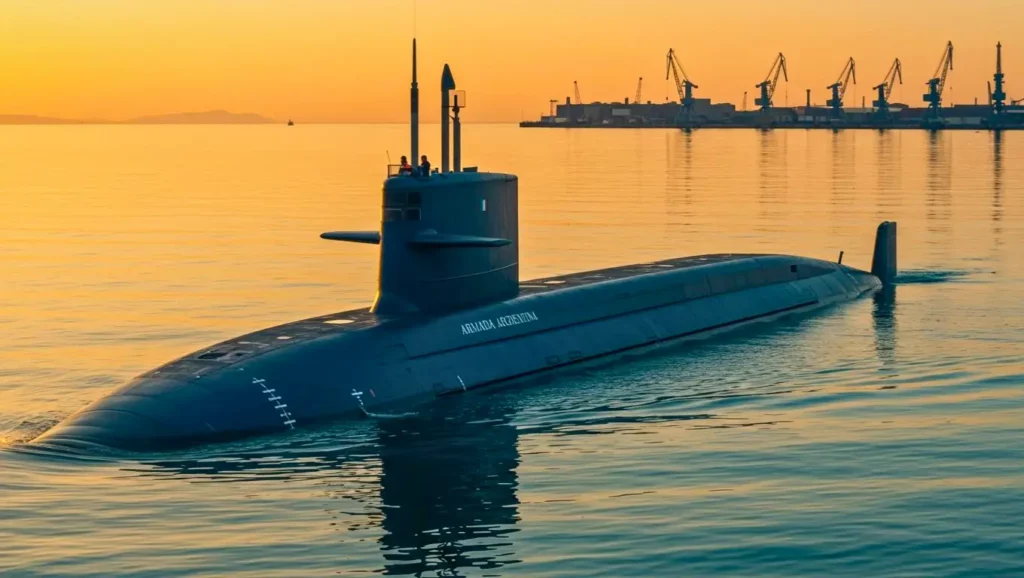
This announcement has created a stir on both sides of the Atlantic. On November 7, 2025, Argentine President Javier Milei officially announced a historic order placed with Naval Group: three brand new Scorpène submarines, for an estimated amount of 2.3 billion euros. An industrial victory for France, a strategic turning point for Argentina, and a powerful symbol of the resurgence of submarine power in the country.
A Fleet Reduced to Nothing Since 2017: Argentina Finally Addresses a Strategic Gap
Since the tragedy of the San Juan, which disappeared in 2017 with its 44 crew members, the Armada Argentina has had no operational submarines. Eight years of silence underwater for a country bordered by 4,700 km of coastline and facing increasing challenges regarding maritime sovereignty, illegal fishing, and defense.
In this context, the revival of the submarine fleet had become urgent, even vital. This contract with Naval Group thus revives a crucial strategic capability that had been left dormant. It also repositions Buenos Aires among modern navies.
Three Scorpène, a Transfer of Expertise, and a Strong Geopolitical Signal
The ordered submarines are not nuclear but are
Beyond this contract, there is also a diplomatic victory. Naval Group has outpaced German TKMS, who was previously the favorite. This success was facilitated by the good relationship between Emmanuel Macron and Javier Milei, marking France’s return to a domain where it had faced several setbacks recently (Canada, Australia…).
An Unconventional Contract with Deferred Payment, Reflecting Argentina’s Economic Situation
In a rare move, payment will only be made upon delivery of the first submarine. This gesture of flexibility from France is likely influenced by Argentina’s still fragile economic situation, even though there are signs of recovery. Normally, such a contract would only be valid after an upfront payment.
This financial gamble is not without risk, but it could prove strategically rewarding by strengthening bilateral ties and paving the way for further cooperation in defense or energy.



