


Cloudflare: Major Outage Related to Bot Management Disrupts Parts of the Web
The web was shaken for several hours. This Tuesday, Cloudflare experienced its most significant outage since 2019, paralyzing a large part of the Internet, affecting platforms from X to ChatGPT, along with Downdetector.
The culprit? A malfunction within the core of the Bot Management system, designed to identify and regulate automated crawlers.
A Systemic Outage in One of the Pillars of Web Infrastructure
For years, Cloudflare has proclaimed that approximately 20% of Internet traffic passes through its network. Its mission: to handle traffic spikes, block massive DDoS attacks, and ensure the availability of websites amid sudden traffic variations.
However, on Tuesday, it was the structure itself that faltered.
The crash rendered numerous major services inaccessible, reminiscent of previous global outages linked to Microsoft Azure or Amazon Web Services. This reality once again highlights the fragility of a centralized Internet, where key players become critical points of failure.
The issue was neither generative AI nor DNS-related, nor an attack
Matthew Prince, co-founder and CEO of Cloudflare, published a detailed article tracing the origin of the problem. Contrary to initial hypotheses — including a potential DDoS attack — the incident stemmed from an internal malfunction related to the permissions system of a database.

Specifically, the issue was related to the component responsible for generating bot scores, which are essential for distinguishing between human requests and legitimate or malicious bots.
A Change in ClickHouse Triggered the Malfunction
The machine learning powering Bot Management relies on a frequently updated configuration file. However, a change in the behavior of the ClickHouse requests responsible for this file led to the duplication of “feature rows.”
The result: the configuration file ballooned in size, exceeding the memory limits, eventually causing the central proxy handling traffic dependent on the bots module to crash.
Customers using rules based on these scores found their legitimate traffic blocked — a massive series of false positives.
In contrast, customers not using these scores remained unaffected.
AI Bots Are Not to Blame, Yet the Issue Remains Sensitive
Cloudflare recently intensified its efforts against crawlers used to train generative AIs. Notably, there was the announcement of the AI Labyrinth system, designed to trap bots that ignore “no crawl” directives.
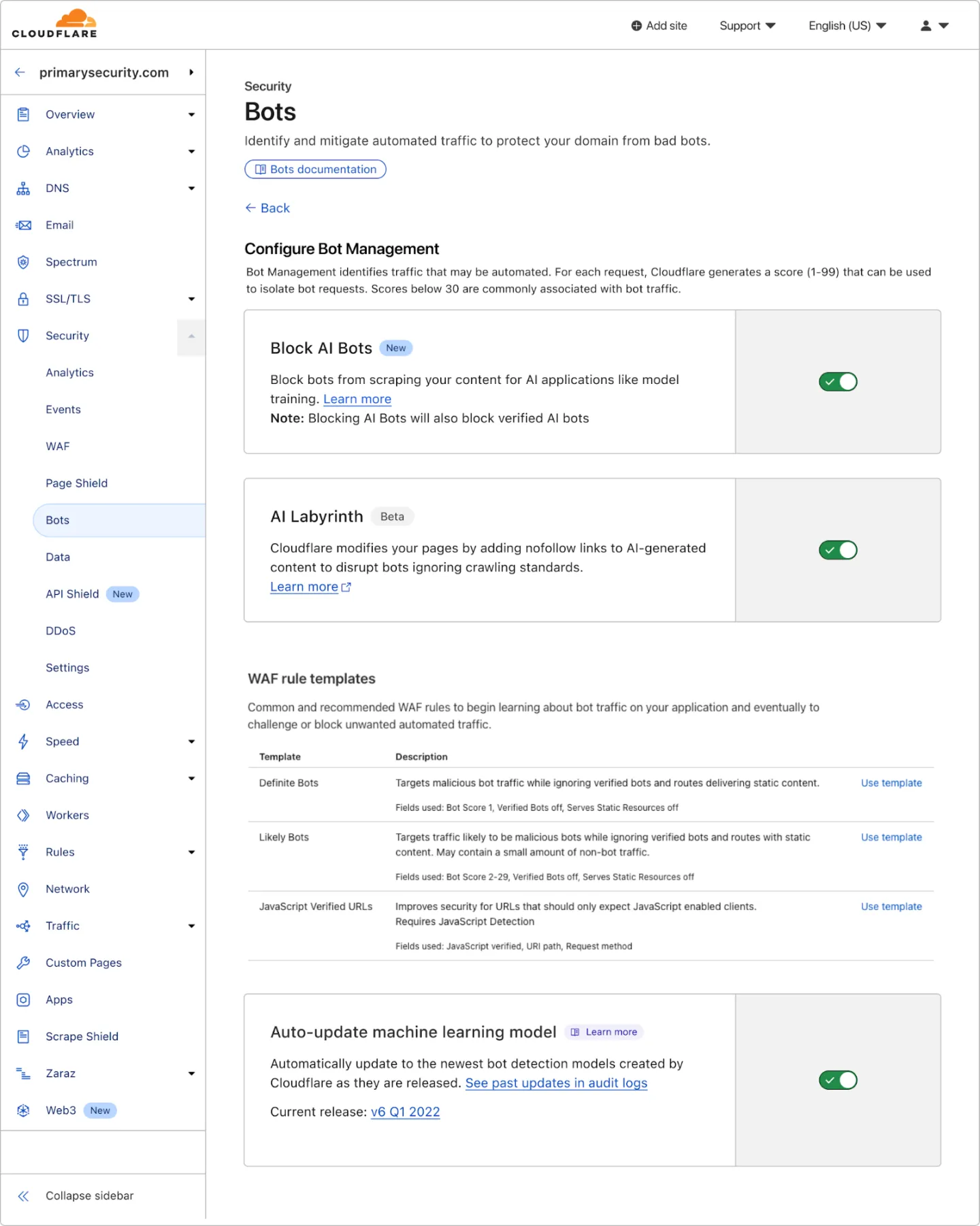
However, Prince emphasizes that this outage had no connection to the new AI-based tools. It was a process flaw, not a failure of the experimental technology.
Cloudflare Promises Structural Changes
To prevent such incidents from recurring, the company announced four key measures:
- Enhance the management of configuration files generated by Cloudflare, treating them as if they came from external users.
- Activate more global switches to quickly disable functionalities in the event of a malfunction.
- Limit the capacity of core dumps and system errors to exhaust resources.
- Review all failure modes of critical proxy modules.
A comprehensive technical response, but one that does not address the fundamental issue: the web increasingly relies on centralized infrastructures, and every vulnerability presents a systemic risk.
An Outage That Raises Broader Questions
This Cloudflare incident joins a troubling series affecting Microsoft, AWS, and other giants. As the web depends on a few central players, outages may become less frequent but significantly more impactful.
The modern Internet is not just a distributed network; it is an ecosystem where certain nodes have become vital. When one of them fails, a part of the connected world trembles.



