

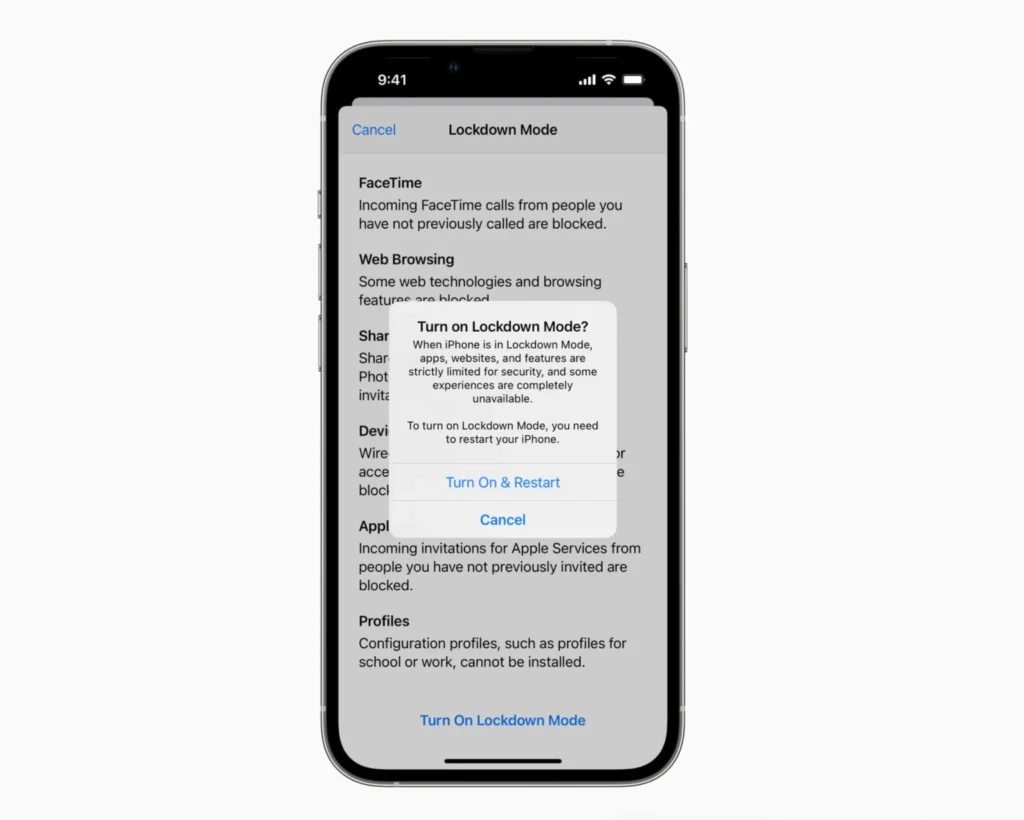
Zero Defeat: Apple’s Lockdown Mode Resists Even The Most Sophisticated Spyware
In a seemingly understated statement, Apple claims to have no known cases of a successful mercenary spyware attack against an Apple device using Lockdown Mode since its introduction in 2022.
If this assertion holds, it represents one of Apple’s most significant achievements in combatting high-end mobile surveillance.
A Feature Designed Not For The Masses, But For High-Risk Targets
Apple describes Lockdown Mode as protection for individuals who may be targeted by “extremely rare and highly sophisticated” attacks: journalists, activists, lawyers, political dissidents, public officials, or anyone exposed to surveillance tools sold by specialized firms.
The company further explains that this protection is based on a simple yet radical logic: drastically reducing the attack surface by disabling or limiting certain sensitive functions of the system.
In practical terms, this results in a deliberately restricted experience: certain attachments and link previews in Messages are blocked, advanced web technologies are limited, FaceTime calls or unexpected invitations are filtered, and wired connections to a computer are restricted when the device is locked. Apple itself documents this mode as an exceptional measure, not as a setting meant for everyday users.
Why This Assertion Matters
The importance of this announcement lies in the type of threat addressed. Mercenary spyware attacks—as termed by Apple—are not your run-of-the-mill malware. They involve tools sold to states or governmental clients, some capable of exploiting zero-click vulnerabilities, meaning no visible action is required from the victim.
Apple emphasizes that its threat notifications are specifically designed to alert individuals targeted by such attacks, which are significantly more complex than everyday cybercrime.
The most well-known precedent is Pegasus, associated with NSO Group. Amnesty International documented, as early as 2021, compromises of iPhones via iMessage through zero-click attacks, while Citizen Lab later documented new exploitation chains targeting iOS 15 and iOS 16 in 2022. In other words, the threat is neither theoretical nor outdated: it is very real, and Apple is developing Lockdown Mode specifically in response to this level of aggression.
What Apple Proves, And What It Does Not
It’s essential to be precise in interpretation. Apple does not claim that Lockdown Mode is mathematically impenetrable. It asserts that, to its knowledge, no successful attack has been observed against a device where the mode was activated. This distinction is crucial in the realm of security.
This caution does not diminish the significance of the message. If Lockdown Mode continues to withstand documented attacks, it suggests that the strategy of drastically reducing entry points is effective, at least against this specific category of threat.
A Targeted Victory, Not An Invisible Revolution For Everyone
For the average user, this announcement doesn’t change much in day-to-day life. Lockdown Mode is not a new, default security baseline for all iPhones. It is a consent-based mode that is highly restrictive and designed for a small number of people facing exceptional risks. Apple itself notes that this feature is only relevant if one believes they are targeted by a highly sophisticated cyberattack.
However, at a more strategic level, the message is powerful. It shows that Apple can effectively strengthen its platforms against the most advanced attacks when it is willing to sacrifice comfort and versatility. Perhaps that is the most intriguing aspect: not that everyone should enable Lockdown Mode, but that the philosophy behind it could inspire more transparent protections in the future.



