

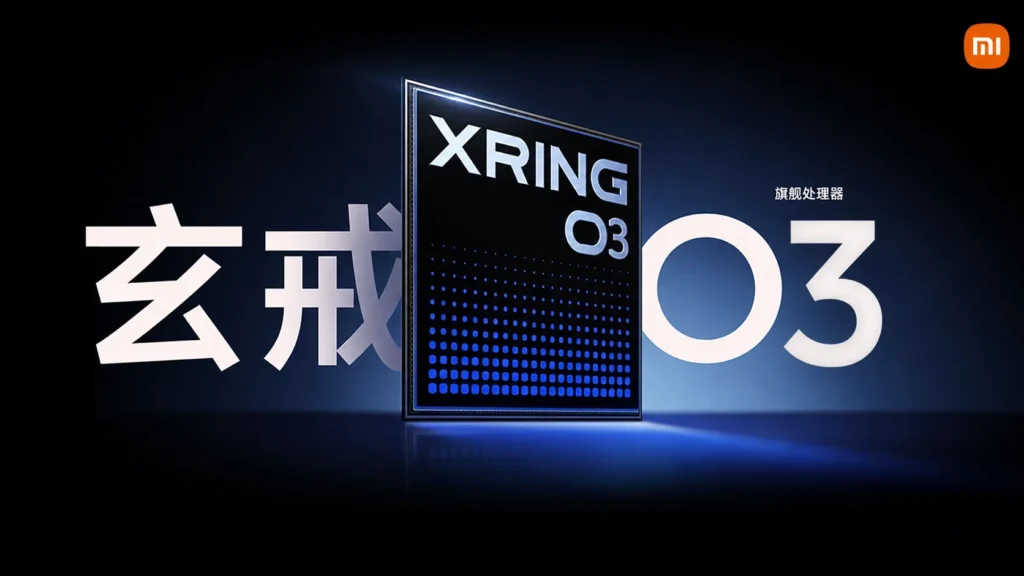
Xiaomi Xring O3 : une nouvelle puce pour un mystérieux smartphone Ultra
Xiaomi appears to be accelerating its technological independence strategy. Following the launch of its first smartphones featuring its own chips, the brand is reportedly working on a new generation called Xring O3, aimed at powering a future Ultra model that remains shrouded in mystery.
A New Push for Proprietary Chips
According to leaks from the leaker Yogesh Brar, Xiaomi is developing a new Ultra smartphone distinct from the Xiaomi 18 Ultra expected later this year.
This model could debut the new Xring O3 chip, representing a significant step in Xiaomi’s efforts to decrease its reliance on Qualcomm and MediaTek.
Xring O3: A Reimagined Architecture
The Xring O3 would signal a shift in technical philosophy. Unlike its predecessor, it will adopt a classic octa-core configuration that is optimized:
- 1 Prime core up to 4.05 GHz
- Several “Titanium” cores around 3.42 GHz
- Low-power cores up to 3.02 GHz
The GPU may also increase in power, with frequencies approaching 1.5 GHz, while memory will remain at 9600 MT/s. The goal is to enhance sustained performance, multitasking, and energy efficiency—key criteria for today’s premium smartphones.
Heard Xiaomi is working on an Ultra phone that will be powered by their in-house SoC (XRING O3)
Not sure how it will fit beside the Xiaomi 18 Ultra…
No global release planned
— Yogesh Brar (@heyitsyogesh) May 4, 2026
A Still Vague Positioning in the Ultra Range
The most intriguing aspect remains the positioning of this upcoming device. Several scenarios are being considered:
- An experimental model to test the Xring O3 chip
- An alternative to the Xiaomi 18 Ultra
- A product exclusive to the Chinese market
There are also rumors of a potential integration into a future foldable device, sometimes referred to as the Xiaomi 17 Fold.
A Strategy that Mirrors Apple… and Huawei
With this initiative, Xiaomi is following a path already taken by Apple and Huawei: controlling hardware and software, optimizing overall performance, and differentiating its products in the long run. However, the challenge is enormous: designing a competitive and high-performance chip against industry leaders is one of the most complex issues in the mobile sector.
Beyond performance, the Xring O3 represents a strategic issue: long-term cost reduction, independence from suppliers, and control over innovation.
In a tense geopolitical and industrial context, this approach has become almost essential for major players.
Xiaomi is Preparing its Most Ambitious Shift
With the Xring O3, Xiaomi is not merely looking to improve its smartphones. The brand is attempting to redefine its position in the technological value chain. If this chip meets expectations, it could represent a pivotal moment—not just for Xiaomi but for the overall balance of the mobile market.
Time will tell if this ambition translates into tangible performance… or if it remains, for now, a work in progress.



