

As AI applications, simulation, and real-time rendering gradually move from data centers to engineering offices, workstations are reclaiming their central role in digital value chains. Transitioning from specialized tools, these workstations are evolving into hybrid computing stations that sit between servers and client machines. This shift is prompting hardware manufacturers to rethink their designs to meet local workloads that increasingly resemble high-performance computing (HPC).
For the past two years, design teams, data scientists, and embedded AI engineers have been working to bring computational power closer to the field. Their reliance on remote clusters has extended validation cycles, slowed down iterations, and complicated operations. This evolution creates a new operational need for on-site machines capable of orchestrating massively parallel CPUs, multiple GPUs, high-performance local storage, and high-bandwidth memory. These advancements aim to accelerate workflows without the ongoing back-and-forth with central infrastructure.
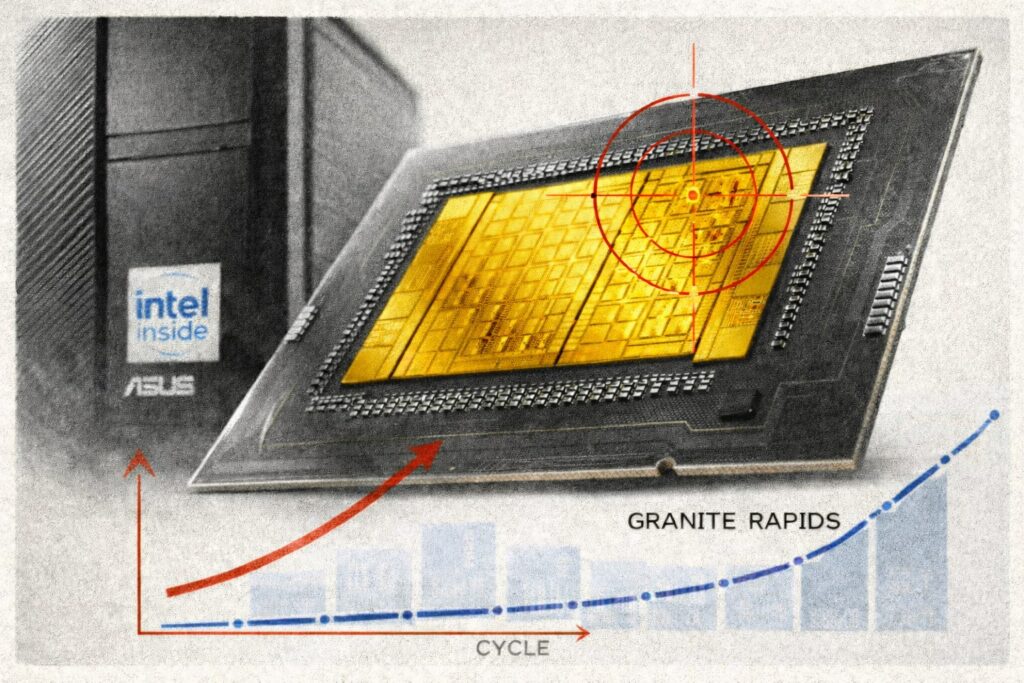
Intel is responding to this transformation with the Xeon 600 workstations, a variant of Granite Rapids paired with a W890 chipset. This strategic choice modernizes individual workstation architecture, borrowing from single-socket server designs to cater to the demands of engineering, technical creation, and AI development that require computational density, hardware scalability, and platform stability. This repositioning comes at a time when the market is heavily dominated by AMD’s extreme single-socket configurations.
### Multi-GPU Environments and Large Data Pipelines
Architecturally, the Xeon 600 lineup incorporates the core principles of Granite Rapids, offering up to 128 PCIe 5.0 lanes directly from the processor, eight DDR5 memory channels, and support for CXL 2.0 to prepare for the integration of memory extensions or external accelerators. This hardware foundation explicitly targets multi-GPU environments and large data pipelines, as input/output becomes a limiting factor when workloads involve both parallel computing and intensive local storage. For IT departments, this means the deployment of highly powerful workstations while maintaining compatibility with existing enterprise setups.
On the computational side, Intel is focusing on high core density, maxing out at 86 cores in the high-end models, combined with the widespread inclusion of AMX in each core. The FP16 extension of AMX directly enhances matrix operations, local inference, and software frameworks used in rendering or image processing, solidifying the CPU’s role in hybrid AI scenarios where processing tasks are shared between the CPU and GPU. This strategy aims to reduce exclusive reliance on accelerators for various AI workflows.
### Memory Speeds Reaching 8,000 MT/s
Memory serves as another crucial technical lever. This platform introduces support for MRDIMMs capable of reaching speeds of up to 8,000 MT/s through a multiplexing mechanism, in addition to traditional DDR5 RDIMMs. For simulation, large data analysis, or certain phases of AI preparation, memory bandwidth often becomes more critical than raw processor frequency. The Xeon 600 also boasts a maximum capacity of up to 4TB and a significantly expanded L3 cache to minimize disk access and stabilize performance under prolonged loads.
Beyond hardware, Intel emphasizes manageability as a decision-making criterion. The Xeon 600 series integrates vPro technology that includes remote management, security, and recovery features — such as out-of-band wipe and restore options. For IT departments, these mechanisms lower the operational costs associated with workstations that are often assigned to rare skill sets and certified software, as any downtime or compromise directly impacts production and project timelines.
Intel is also segmenting its offerings into two distinct usage categories: Core Ultra processors oriented towards interaction and advanced productivity, and Xeon 600 designed specifically for massively parallel, memory-intensive, and highly extensible workloads. This distinction repositions the Xeon workstation as a strategic asset in the information system, rather than as merely an oversized client terminal.
### Competing in the High-End Market
In a competitive landscape, AMD continues to set the standard for high-end single-socket workstations with its Threadripper Pro lineup, which features up to 96 cores, eight memory channels, and 128 PCIe 5.0 lanes. With the Xeon 600, Intel finally presents a platform that aligns with AMD in terms of input/output and scalability, although it remains slightly behind in maximum core count. Therefore, the choice among buyers may lean less on raw capability comparisons and more towards balancing computation, memory, software ecosystem, and enterprise usability.
Intel aims to differentiate itself through two key areas: memory innovation with MRDIMMs and enhanced bandwidth, as well as advancements in CPU-based AI capabilities via AMX FP16 and an optimized software stack for rendering, image processing, and certain inference tasks. AMD, for its part, retains advantages in core density and enjoys established adoption within creative and technical environments. Ultimately, purchasing decisions will focus on the reproducibility of real-world performance gains, platform stability from OEMs, and the total cost of ownership.
In the short term, Intel must demonstrate that its convergence of single-socket servers and workstations translates into measurable benefits for various professions. In the medium term, the challenge is structural: the closer integration of local AI development and Xeon production allows Intel to capture workflows right from the individual workstation before they transition to central infrastructure. This evolution gradually redefines the workstation’s place within enterprises, now envisioned as a true computational node within the information system.



