

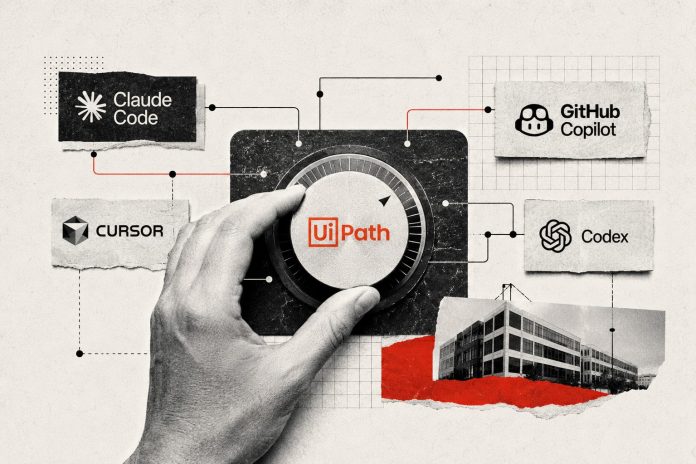
UiPath has unveiled Maestro Flow, an orchestration interface tailored for developers. This new platform seamlessly integrates with agents, regardless of their origin, and focuses on coordination, traceability, and production deployment. For simpler, shorter workflows that don’t require incident recovery or detailed audit trails, UiPath also offers Maestro Lite.
Maestro Flow builds upon UiPath’s existing Maestro engine, allowing developers to design, execute, monitor, and govern an entire process as a single entity using familiar environments like Visual Studio Code or UiPath Studio. The company claims that the prototype version can go live without the need for rewriting or platform changes. The workflow created with Maestro Flow coordinates agents, software robots, APIs, documents, and team members, marking a significant shift for UiPath from robotic process automation towards a broader control layer.
This announcement comes at a time when creating agents is no longer a bottleneck. Coding assistants can now generate what used to be a project in mere hours, leaving IT departments with a plethora of standalone agents that never integrate into a production process. The challenge has shifted to coordination, defining permissions for each agent, and tracking their actions. Various classes of vendors, including automation specialists like UiPath, application developers like Salesforce, cybersecurity firms, and observability providers, are now competing in this space, each approaching it from their own expertise.
Orchestration Becomes the Control Hub for Agents
Maestro Flow positions itself as an arbiter rather than a workshop. UiPath allows developers to use their preferred tools for coding agents and manages the subsequent responsibilities, including chaining, incident recovery, monitoring, and preserving execution traces. This division of labor recognizes a market reality: no vendor can impose its own coding workshop on development teams anymore.
This division of work is accompanied by a second promise: deploying processes as a single artifact from Visual Studio Code to production. A process constructed during testing transitions into a deployable artifact without reconfiguration or rewriting. This addresses a common blockage faced with validated pilots that fail to progress due to a lack of operational guarantees. However, this remains an engineering promise that cannot be verified until significant deployments are reported by users. “French companies do not have a problem creating AI agents; they have a problem with orchestration,” states Alexandra Syrovatski, UiPath’s Vice President for Southern Europe, in the launch announcement. There is no public data supporting this diagnosis, which reflects the vendor’s perspective alone.
Governance Focuses More on Traceability Than on Permissions
For UiPath, governance encompasses two distinct components that need clarification. The first pertains to execution traceability—understanding what each agent did, when, and with what result, and the ability to replay those actions. The second involves managing permissions, including what an agent can access, in whose name it acts, and how to revoke those permissions. UiPath elaborates extensively on the first aspect but remains vague on the second, which can be a sticking point for security committees.
This distinction is crucial for IT leaders, as a platform that records everything without governing permissions shifts the identity of agents to another layer, such as a directory service, access management system, or third-party control scheme. Readers comparing offerings from cybersecurity and automation will frequently find discrepancies in the scope of governance, illustrating how governance for agents in the software chain is determined by these differences.
The RPA Market is Evolving Around AI
UiPath has built its reputation on robotic process automation, a technique that mimics operator actions within existing applications. This market relied on stable procedures and the cost of traditional development—both of which have been undermined by language models. Today, agents can handle variable cases that robots struggled to process, prompting UiPath to respond gradually with solutions like Maestro Case for dynamic processes and now Maestro Flow for the control layer.
The transition from Maestro Case to Maestro Flow in just eighteen months indicates a constraint rather than a choice, as value shifts from executing a routine task, now commonplace, to coordinating heterogeneous actions. Competitors are also entering the fray from unusual angles—application vendors expose their own control plans, observability providers now maintain traces, and identity specialists govern rights. These players are now vying for the same territory, and we have previously detailed how these vendors compete over orchestration.
UiPath supports this shift with its own findings, revealing in a survey that 52% of leaders daily manage workflows that blend stable procedures with variable cases. This figure comes from an interested party, lacking published methodology to verify it. Recent alliances reflect the same trend, with a partnership with Deloitte addressing exceptions and workflows among enterprise resource planning software, a domain where conventional robots struggled. Maestro Lite complements the offering from the ground up, tailored for sequences that developers can write once and execute without specialized monitoring, a detail noted on the vendor’s website but absent from the French press release.
Competitors from identity and observability set the benchmark, and UiPath must address three critical questions before an IT director decides: what permissions Maestro Flow grants and revokes, what it retains as verifiable traces for auditors, and what it requires from an agent to accept it into a workflow. The answers will position the offering between execution orchestrator and comprehensive control plan—two concepts that the commercial vocabulary currently conflates.



