Why the Snapdragon 8 Elite Gen 6 Pro Will Cost Manufacturers a Fortune?
Recent leaks concerning Qualcomm’s upcoming chip generation provide a clearer picture of a two-tier strategy. On one side, there’s a standard Snapdragon 8 Elite Gen 6 aimed at “premium mainstream” flagships.
In contrast, a more aggressive Pro variant is designed for Ultra smartphones and technological showcases in 2027.
Snapdragon 8 Elite Gen 6: A Dual Version Range That Matters
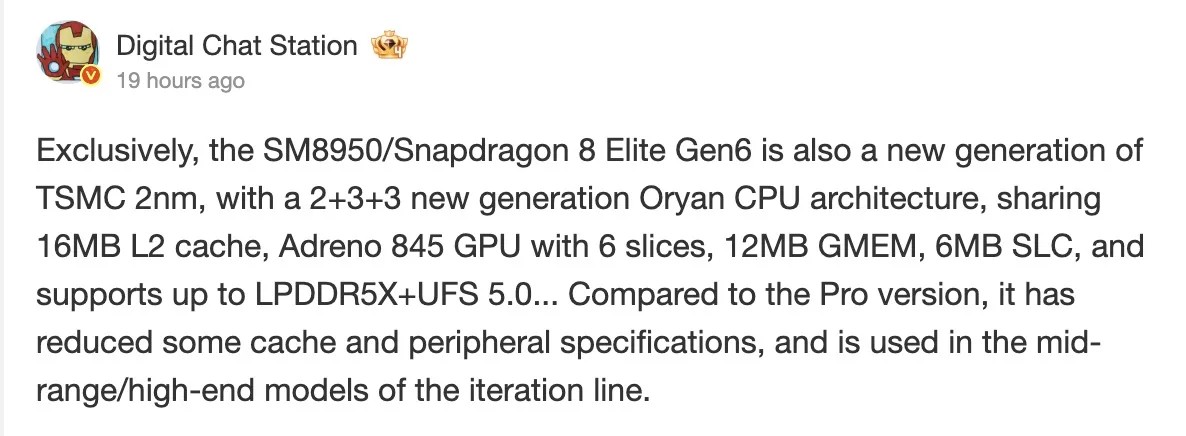
According to multiple reports from leaker Digital Chat Station, Qualcomm is indeed preparing two distinct variants: the Snapdragon 8 Elite Gen 6 with the identifier SM8950, and the Snapdragon 8 Elite Gen 6 Pro identified as SM8975.
Both chips would be manufactured by TSMC using a 2 nm process, but they will target different market segments.
The most intriguing aspect of the leak is that Qualcomm is not just launching a single successor but is clearly segmenting its high-end offerings: a balanced chip to widely disseminate its new architecture, and a Pro version to reserve the most significant performance gains for the most expensive models.
The Standard Snapdragon 8 Elite Gen 6 Aims for Balance
The standard Snapdragon 8 Elite Gen 6 will feature a new CPU configuration of 2+3+3 based on Oryon cores, along with 16 MB of shared L2 cache. On the graphics side, it will include an Adreno 845 with a six-slice architecture, 12 MB of GMEM, and 6 MB of system cache. It will also support LPDDR5X and UFS 5.0 storage.
On paper, this specifications list indicates a chip that is less about raw power and more about intelligent positioning. The implicit message is clear: Qualcomm aims to provide a very high level of performance without significantly increasing integration costs. This would make it a logical candidate for the “traditional” flagships of the upcoming cycle, which must remain premium without entering a pricing arms race.
The Snapdragon 8 Elite Gen 6 Pro Version Targets a Clearer Gap
In contrast, the Snapdragon 8 Elite Gen 6 Pro will maintain the same core CPU logic but will elevate several key components: Adreno 850 GPU, 18 MB of GMEM, 8 MB of LLC cache, and most importantly, support for LPDDR6 in addition to LPDDR5X according to some leaks.
This combination will position the Pro version as the chip for Ultra smartphones, where manufacturers seek to maximize gaming, integrated AI, and memory bandwidth.
In other words, the real difference will not only be in clock speeds but also in memory, cache, and graphical capabilities—precisely the areas that are increasingly important in demanding tasks: photo processing, computational video, advanced gaming, and local AI functions.
Very High Frequencies, Yet Possibly Less Spectacular CPU Gains
Another intriguing point concerns raw performance. Several reports suggest that frequencies may exceed 5 GHz on the Pro version, with some even indicating a theoretical upper limit. Meanwhile, other leaks imply that CPU gains could be below 20% compared to the previous generation.
This contrast is revealing. Qualcomm may not be pursuing a dramatic revolution on the CPU front but rather a more composite improvement: slightly more speed, better efficiency from the 2 nm process, and a more noticeable boost in GPU performance, memory, and AI usage.
That said, caution is warranted as these figures are derived from pre-launch rumors, making them highly fluid.
A Strategy Aligned With the Premium Market’s Evolution
This division between the standard and Pro versions also speaks volumes about the smartphone market in 2026-2027. Android flagships have become so closely matched in raw performance that it is now more beneficial for a chipmaker like Qualcomm to offer multiple premium tiers rather than a single chip intended for all.
The standard version would then serve to maintain a high level of access to the very high-end, while the Pro would become the chip for “showcase” models, justifying increasingly higher prices.
In this context, the standard Snapdragon 8 Elite Gen 6 should not be viewed as a budget version. Rather, it is a more rational chip intended for the core of the premium market. This may well be what makes it particularly interesting.
Qualcomm Appears to Be Preparing a Clearer Hierarchy
At this stage, the leaks suggest a lineup better organized than in the past. The Snapdragon 8 Elite Gen 6 standard would embody stability, efficiency, and broad deployment. Meanwhile, the Snapdragon 8 Elite Gen 6 Pro would aim to widen the gap on Ultra devices, featuring more cache, a more ambitious GPU, and LPDDR6 as a technological benchmark.
One major unknown remains: the actual cost for manufacturers associated with this upgrade in quality. As Qualcomm segments its upper catalog more finely, brands will have to balance technical prestige against the final product cost.
And it is often here, much more than in benchmarks, that the true impact of a new mobile chip is determined.