

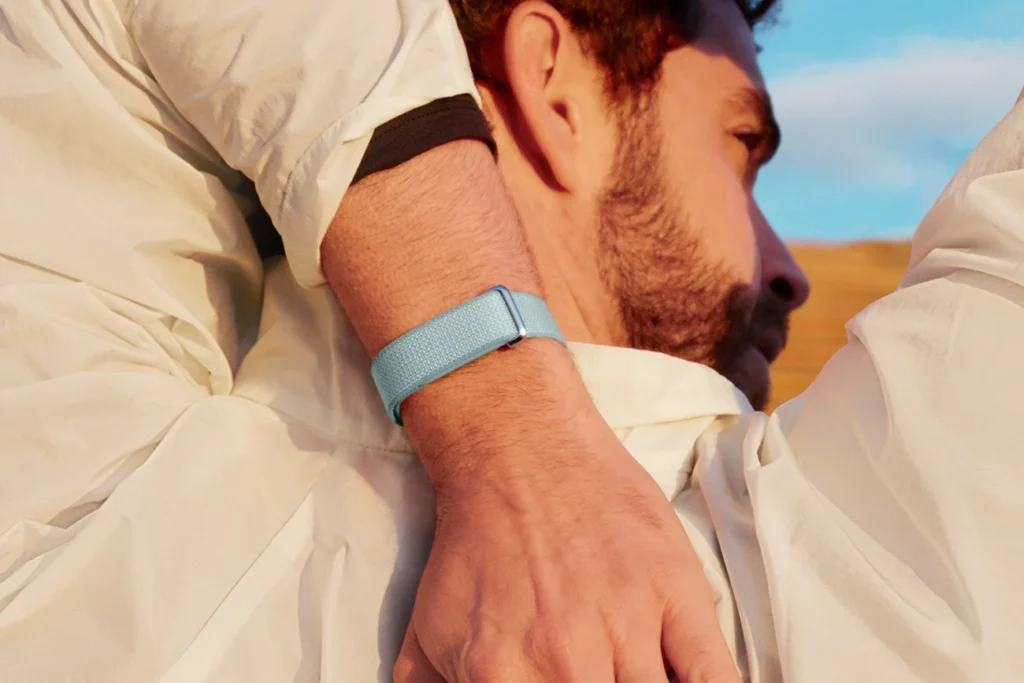
Why should you consider the Fitbit Air?
Google seems finally ready to seriously revive Fitbit. After several years of relatively quiet hardware introductions, the tech giant is preparing a product that significantly differs from its previous fitness trackers: the Fitbit Air.
This wearable is minimalist, lacking a screen, ultra-light, and primarily designed to integrate with the new Google Health platform and its AI coach powered by Gemini.
On paper, the concept may be surprising. In 2026, when all smartwatches aim to display more and more information, Google is doing the exact opposite. And this is likely what makes the Fitbit Air particularly intriguing.
A Connected Bracelet… Without a Screen
The first element that immediately distinguishes the Fitbit Air is its complete lack of a screen. Google is adopting a much more discreet and less intrusive approach compared to traditional smartwatches.
The idea is simple: wear a health tracker all the time without being overwhelmed by notifications, distractions, or the digital fatigue associated with omnipresent screens.
The Fitbit Air resembles more of a recovery bracelet or a lifestyle accessory than a conventional smartwatch. The entire experience revolves around the Google Health app on your smartphone, while the bracelet remains silent and nearly invisible on your wrist.
For many users, this return to simplicity could be the deciding factor.

A Serious Competitor to Whoop
It’s impossible to discuss the Fitbit Air without mentioning Whoop. For several years, the American brand has dominated the market for recovery-focused bracelets that lack screens. Google clearly aims to penetrate this market and is effectively responding directly to Whoop.
However, Google has several potential advantages:
- a much more accessible price
- deep integration with Android
- Gemini for intelligent analysis
- the power of the Google ecosystem
- compatibility with both Android and iPhone
The Fitbit Air is set to launch at a price of 99 euros, significantly more affordable than the annual subscription required by Whoop.
Comfort Is Clearly a Top Priority
Google places great emphasis on the product’s comfort. The Fitbit Air is designed to be worn 24/7, including during sleep. It features a sufficiently discreet design so that you may forget its presence on your wrist.
This aspect is far from trivial.

Many smartwatches tend to be bulky for sleeping, exercising, or simply getting through a whole workday. The Fitbit Air aims to tackle this issue with a compact format, ultra-light design, micro-adjustable strap, and minimalist approach.
Google even states that the bracelet was rated more comfortable than several major competitors during a study conducted in 2025.
Gemini Could Truly Transform the Experience
The Fitbit Air is not just a connected bracelet; it is primarily designed as a permanent sensor meant to feed into Google Health Coach, the new health assistant powered by Gemini.
And this is likely the most promising aspect of the product.

Unlike typical fitness apps that merely display statistics, Google aims to leverage AI to interpret the data and provide genuinely personalized recommendations.
The system will analyze your sleep, recovery, physical activity, heart rate, habits, schedule, movements, and even some medical data in compatible countries. The goal is to offer contextualized advice rather than just basic stats.
An Excellent Choice for Those Who Dislike Smartwatches
The Fitbit Air could appeal to a much broader audience than just athletes. Many people dislike wearing a smartwatch due to various factors: too bulky, overly conspicuous, distracting, inadequate battery life, and excessive notification overload.
The Fitbit Air addresses these criticisms directly.
It maintains essential features: heart rate monitoring, sleep tracking, recovery analysis, physical activity tracking, automatic workout detection, and advanced health monitoring—without the usual constraints associated with smartwatches.

Impressive Battery Life
The battery life could also become a significant selling point for the Fitbit Air. Google claims up to a week of usage on a single charge, along with fast charging that can provide a full day’s battery in just five minutes.
In a market where some watches require daily recharging, this feature remains incredibly important for continuous use.
Google Seems to Have Finally Found a True Identity for Fitbit

Since Google’s acquisition of Fitbit, many felt that the brand was gradually losing its identity. The Versa and Sense ranges were sidelined while the Pixel Watch adopted Fitbit’s most advanced functions.
The Fitbit Air could signify a strategic turning point.
Google appears to want to clearly differentiate: the Pixel Watches for the complete smartwatch experience, and the Fitbits for discreet, long-term health monitoring. This approach seems much more coherent.
Should You Consider It?
If you’re looking for a lightweight, discreet alternative focused on health rather than a feature-packed smartwatch, the Fitbit Air could emerge as one of the most intriguing wearables of 2026.
The product already checks many boxes: minimalist design; constant comfort; advanced health tracking; excellent battery life; integrated Gemini AI; relatively accessible price; compatibility with both Android and iPhone.
Of course, it remains to be seen if Google will deliver on the promised quality of AI coaching and the accuracy of analyses.
But one thing is certain: with the Fitbit Air, Google seems to finally offer something genuinely different in a wearables market that has become increasingly repetitive.



