

What is Microsoft Copilot? Everything you need to know about the AI assistant
Microsoft Copilot is the brand under which Microsoft consolidates all its artificial intelligence assistants, integrated into Windows, the Microsoft 365 suite, Edge, GitHub, and its professional tools.
Launched in late 2023 to succeed Cortana, Copilot underwent a significant transformation in 2026: it is no longer just an assistant answering questions but a platform of AI agents capable of executing end-to-end tasks. Another major change is that Copilot is not tied to a single model but now leverages models from OpenAI and Anthropic.
What is Microsoft Copilot?
The term “Copilot” actually encompasses an entire family of products, which can be confusing. The primary distinctions include:
- Public Copilot: the free assistant accessible on the web (copilot.microsoft.com), in the Windows app, on mobile devices, and in the Edge browser.
- Microsoft 365 Copilot: the professional version integrated into Word, Excel, PowerPoint, Outlook, and Teams, utilizing company data.
- GitHub Copilot: the programming assistant for developers.
- Copilot Studio: the platform enabling businesses to create their own AI agents.
- Security Copilot and Copilot in Azure: the variations for cybersecurity and cloud services.
The common thread connecting all these products is the transformation of generative AI into an integrated assistant for tools we already use daily, rather than a separate application.
The Major Shift of 2026: Copilot Becomes Multi-Model
During its first two years, Copilot was synonymous with GPT, the OpenAI models. One of the most significant changes in 2026 is that Copilot is no longer a single-model solution. Microsoft chose a “model-agnostic” strategy, meaning that it routes each request to the most suitable model.
Specifically, Microsoft has integrated Claude models from Anthropic alongside OpenAI models. This integration occurred gradually, initially in the Researcher agent and Copilot Studio, and later in the automatic model selection. It was further solidified through a broader partnership between Microsoft and Anthropic, making Claude available on Azure AI Foundry.
Microsoft is also developing its own models (Phi and MAI families) as a lightweight alternative to reduce its reliance on OpenAI. For users, this diversity means they can choose models in certain interfaces (for instance, a dropdown menu in Researcher or Copilot Studio), although it also introduces technical complexity behind the scenes.
Copilot Becomes Agentic: The AI That Acts
The other major transformation in 2026 is the shift from assistant to agent. Copilot is no longer just answering questions; it now plans, executes, and delivers complete tasks.
Copilot Cowork
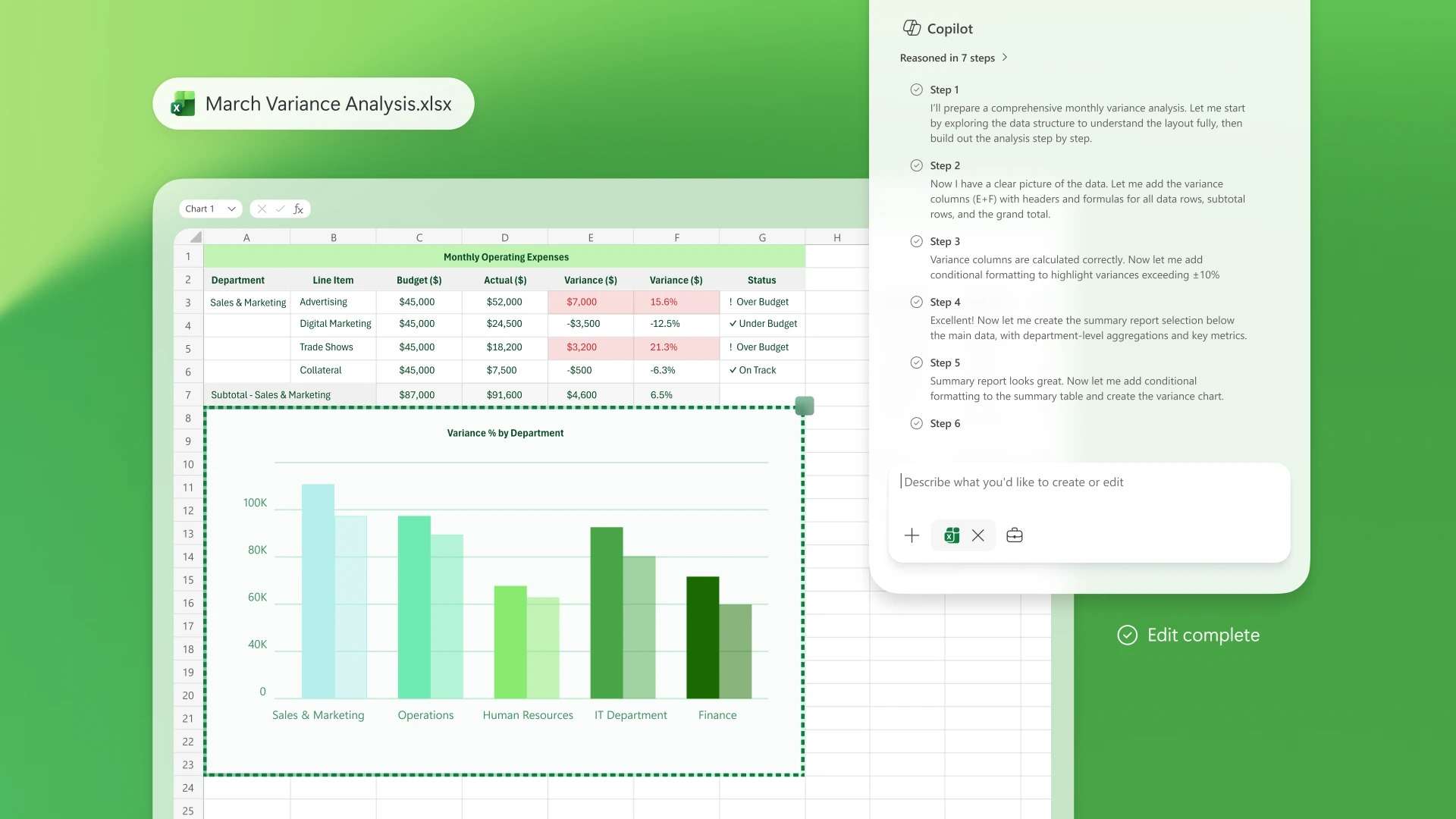
Copilot Cowork, unveiled in March 2026 as part of the “Wave 3” of Microsoft 365 Copilot, is the most notable example of this shift. It is an agent capable of breaking down a goal, establishing an action plan, executing steps, and displaying progress, with the user able to intervene at any moment.
Notably, Microsoft developed Cowork using Anthropic’s technology that powers Claude Cowork, adapting it for its cloud, enterprise security, and native integration with Microsoft 365.
Review: When Claude Edits GPT
Microsoft also introduced an original feature in the Researcher agent called Review. This principle is inspired by peer review: a GPT model generates a research response, and then a Claude model independently reviews it to verify its accuracy, completeness, and source quality before delivery.
This approach enhances reliability by not relying on a single model to produce and evaluate its own response.
Towards Autonomous Agents
Microsoft is exploring agents capable of acting in the background, autonomously and continuously. In Copilot Studio, “computer-using agents” (agents capable of controlling a browser or desktop application, even without an available API) are now generally available.
The stakes are high: giving AI more autonomy means granting it extended permissions without compromising data security— a crucial balance for enterprise adoption.
Microsoft 365 Copilot in Daily Life
In the office suite, Copilot integrates into all applications:
- Word: writing, summarizing, rephrasing, and rewriting documents.
- Excel: data analysis, formulas, pivot tables, and visualizations.
- PowerPoint: creation of presentations from text or documents.
- Outlook: sorting, summarizing, and writing emails.
- Teams: meeting summaries, notes, and follow-up actions.
- Copilot Chat: a secure chat for businesses, included at no extra cost for eligible Microsoft 365 accounts.
The strength of Microsoft 365 Copilot lies in its access to organizational data (emails, files, conversations), respecting existing permissions: Copilot can only access content that users are already authorized to view.
Notably, Anthropic is also pushing its Claude assistant directly into Word, Excel, and PowerPoint, and has opened a Microsoft 365 connector on all its plans. Therefore, Microsoft and Anthropic are both partners and competitors in the office space.
Copilot in Windows
Copilot is integrated into Windows 11 and serves as a key feature of the “Copilot+” PC range, which includes computers equipped with dedicated AI chips (NPU) capable of executing certain tasks locally. The assistant can answer questions, modify settings, summarize documents, and increasingly interact with what is displayed on the screen. Microsoft is progressively positioning Copilot as a cross-cutting AI layer within the operating system, rather than just a standalone application.
Copilot Studio and Agent 365 for Businesses
Copilot Studio is the platform allowing organizations to create, orchestrate, and govern their own AI agents, equipped with tools for security, oversight, and cost estimation. In 2026, it expanded to include agents capable of piloting applications, redefined workflows, and multi-model usage (OpenAI, Anthropic, or Azure catalog models).
Microsoft also introduced Agent 365, a unified control plan for managing AI agents at an organizational scale, integrated into a new high-end enterprise offering called E7 (which includes Microsoft 365 E5, Microsoft 365 Copilot, and Agent 365). This marks the first new tier of enterprise licensing in a decade.
Pricing and Access in 2026
The Copilot offering is deliberately segmented (the prices below are indicative, excluding promotions and based on region):
- Free Copilot: public access on the web, Windows, mobile, and Edge, with usage limits.
- Copilot Chat: secure chat included at no extra cost for eligible professional Microsoft 365 accounts.
- Microsoft 365 Copilot: approximately $30/user/month (annual commitment) for integrated features within the office suite. Promotions have been available for new commercial clients.
- GitHub Copilot: limited free offering, then Business (around $19/seat) and Enterprise (around $39/seat).
- Copilot Studio / Agent 365 / E7: for businesses, with agent billing linked to Azure consumption.
Note: “Copilot” refers to several products with different billing models. Agents are generally billed based on usage (Azure consumption), separately from standard functions. Please check Microsoft’s official page for up-to-date pricing in euros.
Limitations and Points of Caution
- Complexity of the Offer: the proliferation of “Copilot” options (public, M365, GitHub, Studio, Security) makes the offer difficult to navigate. Clearly identifying the product before subscribing is essential.
- Actual Adoption: despite the scale of the ecosystem, the adoption rate for paid Microsoft 365 Copilot remained modest in early 2026, explaining Microsoft’s push for more agentic functionalities.
- Agent Security: granting AI the ability to act independently raises issues of permissions and confidentiality, particularly in a business context.
- Hallucinations: like any system based on large language models, Copilot may produce inaccurate information; verification remains necessary.
- Variable Availability: some features (Cowork, advanced agents) are initially rolled out through the Frontier program or in specific markets before general release.
Copilot Against Its Competitors
- ChatGPT (OpenAI): Copilot partially relies on the same models but differentiates itself through native integration into Windows and Microsoft 365.
- Gemini (Google): the direct competitor in the office space, integrated into Google Workspace and Android.
- Claude (Anthropic): both a partner (its models power Copilot) and a competitor (Claude integrates directly into Microsoft 365).
The strength of Copilot lies in its unparalleled integration with the Microsoft ecosystem, utilized by hundreds of millions of professionals. Its primary weakness is a convoluted offering and a continued reliance on partner models.
FAQ: Everything You Want to Know About Microsoft Copilot
What is Microsoft Copilot?
Microsoft Copilot is the brand encompassing Microsoft’s AI assistants, integrated into Windows, Microsoft 365, Edge, GitHub, and professional tools. By 2026, Copilot has evolved into a platform of AI agents capable of executing tasks, leveraging models from OpenAI and Anthropic.
Is Microsoft Copilot Free?
A free public version exists (web, Windows, mobile, Edge), with limitations. The professional features integrated into the office suite require a Microsoft 365 Copilot license (approximately $30/user/month). A secure chat, Copilot Chat, is included at no extra cost for eligible Microsoft 365 accounts.
What AI Models Does Copilot Use?
Since 2026, Copilot is no longer a single-model solution. It utilizes models from OpenAI (GPT) and Anthropic (Claude), as well as Microsoft’s in-house models (Phi, MAI). In certain interfaces like Researcher or Copilot Studio, users can choose the model.
What is Copilot Cowork?
Copilot Cowork is an AI agent, unveiled in March 2026, capable of managing lengthy and structured tasks within Microsoft 365: it breaks down a goal, plans, executes, and displays progress. It was developed using Anthropic’s technology, tailored for cloud and enterprise security.
Can Copilot Act on Its Own?
Increasingly so. Microsoft is deploying agents capable of executing end-to-end tasks, even piloting applications (computer-using agents). These capabilities come with safeguards, as the autonomy of AI involves extensive permissions and security considerations.
What’s the Difference Between Copilot and ChatGPT?
ChatGPT (OpenAI) is a general-purpose autonomous assistant. Copilot partially relies on the same models but is distinguished by its native integration into Windows and Microsoft 365, and by its access to enterprise data while respecting permissions.
Conclusion
By 2026, Microsoft Copilot has transitioned from a simple assistant to a platform of AI agents, deeply integrated into Windows and Microsoft 365. The two major shifts—the transition to multi-models (OpenAI and Claude) and the emergence of agentic capabilities with Copilot Cowork—redefine what can be expected from a professional assistant. For organizations already embedded in the Microsoft ecosystem, Copilot serves as a key productivity lever; however, clarifying an increasingly confusing offering and convincing enterprises to embrace it remains crucial, as paid adoption is yet to be confirmed.



