

VisionOS 27: Siri AI, Curved Windows, and New Immersive Experiences for Vision Pro
Apple continues its vision of spatial computing. During WWDC 2026, the Cupertino company unveiled VisionOS 27, a major update that brings the Vision Pro closer to becoming a true computer of the future.
Beyond the highly anticipated arrival of Siri AI and new Apple Intelligence features, VisionOS 27 introduces several advancements specifically designed for mixed reality: curved windows, immersive panoramas, interactive notifications, and enhanced network performance.
While the iPhone and Mac took center stage, this new version of VisionOS demonstrates that Apple is still heavily investing in its spatial ecosystem, despite a quieter commercial rollout than anticipated.
Siri AI Finally Arrives on Vision Pro
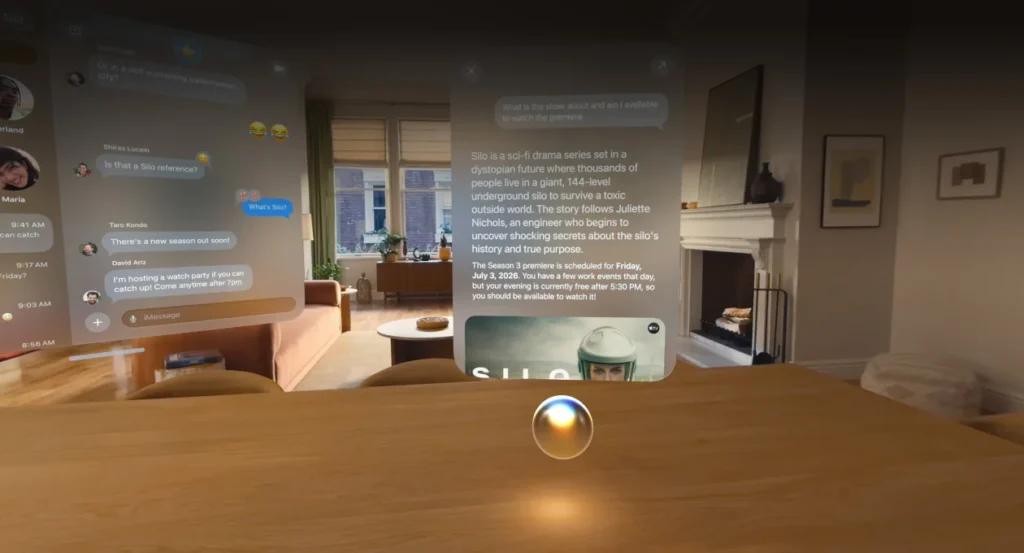
The main highlight of VisionOS 27 is undoubtedly the integration of Siri AI, the next generation of Apple’s intelligent assistant. Unlike the previous Siri, this version aims to be more conversational, contextual, and capable of understanding the user’s surroundings.
With Visual Intelligence, Vision Pro owners will be able to query Siri about nearly everything in their physical or digital environment. The assistant will be able to analyze real objects, understand content displayed in applications, and respond to questions related to what the user observes directly in their field of vision.

Apple promises a more natural experience, where artificial intelligence becomes a true contextual companion rather than just a voice assistant.
Notably, Siri AI will be available upon launch in the European Union on VisionOS, unlike the iPhone and iPad versions, which will still face some regulatory restrictions.
Panoramas Become True Immersive Environments
Apple is also leveraging the visual capabilities of Vision Pro more effectively. With VisionOS 27, user-captured panoramic photos can now be transformed into complete immersive scenes. Images are no longer just simple memories displayed on a virtual screen; they become spaces in which the user can literally immerse themselves.
This evolution aligns with Apple’s strategy to transform personal content into spatial experiences capable of enhancing emotional attachment to the platform.
Curved Windows to Better Utilize Virtual Space
Apple also introduces one of the most intriguing features of this update: curved windows. Inspired by the ultra-wide curved monitors used in professional environments, these new interfaces allow for a visual approach that brings the edges of content closer to the user without diminishing the display area.
The goal is straightforward: improve visual comfort while enhancing the sense of immersion. The first compatible applications will include Safari, Freeform, and Apple TV Multiview.
This feature perfectly illustrates one of the unique advantages of spatial computing: completely breaking free from the physical constraints posed by traditional screens.
A Redesigned Control Center
VisionOS 27 also brings a redesign of the Control Center. Apple now adopts a structure divided into three distinct areas:
- Notifications and media playback
- Main system controls
- Immersive environments
This new organization aims to simplify access to essential functions while minimizing unnecessary interactions in a three-dimensional space.

Notifications Become Interactive Through Gaze
One of the most natural features of VisionOS 27 concerns notifications. Now, when an alert appears in the virtual environment, simply looking at it will automatically enlarge it.
This gaze-based interaction fits into Apple’s philosophy of reducing gestures and making interfaces more intuitive.
In the future, this type of interaction could become a central element of navigation in upcoming mixed reality devices.

Significant Network Performance Improvements
Apple also announces a major improvement in connectivity. Vision Pro will now be able to connect to Wi-Fi networks up to three times faster, according to the company.
While Apple hasn’t detailed the technical optimizations behind this promise, this improvement could benefit spatial streaming experiences, collaborative applications, and large immersive content.
Increased Customization with New Widgets
Spatial widgets are also gaining flexibility. Apple introduces a new “extra-small” format that allows for more elements to be added to the virtual space without cluttering the environment.
Since VisionOS 26, widgets can remain anchored in specific places in the real world. This new size should encourage more customization scenarios, particularly in virtual workspaces.
An Update That Confirms Apple’s Long-Term Strategy
Unlike spectacular updates aimed at immediate impressions, VisionOS 27 appears more like a maturation step. Apple is progressively improving the user experience, refining spatial interactions, and adding the technological building blocks necessary for a deep integration of artificial intelligence.
The arrival of Siri AI, curved windows, and immersive environments indicate that the company does not view Vision Pro as merely a mixed reality headset, but as a new computing platform intended to evolve over the next decade.
While the mixed reality market remains nascent, VisionOS 27 illustrates one thing: Apple continues to patiently build the foundations of its future spatial ecosystem.



