

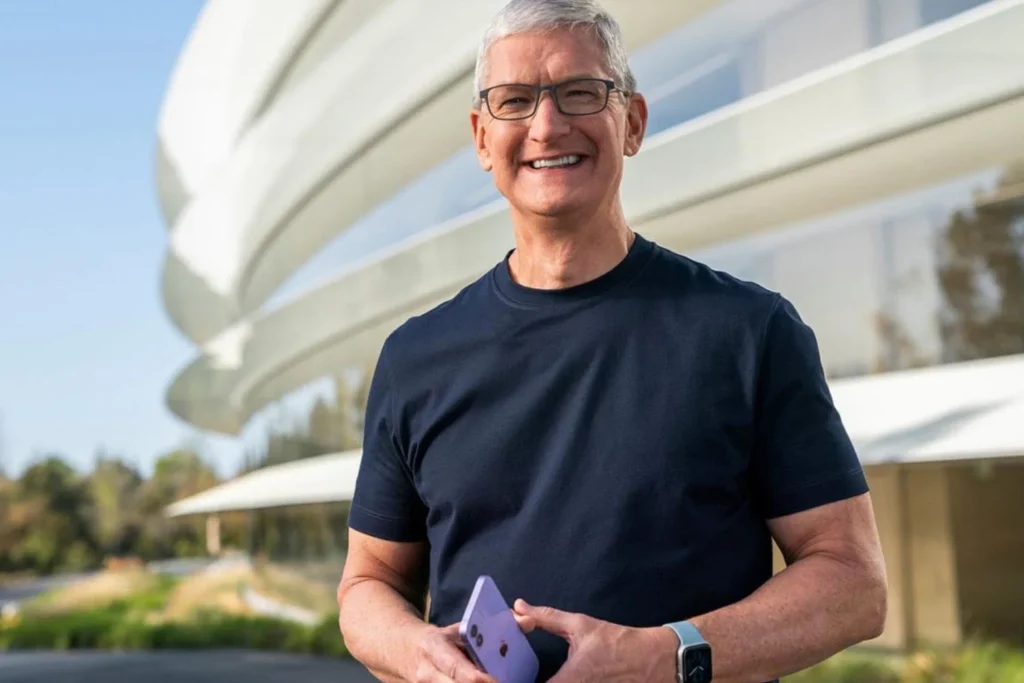
Tim Cook remains at Apple, but leadership transition reveals the group’s vulnerabilities
Apple is entering one of the most sensitive transition periods of the Tim Cook era. In recent months, several high-level changes have fueled speculation about the stability of the company’s leadership. However, Tim Cook put an end to retirement rumors during an interview with Good Morning America: he denied plans for retirement and reaffirmed his commitment to Apple.
This clarification comes at a pivotal moment. Apple is preparing to celebrate its 50th anniversary on April 1, 2026, while also managing a succession of executive departures, major challenges regarding AI, and an especially busy product roadmap ahead.
Tim Cook Addresses Retirement Rumors
In response to speculation, Tim Cook chose to speak out publicly. When questioned on American television, he explained that he had never announced any imminent departure and that he feels a deep passion for his work at Apple.
This is significant because, in a company like Apple, silence can quickly become a source of uncertainty. By taking the initiative to speak, Tim Cook not only reassured his position but also aimed to stabilize the narrative surrounding Apple at a time when the company appears to be entering a more precarious phase in its recent history.
Indeed, Apple is undergoing a Leadership Restructuring
The rumors didn’t arise out of thin air. Apple has indeed gone through several departures and high-level reorganizations. John Giannandrea, a central figure in AI and machine learning strategy, officially left his position at the end of 2025, ahead of a retirement planned for spring 2026, with Amar Subramanya appointed to oversee AI.
Kate Adams, the legal chief, did not leave Apple immediately, but her departure has been announced, with Jennifer Newstead set to succeed her in 2026.
As for Alan Dye, the interface design head, multiple sources have reported his departure from Apple to join Meta at the end of 2025.
In other words, there has indeed been a sequence of changes at the top. However, it’s important to clarify: referring to a vague wave of departures “in just a few weeks” without specifics can exaggerate the actual timing of these movements, which have unfolded across several distinct announcements and transitions.
Johny Srouji’s Case Highlights the Importance of Certain Positions
The most sensitive rumor likely revolved around Johny Srouji, head of Apple’s chip design. His retention is far from trivial; he is one of the key architects of Apple’s technological advantage in silicon. After speculations about a potential departure, Srouji internally assured that he does not plan to leave the company anytime soon.
This could be one of the most reassuring points for Apple. While the company may have flexibility regarding certain positions, it has significantly less on profiles that directly shape its hardware platforms and proprietary chips. This analysis aligns with the strategic role Srouji plays in the development of Apple Silicon.
Apple’s Real Weakness Lies in Artificial Intelligence
If there is an area where Apple appears to be genuinely struggling, it is in AI. Apple officially acknowledged back in March 2025 that some promised enhancements for Siri had been delayed until 2026.
Since then, Apple has also reorganized its AI leadership, with Giannandrea’s replacement and a clear intent to regain control over a subject where the company has fallen behind compared to OpenAI, Google, or Anthropic.
Another notable evolution: Google and Apple announced a multiyear collaboration in January 2026, whereby the next generation of Apple Foundation Models will rely on Google’s Gemini models and cloud infrastructure. This partnership aims to contribute to future Apple Intelligence features, including a more personalized Siri.
This is a significant shift. Apple has historically built its ecosystem on a very vertical mastery. Relying on Google for part of its AI foundation highlights how critical this issue has become—and how Apple no longer believes it can do everything alone, at least in the short term. This interpretation stems from the officially announced partnership.
What’s Truly at Stake for Apple in 2026
The issue is not merely when Tim Cook will leave the company. The real challenge is whether Apple can navigate this pivotal period without losing its strategic coherence.
The company is entering a year in which several breakthrough or semi-breakthrough products are expected, such as the first foldable iPhone, potential AI glasses, and a new wave of MacBook Pros. However, these products remain, for now, in the realm of rumors and market anticipations, not official Apple announcements.
Nonetheless, what is certain is that Apple will celebrate its 50th anniversary in a context of increasing pressure: unfinished AI transition, unstable market, more aggressive competition, and visible internal reshuffling.
Ultimately, Tim Cook has not only refuted rumors; he has also reminded everyone that Apple still aims to present itself as a cohesive, driven company fully in control of its trajectory. The question now is less about his personal timeline and more about how quickly Apple can realign its narrative of innovation with its ambitions.



