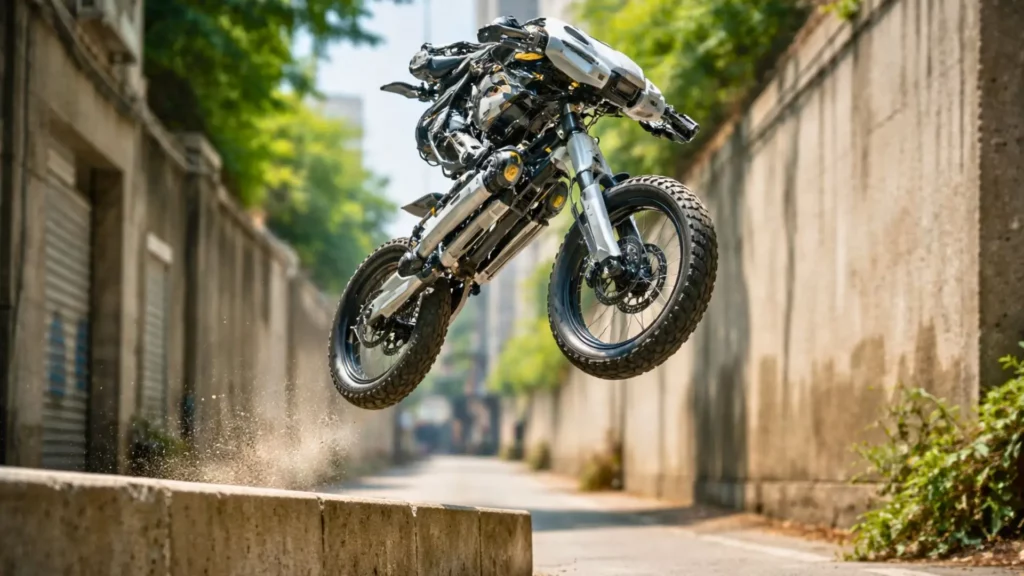
Researchers at the Robotics and AI Institute in the United States have unveiled UMV, a bike-robot capable of moving quickly, jumping high, and balancing on one wheel. Beyond this spectacular demonstration lies a serious concept for robotic mobility in challenging terrains.
With 23.5 Kilograms and Two Wheels, UMV Excels Where Many Fail: Going Fast Without Sacrificing Agility
UMV is not your typical autonomous bike. The prototype combines a lightweight frame with a mobile upper block connected through articulated kinematics. This design allows for real-time adjustments of the center of mass, enabling the execution of stunts rarely seen on wheels.
In the trials published by the team, the robot can stand on the spot, ride on its rear wheel, and overcome obstacles. Notably, its mechanics rely on only five motorized degrees, significantly fewer than many robots capable of similar acrobatics.
Trained First in Simulation, the Robot Transitions to Reality Seamlessly, Changing the Design Approach
The most striking aspect isn’t always visible on screen. Researchers initially trained UMV in simulation using reinforcement learning. They then transferred this control to the real machine without final adjustments, a feat that is still challenging to achieve.
This method reduces testing time and minimizes lengthy correction campaigns on the prototype. In mobile robotics, this efficiency matters, expediting development while allowing for risky maneuvers in a significantly safer digital environment.
The performance metrics provide a concrete illustration. UMV can reach speeds of 8 meters per second, equivalent to 28.8 km/h, and can jump up to a meter high. In other words, this small 23.5-kilogram robot already competes with far more complex systems on certain obstacles.
Why This Robot Bike Captivates Logistics, Dense Cities, and Narrow Paths Avoided by Other Machines
On the ground, the interest goes beyond mere spectacle. A two-wheeled robot occupies little space and remains efficient over long distances. Additionally, its ability to jump or recover quickly allows it to navigate curbs, tight passages, and uneven terrains without requiring massive architecture.
The authors already cite several potential applications. While urban delivery comes to mind first, the concept also targets transport in rugged terrains and access to areas too narrow for larger or heavier vehicles.
Underlying the Concept, UMV Revives an Old Question: What If Two Wheels Were Enough to Explore Almost Everywhere?
For years, mobile robots have been torn between fast wheels and agile legs. UMV seeks an alternative path. It retains the efficiency of a bike while introducing dynamic body control to overcome obstacles that traditional platforms still avoid.
This is not yet a product ready for city streets. However, the demonstrator suggests that acrobatic mobility can emerge from a simple architecture, provided the control mechanisms are in place. This is a clear and significant message for both laboratories and industry.
The next step is to transition from demonstrations to repeated missions outdoors under real constraints. That’s where the crucial test lies. If UMV proves its robustness, terrain exploration and certain mobile services could see major advancements sooner than anticipated.