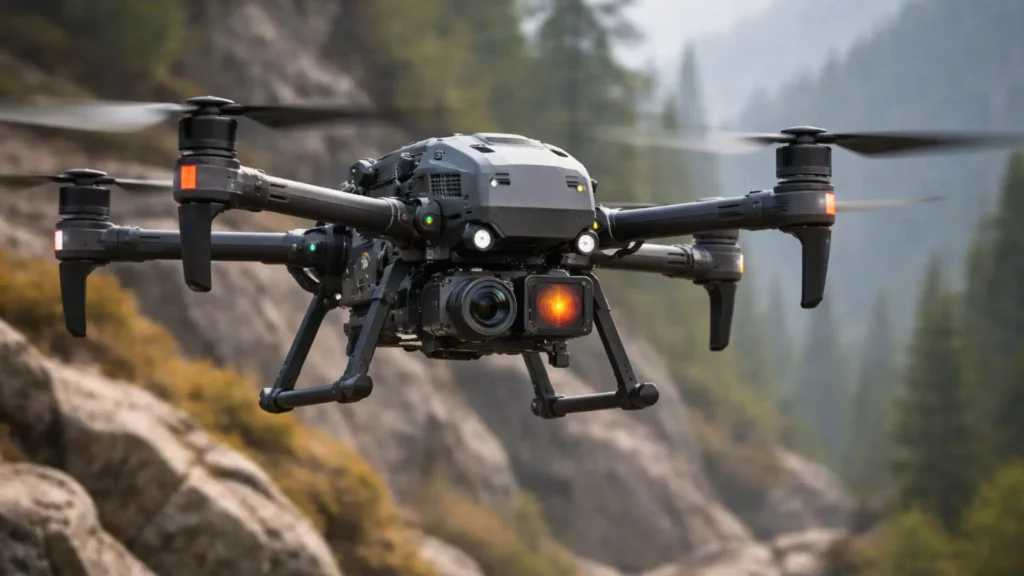
Locating a lost person before hypothermia, dehydration, or exhaustion sets in makes all the difference. In 2026, American researchers introduced a drone capable of cross-referencing multiple signals to alert rescue teams more quickly. Their promise is simple: to gain critical minutes.
In difficult areas, this autonomous drone scans the terrain faster and reduces the element of chance
In search and rescue operations, critical time primarily affects the human body. Cold, heat, fatigue, or injury quickly diminish chances of survival. Teams navigate steep slopes, dense forests, or poorly mapped areas. Each detour becomes costly.
This is where autonomous flight changes the game. The drone developed at Kennesaw State follows a precise grid pattern and transmits live images back to the ground. However, without automatic sorting, operators still have to analyze large volumes of images and sequences.
Thermal, infrared, color: the fusion of sensors reveals a silhouette and begins to assess its condition
The system relies on more than a single image. It combines sensor fusion and real-time comparison. Thermal cameras, infrared, and color cameras work together, enhancing the algorithm’s ability to detect human presence and reduce false alerts.
Furthermore, the AI does not merely search for a silhouette. It assesses the body’s posture, distinguishing between a standing person and a prone body. It then isolates the head, specifically targeting the forehead, which is useful for estimating forehead temperature.
From there, the tool attempts to gauge vital signs indirectly. It estimates whether the individual remains conscious and signals any abnormal temperatures indicative of heatstroke, severe hypothermia, or a critical situation.
Field trials are reassuring, but the tool remains experimental and faces several challenges hindering its advancement
The initial trials were not limited to laboratory demonstrations. Volunteers traversed various environments, and the drone provided consistent measurements from the surface of their heads. For rescue teams, these field tests validate the concept’s potential.
Nevertheless, not every issue has been resolved. Researchers are still seeking sustainable autonomy and lighter sensors. Rain, deep nighttime conditions, or dense foliage complicate observation. Additionally, every enhancement must remain deployable on a compact device.
Detection of cries, miniaturization, coordinated flights: the next step aims for much broader searches
The next phase of the program focuses on sound detection. The team is developing AI-assisted sound detection to recognize distress calls. This would be crucial in wooded areas or behind terrain features. Furthermore, smaller sensors could free up useful weight.
The other, more ambitious project involves coordinated swarming. Multiple drones could autonomously cover a vast area, sharing detections and adjusting their trajectories accordingly. Teams would then receive a clearer map with fewer duplicates and blind spots.
Ultimately, the promise is not to replace rescuers but to provide them with quicker sorting. Knowing where to search, who is on the ground, and what risks dominate allows for prompt engagement of necessary resources.