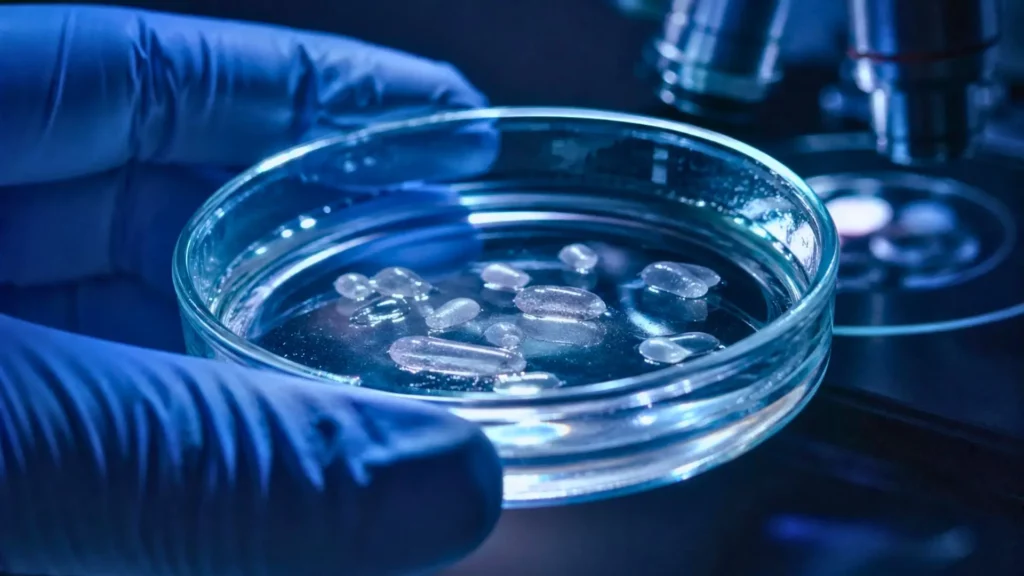
A cluster of cells has just learned a new dance. Biologists from Tufts and the Wyss Institute have integrated neurons into biological robots derived from frogs. The outcome is not an animal but a living model to understand how tissues coordinate their movements.
Cells from frogs Become Living Robots Without Motors, Metal, or Traditional Batteries
2020 marked the public debut of xenobots, created from embryonic cells of Xenopus laevis. These biological robots swim using cilia, tiny hair-like projections that beat like oars. Therefore, movement comes from the tissue itself.
9 to 10 days of survival is sufficient for these structures to demonstrate a rare property in robotics: their energy comes from the embryo’s reserves, not from a battery. The boundary shifts immediately. The robot becomes a temporary living body, more akin to an organoid, a cluster of cultured tissue, than a miniature drone.
Neurons Added to the Biobot Center Change the Trajectory of Movement
February 20, 2026, the journal Advanced Science publishes a study conducted by biologist Michael Levin and researcher Haleh Fotowat. Their team introduces neuronal precursors, cells destined to become neurons, into the center of the biobot during its formation. The window lasts about 30 minutes.
24 hours later, the sphere has healed around the implant. The neurons then form axons and dendrites, branches that send and receive signals. At the cellular level, the outcome resembles wiring installed in a house that has already been built.
Visible Nerve Signals Prove That a Body Without a Brain Can Coordinate Multiple Movements
Calcium imaging reveals electrical activity in the neurobots. This method makes visible the fluctuations in calcium, a signal used by neurons when they communicate. For researchers, the green or red light acts like a indicator light on a dashboard.
Two behaviors particularly distinguish neurobots from traditional biobots. The former are less stationary and produce more repeated patterns instead of just simple circles or straight lines. The neuron does not operate like a driver but modifies how the body organizes itself.
Pentylenetetrazole, an experimental drug that stimulates nerve activity, also alters their movements. Biobots without neurons tend to slow down. Neurobots, on the other hand, sometimes react with greater complexity, confirming the influence of the nervous network on movement.
A Pathway for Regenerative Medicine Emerges, but No Neurobot Yet Treats a Patient
Thousands of genes change activity when neurons are introduced into the biobot. Several pertain to the nervous system, which was expected. Others relate to vision, despite the absence of an eye. The possibility remains open: a cell may prepare for a function before the complete organ develops.
Officials from Tufts and the Wyss Institute emphasize fundamental biology. Neurobots are not ready for medical applications in patients. Their immediate interest lies in observing how cells negotiate a form, similar to workers constructing without an architect.
Regenerative medicine, which aims to repair damaged tissues, can benefit from these rules of self-organization. No clinical use has yet arisen from this experiment. For now, the solid fact resides in a culture dish: neurons have modified a body without a brain.