

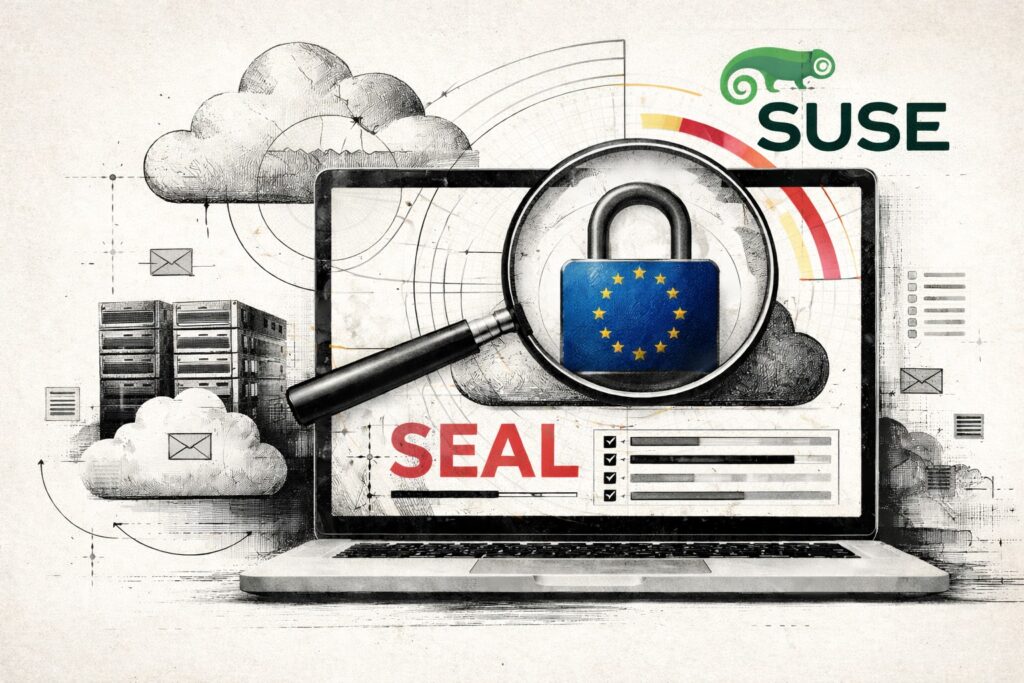
SUSE Unveils Cloud Sovereignty Self-Assessment Tool to Measure Compliance with EU Regulations
SUSE is launching a new self-assessment tool aimed at transforming abstract regulatory requirements into measurable operational indicators. Leveraging the European Cloud Sovereignty Framework 2025, organizations can now obtain a SEAL score, gap analysis, and a technical roadmap in under twenty minutes. This development comes as sovereignty increasingly becomes a key criterion for accessing public markets and handling sensitive data.
The new web-based, self-service tool allows private enterprises and public administrations to evaluate their cloud sovereignty level according to the 2025 EU framework. Marketed as a first-of-its-kind solution, this automated self-assessment replaces lengthy and costly manual processes with diagnostics that IT teams can easily employ.
Recent analysis from Forrester indicates that digital sovereignty and AI are driving a resurgence in private cloud solutions, with an expected annual growth rate poised to double by 2026. Concurrently, the rollout of the European framework places a significant compliance burden on organizations. Those unable to demonstrate their digital sovereignty risk losing contracts, especially within the public sector and regulated environments.
A SEAL Score to Define Sovereignty
At the core of this tool is SUSE’s Cloud Sovereignty Framework, represented by the SEAL score (Sovereignty Effective Assurance Levels). This tool classifies organizations on a scale from SEAL-0 to SEAL-4 based on eight objectives delineated by the EU framework. The dual purpose of this classification is to establish a common language among technical teams, business leaders, and public buyers, while also allowing for comparisons that were previously difficult—such as when a tender requires a SEAL-3 level but the current infrastructure only meets a SEAL-1.
This structured assessment replaces a declarative approach with a comprehensive evaluation. Users answer a series of questions covering various areas, including cloud architecture, data governance, supply chain management, and operational autonomy. The tool outputs an overall score, detailed breakdowns by objective, and a gap analysis, all available for download in PDF format in less than twenty minutes.
Risk Weighting Focused on the Supply Chain
SUSE’s tool goes beyond generic diagnostics by incorporating a weighted risk analysis that prioritizes vulnerabilities based on their actual impact. The supply chain accounts for twenty percent of the evaluation, while operational autonomy is weighted at fifteen percent. This prioritization reflects the on-the-ground realities that supplier dependencies—whether concerning infrastructure, software, or managed services—are major blind spots in digital sovereignty today.
This approach enables CIOs and CISOs to pinpoint where to focus their efforts, whether to mitigate dependency on a particular hyperscaler, strengthen their control over orchestration layers, or renegotiate support contracts. Andreas Prins, Head of Global Sovereign Solutions at SUSE, describes the challenge as a “black box” effect in digital sovereignty, highlighting the persistent gap between regulatory requirements and what technical architectures can realistically control.
Local Privacy with No Central Data Collection
On a technical level, SUSE has opted for a system that does not involve collecting results on a central server. Unlike traditional SaaS tools, the data from the self-assessment is stored exclusively in the user’s browser. This design addresses the needs of organizations handling sensitive information, which often hesitate to outsource such diagnostics for fear of data breaches or indirect data exploitation.
This “local-first” approach sends a strong message to regulated sectors. It meets the constraints faced by public administrations, higher education institutions, or critical infrastructure operators, for whom even a basic sovereignty audit could expose strategic insights about their architecture or governance.
From Assessment to Roadmap
Beyond simply providing a score, the tool generates a roadmap for improvement, offering technical recommendations aligned with SUSE solutions and its European partner ecosystem. This continuity ensures immediate operational relevance for existing clients but inherently introduces a supplier bias; the recommended trajectory is framed by SUSE’s offerings, limiting the exercise to “tool-based” sovereignty rather than offering a fully agnostic evaluation independent of the existing technology stacks.
This focus creates structural constraints. By centering the recommendations around its own components and partner ecosystem, SUSE narrows the scope of possible remediation scenarios. Moreover, the company’s offering does not encompass all necessary layers for complete sovereignty, especially in certain areas of infrastructure, managed services, or cross-governance. For enterprises, locating the SEAL score can be a useful entry point, but correcting the trajectory will often require additional suppliers to address all technical and operational dependencies.
For SUSE, this initiative represents more than just the launch of a new tool—it signals a market evolution where sovereignty becomes a measurable, comparable, and contractually enforceable criterion. The company aims to play a pivotal role in this shift, relying on its reputation in open source and a strong local presence. As European frameworks continue to crystallize, such instruments could very well become prerequisites in procurement processes alongside traditional security certifications. For digital leaders in enterprises, the stakes extend beyond mere compliance; they touch on the ability to manage technological dependencies, preempt regulatory demands, and secure access to public markets and critical data.



