

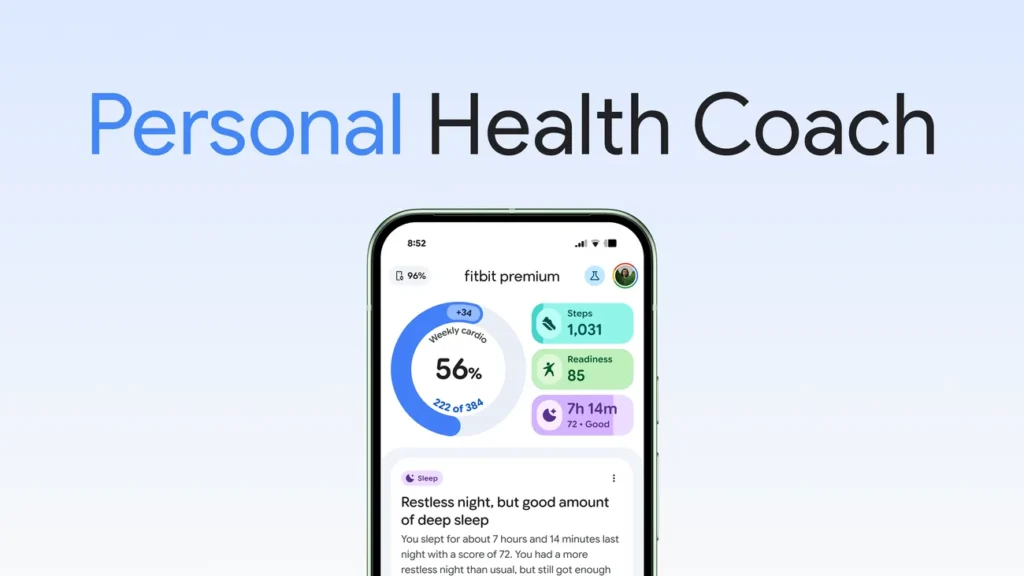
Stress, cycle, nutrition: How the new Fitbit aims to manage your life?
Google continues to enrich the Fitbit experience around daily health, introducing a new wave of features for its Personal Health Coach in Public Preview. Starting today, the platform adds three major components: Cycle Health, Mental Wellbeing, and Nutrition & Water Logging.
Significantly, Google is also making this public preview more accessible to users without a Premium subscription, although some advanced functions remain exclusive to subscribers.
At first glance, this appears to be just another update for Fitbit. However, this shift reflects a broader strategy from Google: transforming wearables from mere activity trackers into gateways for more continuous, contextual health support increasingly driven by AI.
Cycle Health: Fitbit aims to better integrate menstrual health into overall tracking
The most substantial new feature regarding women’s health is called Cycle Health. Google notes that users can now log their periods and symptoms directly via the calendar and review their history over time. Premium subscribers additionally receive personalized insights generated by the health coach regarding their cycle.
This approach is noteworthy as it finally brings cycle data closer to the rest of the wellness dashboard, rather than treating it as a separate feature. The goal is not just to store a timeline, but to better connect this information to energy levels, sleep, activity, and overall well-being. Mental Wellbeing: Fitbit broadens its scope to include mood, mindfulness, and resilience.

Google is also strengthening the psychological and emotional aspects of Fitbit with Mental Wellbeing. The update allows users to journal their moods, log mindfulness sessions, and gain deeper insights into their body’s stress responses. A notable addition is the introduction of a new stress management score called resilience, designed to provide clearer insights into how the body responds to mental strain based on various health signals.
Again, Google is not merely adding another metric. The brand is working to evolve Fitbit into a more holistic view of well-being, where stress is not just an isolated score, but a dynamic tracked over time.
Nutrition and hydration: a return to the core of the revamped app
The third set of new features centers on nutrition and hydration. Google is re-centering these functions within the Fitbit experience, allowing for personalized caloric goals, meal journaling, calorie tracking, water intake counting, and the use of customized macronutrient ranges for more flexible nutritional tracking.
This addition is more significant than it appears. Nutrition has always been part of the Fitbit ecosystem, but Google now clearly integrates it into the logic of the personal health coach, alongside sleep, activity, and mental well-being. In other words, Fitbit aims not only to measure your actions; the platform seeks to more effectively structure everything that contributes to your daily balance.
A broader access for more users, but with a clear hierarchy
Another important evolution pertains to access. Google now states that users without a Premium subscription can join the Public Preview to monitor their health, fitness, and sleep data, while Premium subscribers maintain additional functions like Ask Coach and personalized training plans.
Google transforms Fitbit into a health software layer rather than just a tracker
Fitbit is gradually moving away from the sole role of an activity dashboard to become a broader interpretation system, where AI connects sleep, fitness, mood, nutrition, hydration, and the cycle within a single experience. This aligns perfectly with the more ambitious vision of the Personal Health Coach that Google presented a few weeks ago, with Gemini serving as the engine for personalized health advice.
The real question remaining is: how far will users embrace this shift toward software, AI, and premium services? However, regarding product direction, the signal is clear. Google no longer wants Fitbit merely to count steps; it wants Fitbit to interpret lives.



