

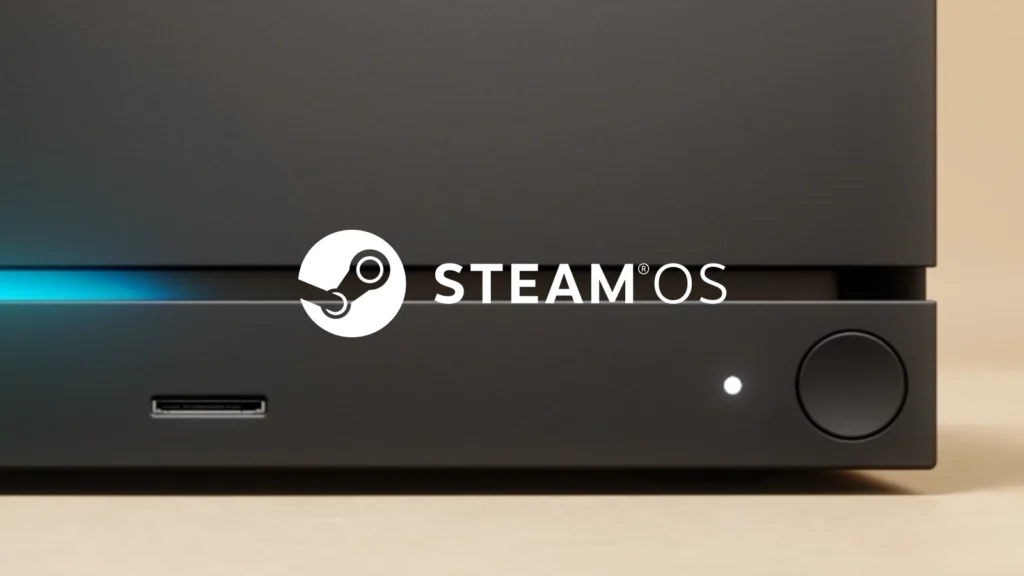
SteamOS could transform any PC into Steam Machine according to Valve
Since its announcement, Valve’s new Steam Machine has generated a lot of buzz. However, contrary to what many might think, it is not its power, nor its return to the living room gaming market that is attracting the most attention.
It is its price.
With a cost far exceeding that of traditional consoles, many gamers are questioning whether Valve’s offering is truly competitive against the PlayStation or Xbox. Yet, the most crucial issue might lie elsewhere.
According to Valve, users may not even need to purchase an official Steam Machine to enjoy the experience the company envisions.
SteamOS aims to evolve from the Steam Deck
In an interview with The Verge, Pierre-Loup Griffais confirmed that SteamOS is continuing its transformation into a true desktop operating system. Starting with SteamOS 3.8, users can now consider building their own Steam Machine using standard PC components.
In other words, any gamer with a compatible computer could potentially recreate the Steam Machine experience without purchasing Valve’s official hardware.
This evolution marks a significant step in the company’s strategy. For a long time, SteamOS was primarily associated with the Steam Deck. Now, Valve seems intent on making its operating system a far more universal platform.
Increased hardware compatibility
The latest update, SteamOS 3.8.10, greatly enhances support for modern platforms. Valve has notably improved compatibility with recent Intel processors, next-generation AMD platforms, and traditional desktop setups.
Until now, installing SteamOS on a PC could be relatively complex, especially for users without AMD hardware. The stated goal is now to simplify this experience to make SteamOS accessible to a much broader audience.
The Nvidia challenge remains a priority
One of the main barriers to widespread adoption of SteamOS concerns Nvidia graphics cards. Valve openly acknowledges this limitation. According to Pierre-Loup Griffais, the company is actively collaborating with Nvidia to improve graphics drivers and system compatibility. While full support does not appear to be on the immediate horizon, this collaboration signals a crucial development.
For a long time, SteamOS has been viewed as a solution better optimized for the AMD ecosystem. Robust support for Nvidia cards could significantly accelerate its adoption among PC gamers.
Why are gamers more interested in SteamOS than the Steam Machine?

Interestingly, community reactions reveal an unexpected trend. On Reddit and many specialized forums, a significant portion of gamers appears more excited about installing SteamOS on their existing computer than about purchasing the new Steam Machine.
The reason is straightforward.
Millions of gamers already own a sufficiently powerful PC to play comfortably. What they are seeking is a more straightforward, smoother user experience that is better suited for use from a couch. This is precisely where SteamOS excels.
Over the years, Valve has transformed SteamOS into a highly optimized gaming environment. The system offers features like quick booting, a controller-friendly interface, advanced shader management, and an experience akin to that of a console. In contrast, Windows is often seen as a versatile system before being a gaming platform.
This difference becomes particularly apparent when a user attempts to navigate Windows using a controller from their living room. SteamOS significantly reduces this friction.
A potential threat to Windows?
For decades, Windows has held a near-monopolistic position in the PC gaming realm. Various attempts to create a credible alternative have generally struggled with software or hardware compatibility issues.
However, the context is evolving.
Thanks to advancements made with Proton, Linux, and the Steam Deck, Valve now has a much more mature ecosystem than before. If SteamOS can deliver expanded hardware compatibility, a simplified installation process, strong support for Nvidia cards, and excellent software compatibility, the system could become the first credible alternative to Windows for gaming in many years.
Every PC could become a Steam Machine
This is perhaps where Valve’s true ambition lies. The company is not just looking to sell a new machine. It seeks to disseminate a new way of gaming on PC. If SteamOS becomes sufficiently accessible and compatible, any gaming computer could transform into a Steam Machine.
This strategy could potentially be much more powerful than selling proprietary hardware.
Rather than directly competing with console manufacturers, Valve could extend its ecosystem to millions of existing machines.
A new step for the PC ecosystem
The return of the Steam Machine naturally captures attention, but it may ultimately serve as a showcase to promote something much more significant. For several years, Valve has been quietly laying the groundwork for an operating system capable of competing with established standards in the PC gaming market.
With SteamOS 3.8, this ambition is starting to take on a much more tangible shape.
If Valve succeeds in persuading gamers to gradually move away from Windows for a console-like experience, then the true revolution will not be the Steam Machine itself.
It will be the birth of a new PC gaming ecosystem where every machine can become a Steam Machine.



