

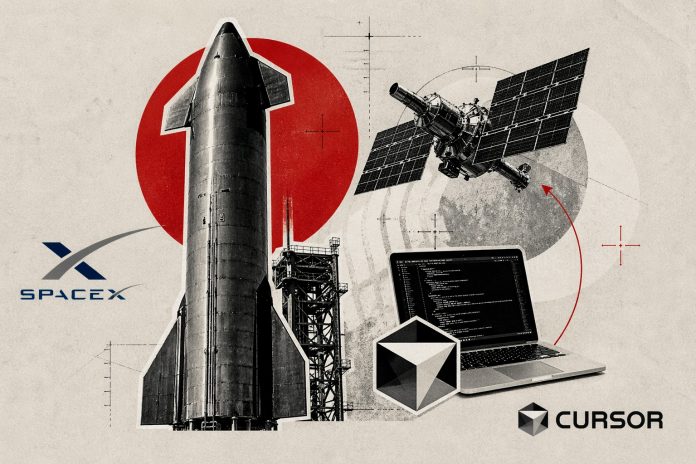
SpaceX has announced a groundbreaking agreement with Cursor, giving it the option to acquire the company later this year for $60 billion or to pay $10 billion for collaborative technological efforts. This unconventional partnership, which includes an acquisition option, allows Cursor to operate under SpaceX’s umbrella without an immediate financial outlay, just weeks before an IPO that could place the company at record valuation levels.
On April 21, SpaceX shared the news on social media, just weeks ahead of its anticipated IPO set for June 2026, which is expected to be one of the largest in financial history. The deal enables SpaceX to potentially acquire Cursor for $60 billion later this year, or, if no acquisition takes place, to invest $10 billion in their technological collaboration. This arrangement is more than just a standard business partnership; it represents SpaceX’s strategic entry into the competitive landscape of developer AI without the immediate need for a full acquisition. To dismiss this announcement as merely another maneuver in the developer co-pilot war would overlook its broader implications, as it encapsulates a larger struggle over the future infrastructure of digital work.
The timing of this operation underscores a strategic vision geared towards building rather than merely acquiring growth. Underlying the agreement is a radical industrial thesis: software production as an end-to-end, automatable flow managed from an orbital computing infrastructure. This perspective clarifies the timing’s significance; just a month earlier, SpaceX had recruited Andrew Milich and Jason Ginsberg, two founding executives from Cursor, to reinvigorate the development of xAI, which Elon Musk had previously criticized as “poorly constructed.” Meanwhile, Cursor was navigating negotiations to secure new funding amidst rising competitive pressures, as Claude from Anthropic and Codex from OpenAI boasted computational infrastructures that the startup could not replicate alone. Founded in 2022 by four MIT alumni, Cursor managed to reach $100 million in ARR within two years, raising $3.4 billion from Thrive Capital, Andreessen Horowitz, and Accel, and achieving a valuation of $29 billion by November 2025. This agreement with SpaceX potentially doubles its valuation within six months, even before an acquisition is confirmed.
Cursor as a Cognitive Production Asset
Cursor’s trajectory exemplifies the structural transformation occurring in software development. Its code-writing assistance tools have been widely adopted by technical teams in large organizations, making the startup a leader in this niche until larger players with substantial computing resources, such as Anthropic and OpenAI, launched competing offerings. The agreement with SpaceX aims to address this limitation. Cursor has acknowledged that its inadequate access to computational infrastructure for training its models has “created a bottleneck in its growth.” The deal grants Cursor access to the xAI supercomputer, which can train large-scale models and is expected to “dramatically increase the intelligence of its models.”
Beyond competitive catch-up, Cursor represents a component for SpaceX in the automated software production chain, serving as the application layer of a system designed to progressively reduce human labor’s contribution in software manufacturing. Combined with xAI’s reasoning models and limitless computing infrastructure, Cursor shifts from being a productivity tool to a node in a standardized intellectual production architecture.
An Integrated Vertical Ecosystem Built in 18 Months
The speed with which Musk is assembling this ecosystem is unprecedented in the recent history of significant technological maneuvers. In February 2026, SpaceX acquired xAI, valuing the combined entity at $1.25 trillion. By March, Musk hired Cursor executives from xAI, and in April, he established a partnership with the startup that includes an acquisition option. In just a few weeks, SpaceX has crafted a cohesive AI vertical: xAI for foundational models, Grok for consumer products, Cursor for the developer layer, Starlink for connectivity, and an impending IPO to fund future endeavors.
The comparison to hyperscalers is unavoidable, though significant differences exist. AWS, Azure, and Google Cloud built their integrated ecosystems over two decades based on a solid commercial foundation. SpaceX is attempting to replicate this structure within 18 months, leveraging its launch access and expertise in physical infrastructure. What structurally hampers hyperscalers—regulations, energy dependence, geographical constraints—is precisely what SpaceX’s orbital approach seeks to bypass.
An Orbital Infrastructure for Automated Production
Musk has explicitly stated this thesis in a letter to his teams: “In the long term, space-based AI is the only way to scale.” This argument is as technical as it is strategic. An orbital data center continuously captures solar energy without interruption from day-night cycles and atmospheric conditions. It dissipates heat directly into the vacuum of space, eliminating the cooling problem that accounts for 30 to 40 percent of energy consumption in terrestrial data centers, depending on configurations. Furthermore, it escapes all national jurisdictions, rendering regulations on data localization, the U.S. Cloud Act, European GDPR, and Chinese sovereignty laws irrelevant.
This aspect should draw particular attention from European CIOs and CISOs. The legal exposure of U.S. infrastructures to the Cloud Act has been a central concern in digital sovereignty strategies for years. An orbital compute facility operated by SpaceX creates a unique situation: infrastructure that is formally outside sovereignty, not because it’s located in a third-party state, but because it is physically beyond any existing legal framework. Even before this infrastructure exists at an industrial scale, regulators in Europe should address the question of its governance.
The SpaceX-Cursor announcement signals a foundational shift that is reshaping the development tools market around a small number of players equipped with both advanced reasoning models and massive computing infrastructure. Anthropic has seen significant revenue growth through Claude Code, while OpenAI invests heavily in Codex and targeting large enterprises. SpaceX is integrating Cursor into an ecosystem that aims to cover the entire chain, from foundational models to the application layer.



