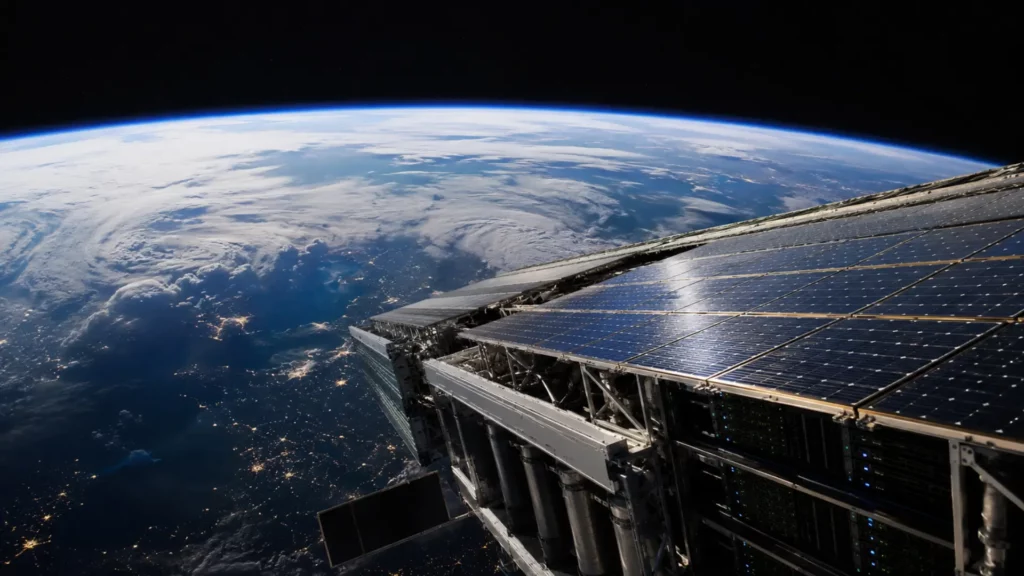
What if the next brains of artificial intelligence were no longer humming in earthly warehouses, but above our heads? SpaceX envisions data centers in orbit, powered by the Sun. A brilliant idea on paper, but fraught with very real obstacles.
SpaceX aims to transform Earth’s orbit into a massive solar data center
At Davos, Elon Musk introduced a statement designed to capture attention: space could soon be the best place to host artificial intelligence. On the surface, the idea can be distilled into a few simple words. Up there, solar panels are free from capricious weather, endless nights, and concerned neighbors over the vast megawatts consumed.
Furthermore, the setting seems almost obvious when gazing at Earth from orbit. Existing data centers on land already consume tremendous amounts of energy, while generative AI is multiplying the demand for calculations. According to the International Energy Agency, electricity demand related to data centers could rise significantly by 2030, driven mainly by servers, cloud computing, and AI models.
However, SpaceX is not discussing a mere space laboratory. The project envisions an immense constellation, featuring orbital platforms capable of housing specialized servers. In the most ambitious scenarios, Musk imagines up to a million structures in orbit, potentially turning the sky into a vast digital infrastructure.
SpaceX’s financial documents reveal major technical risks
Yet, the financial documents prepared by SpaceX for its IPO tell a less triumphant story. The company acknowledges that orbital computation for AI relies on untested technologies. Even more surprising, it admits that these projects may never achieve true commercial viability.
In reality, this discrepancy between the public facade and financial warnings is far from trivial. A company might dream big, but investors pay close attention to the fine print. Reuters reports that SpaceX emphasizes the project’s technical complexity, its early stage, and the risk of failures in the space environment, which is far more hostile than a climate-controlled warehouse.
Indeed, a server sent to orbit does not operate in a well-ventilated office. It faces radiation, extreme temperature fluctuations, launch vibrations, and micro-debris. Moreover, the AI chips, already under significant strain on Earth, could wear out more quickly up there. In space, even a minor failure can quickly escalate into an expensive operation.
Without Starship operational, constructing these space data centers is impossible
Now, everything hinges on another spectacular gamble: Starship. This heavy-lift rocket must enable the delivery of massive quantities of equipment to orbit, far beyond traditional satellites. Without this capability, assembling sufficiently large orbital data centers to genuinely meet the world’s appetite for artificial intelligence becomes unfeasible.
However, Starship is still in its testing phase. Successive flights have demonstrated impressive progress but have also exhibited explosions, control failures, and incomplete returns. Certainly, SpaceX is advancing rapidly, sometimes very rapidly, but building a reliable space logistics chain requires more than just spectacular demonstrations.
Additionally, in its own documents, SpaceX acknowledges that delays or failures in developing Starship could limit its growth strategy. This is a crucial point. In practice, orbital data centers are not just a computing challenge; they depend on a giant space truck, still engaged in a technical endurance race.
AI in space could shift energy problems to the atmosphere
At first glance, the ecological argument may seem appealing. Servers powered by continuous solar energy could ease the pressure on terrestrial electrical grids. They might also avoid some water cooling, which has become a sensitivity in drought-stricken regions. Thus, the idea checks several boxes for a less burdensome digital transition.
However, merely shifting a problem does not make it disappear. Thousands, if not more, orbital platforms would eventually fall back into the atmosphere. Researchers are already concerned about the particles released during the combustion of satellites, posing potential risks to the ozone layer and the fragile chemistry of the upper atmosphere.