

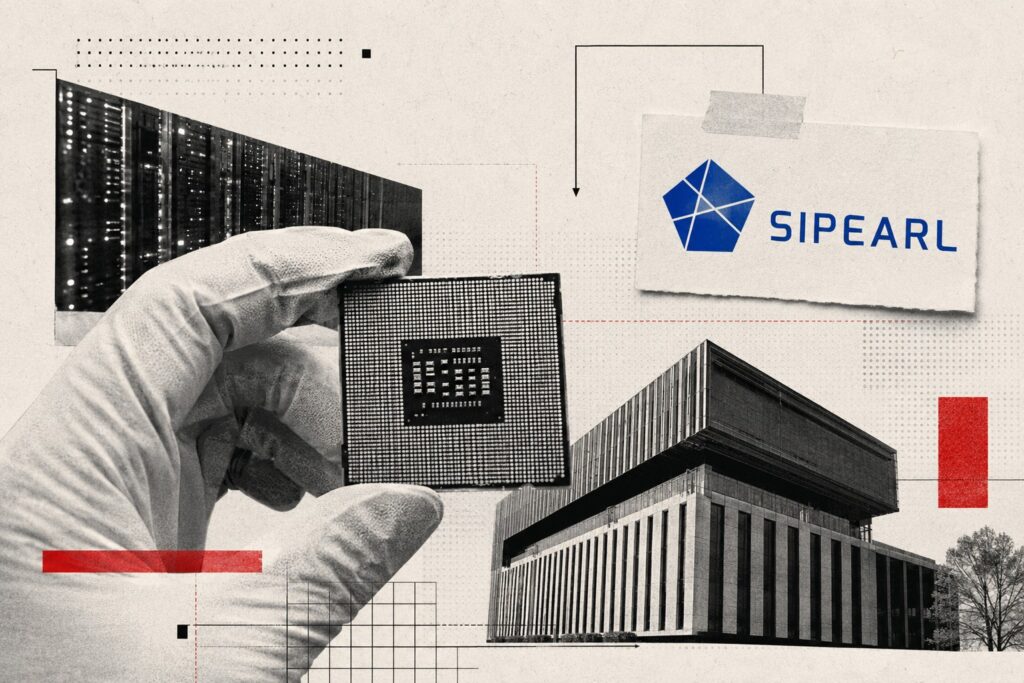
On May 13, 2026, SiPearl achieved a significant milestone with the first power-on of Rhea1, its high-performance microprocessor developed in France. This power-on stage confirms that the physical silicon responds accurately to signals and meets its design specifications. Rhea1 stands as the first server-class CPU based on ARM architecture designed in Europe, intended for supercomputing, artificial intelligence, and data centers.
Founded in 2019 as part of the EuroHPC initiative—Europe’s sovereign high-performance computing program—SiPearl operates as a fabless company, focusing exclusively on designing high-performance processors for supercomputers, AI infrastructure, and data centers.
For CIOs and CTOs engaged in intensive computing or large-scale AI projects, this announcement marks a pivotal shift in the hardware dependency landscape. Currently, the market for data center and supercomputing processors is predominantly shaped by American giants such as Intel, AMD, and Nvidia, whose chips are deeply embedded in Europe’s existing infrastructure. While Rhea1 is not yet commercially available, its successful power-on paves the way for a credible European alternative in silicon.
### Power-On: A Critical Milestone in a Chip’s Journey
The power-on phase is crucial, as it involves energizing a chip for the first time and ensuring it responds properly to a range of electrical signals. This step validates the coherence between the design plan and the actual behavior of the component in physical silicon. A successful power-on indicates that the design is functionally correct at the hardware level, preceding further qualification, optimization, and application validation before commercialization.
For Rhea1, extensive efforts from SiPearl teams went into achieving this milestone after receiving the initial silicon samples. Verification focuses on the logical consistency of the processor’s functional blocks, voltage levels, internal clock synchronization, and the ability to execute initial instructions.
### Architecture, Design, and Manufacturing: The Three Pillars
Rhea1 utilizes ARM architecture, which is licensed from Arm Holdings, a British company controlled by Japan’s SoftBank Group. SiPearl has leveraged this license to design the processor, integrating high-performance Neoverse cores and developing its own memory architecture and AI acceleration capabilities. SiPearl retains sovereignty over the design and intellectual property of the blocks developed by its engineers.
Manufacturing is carried out by TSMC in Taiwan, reflecting the current state of the global semiconductor supply chain, which lacks advanced foundry capabilities in Europe. For organizations contemplating Rhea1 from a digital sovereignty perspective, the distinction between design and manufacturing is crucial. A French-designed chip does not expose users to the U.S. Cloud Act, unlike cloud services from U.S.-based operators. However, reliance on TSMC introduces a different kind of geopolitical fragility due to the concentration of advanced semiconductor production in Taiwan.
### Rhea1 in the EuroHPC Ecosystem and AI Factories
Rhea1 is poised to equip the supercomputers under the EuroHPC program, including the Jupiter supercomputer located in Jülich, Germany. EuroHPC is an initiative involving the European Union and its member states aimed at providing Europe with a sovereign high-performance computing infrastructure accessible to researchers and industries.
In tandem with supercomputing, Rhea1 is also geared towards AI Factories being rolled out in Europe as part of the European AI program. These infrastructures, distinct from EuroHPC supercomputers, are designed for training and inferring large-scale AI models. Several AI Factories have been announced or are under deployment across various member states throughout 2025-2026 to mitigate dependency on U.S. hyperscalers for training infrastructure.
### Hardware Traceability: A Key Factor for CIOs
Hardware traceability has become a critical evaluation criterion for IT departments managing essential infrastructures. Recent U.S. restrictions on the export of AI processors, particularly affecting certain chips, highlight the potential impact of reliance on suppliers subject to extraterritorial regulations on project planning and access to hardware resources.
Rhea1 alters the risk landscape without eliminating all external dependencies. The design is French, with no exposure to U.S. law in its R&D and intellectual property activities. However, dependence on ARM represents a reliance on a British entity, whose architecture licenses are structurally utilized by the vast majority of independent processor designers worldwide. Similarly, TSMC remains a focal point of geopolitical concern, common to nearly all fabless semiconductor companies.
The successful power-on of Rhea1 on May 13, 2026, marks a tangible step toward achieving sovereign design capabilities for high-performance processors in Europe. SiPearl has translated seven years of development and European funding into functional silicon. While the chip has yet to become commercially available and full qualification remains pending, it represents a concrete entry in the register of European alternatives for processors, offering a new option for CIOs and CTOs evaluating their hardware dependencies in AI and HPC infrastructures.



