

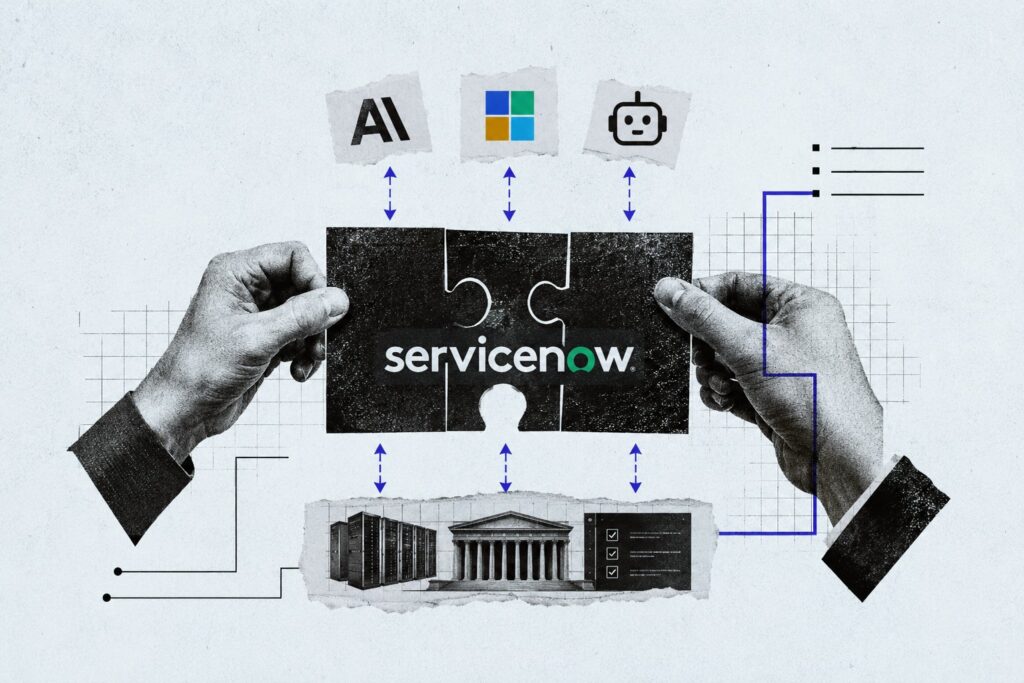
ServiceNow Expands Its Action System to All Enterprise AI Agents
At the Knowledge 2026 conference, ServiceNow announced a significant enhancement to its platform with the introduction of Action Fabric. This new initiative broadens compatibility with various models, enabling interactions with AI agents like Claude, Copilot, and internally-developed systems without a traditional user interface.
For years, ServiceNow CEO Bill McDermott has characterized the platform as an integral part of business operations, spanning IT, security, risk management, HR, finance, legal, procurement, and customer service. The platform seamlessly integrates every function and department, providing a cohesive framework that aligns with the overarching strategy of unifying value chains through integrated structures. This strategy allows clients to create thousands of workflows, playbooks, approval chains, and business rules to automate daily tasks across their organizations.
Now, with the introduction of Action Fabric, ServiceNow is embracing the era of agent-based AI. The platform opens its AI capabilities and action systems to all AI agents, whether they operate on ServiceNow, utilize Claude, Copilot, or are developed internally. Through Action Fabric, these AI agents can directly access governed business actions via the MCP protocol, affirming a growing trend among enterprises to leverage multiple models for their distinct capabilities.
From Registration to Action
The omnipresence of AI has prompted companies to seek platforms that facilitate seamless, model-agnostic execution of their operational pipelines. In ServiceNow, every record corresponds to an action, automated process, or workflow. When an incident arises, business rules activate, assignment workflows initiate, SLA timers start, and every action is bound by business governance. This interaction is critical for AI agents, as the knowledge graph and contextual engine provide necessary situational awareness for intelligent decision-making, while workflows, playbooks, and business rules ensure governed execution.
Consider a new employee starting on a Monday. In a conventional registration system, the employee is merely a data entry. On their first day, nothing is ready: equipment provision, account setup, payroll, and training languish in siloed systems and email chains. However, within ServiceNow, as soon as the record is created, it triggers all necessary actions. IT provisions access, security creates the appropriate badge, training assigns the onboarding path, and finance sets up payroll. SLAs track each step, and if any process stalls, the platform escalates the issue. By the time the employee arrives, everything is in place.
Action Fabric allows this process to happen without a traditional user interface, directly within the platform. A playbook for password resets can now function directly through Claude, and the HR onboarding workflow can execute when an AI agent submits a request through a collaborative tool of choice.
Anthropic serves as the first design partner for Action Fabric, linking Claude Cowork to the governed action system and bringing execution capabilities to the tools employees are already using.
Claude: From Conversation to Governed Action
Anthropic has established itself as a trusted AI provider for global enterprises, many of which are also ServiceNow clients. This synergy is intentional, allowing businesses that invest in governed workflows to integrate AI within a comprehensive functional ecosystem.
ServiceNow illustrates this with the example of a product manager transitioning to a new internal role. They rely on Cowork for consultations and inquiries, but often face obstacles due to a lack of seamless connectivity—such as inaccessible code repositories and unconnected Slack channels. Claude queries ServiceNow, which evaluates the manager’s current access and identifies five gaps. The manager reviews the list, removes any unnecessary items, and confirms. ServiceNow then channels each request through the appropriate approval chain.
“The gap between knowing what needs to happen and actually executing it is key to fluid human-machine collaboration. Connecting Claude Cowork to the ServiceNow action system bridges this gap directly into the workflow,” says Boris Cherny, head of Claude Code at Anthropic.
Governed Workflows, Not Just Data Access
The partnership with Anthropic exemplifies what Action Fabric enables. However, the platform is open to any AI agent. The MCP protocol is an open de facto standard supported by numerous enterprise vendors, marking a departure in ServiceNow’s approach.
While some platforms allow agents to read and write data, ServiceNow empowers them to execute governed work—managing workflows, playbooks, approvals, and catalogs. This results in a comprehensive system of action. Each action is processed through the AI Control Tower (AICT), which verifies identity, limits permissions based on roles, and conducts thorough audits. The MCP server integrates AICT governance, consumption metering, managed OAuth, enterprise audit logs, session management, and role-based tool kits.
The MCP server addresses diverse needs across IT, HR, customer service, security, risk and compliance, and application development, enabling coordinated multi-agent systems at scale.
Every Action Runs on ServiceNow
According to IDC, the number of active AI agents worldwide is expected to grow from approximately 28.6 million in 2025 to over 2.2 billion by 2030. As these agents proliferate, each becomes a gateway to the platform. Whether a developer using Claude in the command line, a manager employing Copilot in Teams, or a security analyst executing a custom agent, all actions are routed through ServiceNow. This dramatically expands the addressable surface area, unifying human and AI operational workloads on a single platform.
This synergy multiplies. Every agent executing actions through ServiceNow generates operational data that feeds process mining, CMDB configuration, and analytics. The more agents leverage the platform, the richer the operational intelligence becomes. These insights bolster the contextual engine, enhancing the efficiency of each agent over time.
Humans and AI agents require a shared execution environment—one where every action is governed, each workflow is connected, and every interaction enhances the platform’s intelligence. In this instance, that environment is ServiceNow Action Fabric. The MCP server is available now, included with every Now Assist and AI Native SKU, with additional features set to roll out in the second half of 2026. Actions without interfaces consume the same Assist units as Now Assist and AI Agents, creating a unified consumption model.



