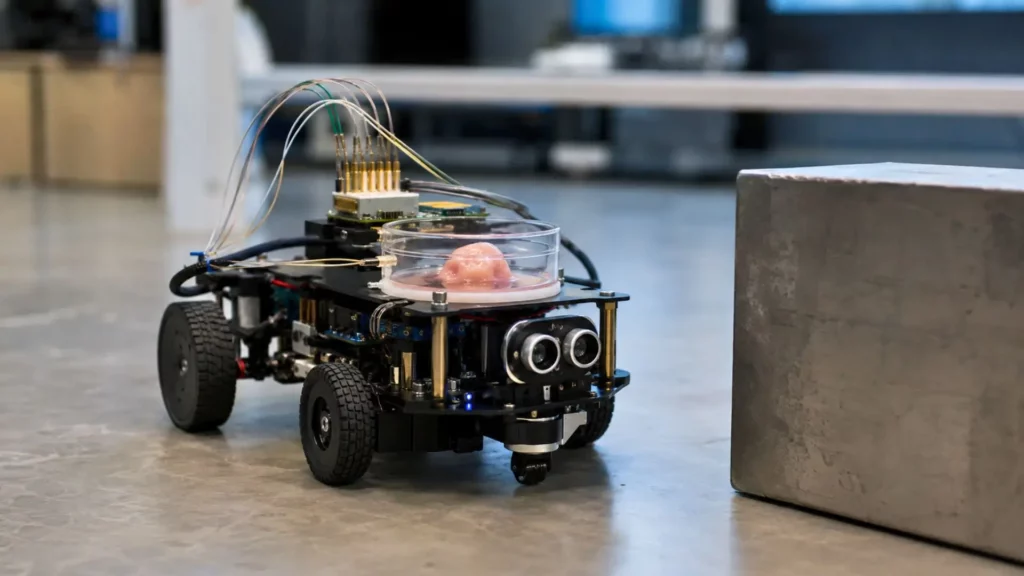
A Chinese team has developed a robot capable of navigating without any computer algorithms. By connecting a culture of human brain cells to an electronic chip, this groundbreaking system challenges our assumptions about artificial intelligence and paves the way for biological computers.
How human cells become a biological pilot to guide an autonomous machine
The project led by Tianjin University focuses on creating an organoid. For this, scientists extract human skin or blood cells and then reprogram them into stem cells. These cells then develop into a living brain tissue.
This assembly consists of about 10,000 living neurons organized into a three-dimensional structure. Through ultrasound stimulation, these cells form a dense network capable of responding to its environment. While this volume is tiny, it is more than sufficient to direct the device.
Unlike traditional computer programs, this mini-brain does not follow pre-established lines of code. The biological tissue evolves autonomously. Thus, the structure learns directly from its own mistakes to adjust the machine’s trajectory with each obstacle it encounters.
Metaboc, the technological interface that enables communication between biological neurons and silicon
To connect this living tissue to the machine, the team designed a device called Metaboc. This software interface translates physical information into electrical signals that the organoid can understand. In return, the reactions of the cell culture translate into concrete movement commands.
However, biological intelligence does not work alone, as algorithms assist in communication. This hybrid system combines the flexibility of human cells with the speed of silicon. As a result, the robot is able to grasp objects or follow moving targets.
A major energy revolution against resource-intensive AI data centers
Beyond the technical achievement, this research addresses a significant ecological urgency. Current computer models require colossal infrastructures. For instance, the learning phase of a tool like GPT-3 consumes as much electricity as over one hundred households in an entire year.
In contrast, these new bio-computers demonstrate remarkable efficiency. The human brain operates on about 20 watts of power, equivalent to a simple light bulb. This level of energy efficiency is impossible to replicate with traditional electronic chips.
Furthermore, the learning of these tissues occurs through a natural absorption of experience, without artificial programming. Connections self-modify in response to the stimuli received. Therefore, the machines of tomorrow could potentially become significantly more efficient while massively reducing their carbon footprint.
The ethical challenges and medical promises of a science that blurs the boundaries of the living
This field is advancing rapidly, as evidenced by the commercialization of the first biological computer by Cortical Labs in 2025. However, the technology faces crucial technical limitations, as maintaining these mini-brains alive currently requires heavy laboratory equipment.
In parallel, the absence of a legal framework raises immense ethical questions concerning the status of these sensitive tissues. Nevertheless, the medical benefits appear promising. These studies could enable the repair of human brain injuries by replacing damaged areas with biological grafts.