

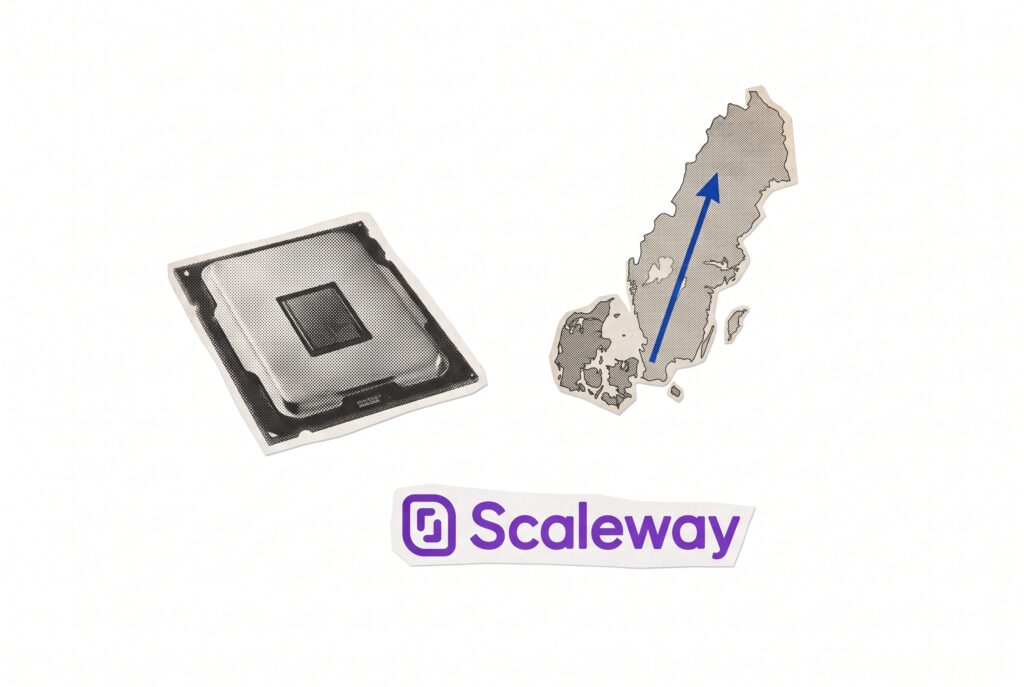
Scaleway Expands Its AI Computing Presence in Europe at ai-PULSE Conference
During its annual ai-PULSE conference, Scaleway took significant steps to bolster its European footprint in AI computing with the introduction of an Nvidia GPU zone in Copenhagen and a new AMD supercomputer in Sweden. The cloud service provider, part of the Iliad Group, aims to cater to companies seeking GPU capabilities under European jurisdiction and the flexibility to choose their architecture.
European enterprises looking to bring their AI projects into production are increasingly in need of graphics processing units (GPUs), with most available resources currently being sourced from American hyperscalers. Recognizing this demand, Scaleway leveraged its ai-PULSE conference, held on October 13, to make a series of announcements that reflect a cohesive strategy. The company is expanding beyond France for AI computing, diversifying its architectures, and strengthening its offerings in European public and industrial markets.
Scaleway plans to establish a “GPU Zone” in Copenhagen equipped with Nvidia HGX B300 infrastructure. It is also forecasting the deployment of a supercomputer in Sweden based on AMD’s Instinct MI355X GPUs, marking the company’s first such venture outside France. While details regarding the scale and timeline for these projects remain undisclosed, Scaleway is clearly positioning itself for growth.
Dedicated GPU Zones in Northern Europe
Scaleway refers to these sites as “GPU Zones,” specifically designed for model training and inference, complementing its existing cloud availability zones. The company chooses locations based on client proximity, access to reliable, low-carbon electricity, and a cooler climate that minimizes cooling needs. Denmark and Sweden fulfill the latter two criteria, and Scaleway is already serving clients in these regions, including the City of Copenhagen and the AI startup Corti. “Access to high-performance computing for AI is becoming a strategic priority for European organizations, which increasingly prefer to work with trusted providers,” commented Damien Lucas, CEO of Scaleway.
The Swedish supercomputer will integrate AMD’s GPUs with its open-source ROCm software, in collaboration with a consortium of established partners. Bull will handle the integration, cooling, and maintenance of the hardware, Giga Computing will supply the servers, HPE Networking will provide Ethernet networking, VAST Data will deliver the data platform, and Motul will supply a cooling liquid designed for high-density racks. Tele2, Scaleway’s partner in Sweden, acknowledges this initiative signals the country’s growing appeal for AI infrastructure.
All sites remain located within the European Union, and Scaleway emphasizes that its operations fall under European jurisdiction. This factor is crucial for IT departments that need to keep sensitive workloads insulated from extraterritorial laws. Although the processors in both cases are American, they pose less legal exposure than the applications and services leveraging them, as the operator — along with its software and support — bears the bulk of legal risk.
Nvidia, AMD, and VSORA: A Diverse Offering
Scaleway highlights the diversity of its processor offerings as a key asset. The Copenhagen cluster relies on Nvidia, while the Swedish supercomputer will use AMD and ROCm, AMD’s open-source software stack that competes with Nvidia’s CUDA. Simultaneously, Scaleway is collaborating with VSORA, ZML, and the Île-de-France Region on an inference solution centered around the Jotunn8 processor developed by French startup VSORA. Scaleway promises to host the first VSORA servers in its data centers and validate the architecture for production use.
This diversity has practical implications for IT departments. Different workloads — whether high-volume inference, model training, or document processing — necessitate distinct accelerators. A provider offering various options empowers organizations to make choices based on cost and performance. The decision between CUDA and ROCm ultimately falls to the IT department, which regains the freedom to select its software platform based on specific workloads. The model catalog follows a similar flexibility, featuring GLM 5.3, an open model from Z.ai designed for coding and agent tasks, alongside LightOn OCR 3, created by French company LightOn for extracting data from complex documents.
A Trajectory Towards Being a European Computing Provider
In April, the European Commission selected Scaleway as one of four Cloud III providers under its procurement system, a €180 million initiative for EU institutions that can last up to six years. By July, Airbus had selected Scaleway for part of its applications, and the company acquired Qarnot, a specialist in high-performance computing that recycles server heat. At the end of September, Scaleway formed a partnership with Dataiku that allows the software company’s clients to run its AI platform in Scaleway’s cloud. The announcements from ai-PULSE thus extend a year marked by entry into the public and industrial markets across Europe.
Scaleway is also launching Quantum Builder, a program aimed at research teams within large organizations, accompanied by Qall, an open development kit that orchestrates traditional CPUs, GPUs, and quantum processors. The company is exploring orbital data centers with Alatyr and participating with the Iliad Group in the European AI “gigafactory” project, which remains a candidacy.
Future Plans and Unreleased Details
The northern expansion presents European IT departments with an additional option for AI computing, courtesy of a European operator, with choices between Nvidia and AMD. It allows organizations to incorporate GPU capacity under European jurisdiction into their strategic planning. IT departments can compare these offerings with those from hyperscalers during upcoming public and private procurement processes without changing jurisdiction when switching processors.
However, the announcements remain largely aspirational. Scaleway has not disclosed the quantity of GPUs, installed capacity, or any timelines and pricing information, nor has it claimed SecNumCloud qualification from ANSSI for these new sites. Companies planning their workloads will need to wait for these specifics to gauge the actual scale of Scaleway’s offerings in comparison to major suppliers.



