

Samsung unveils Flex Titanium: a new foldable screen technology designed to reduce the crease
Just days ahead of the July 22 Galaxy Unpacked event, Samsung reveals one of the major innovations in its next generation of foldable smartphones. Dubbed Flex Titanium, this new screen architecture promises to significantly reduce the visibility of the crease while enhancing the rigidity and durability of the entire display.
This announcement confirms that Samsung is continuing to address one of the main flaws of current foldable smartphones, while competitors like Apple, Google, and OPPO also ramp up efforts in this segment.
A New Titanium-Based Structure
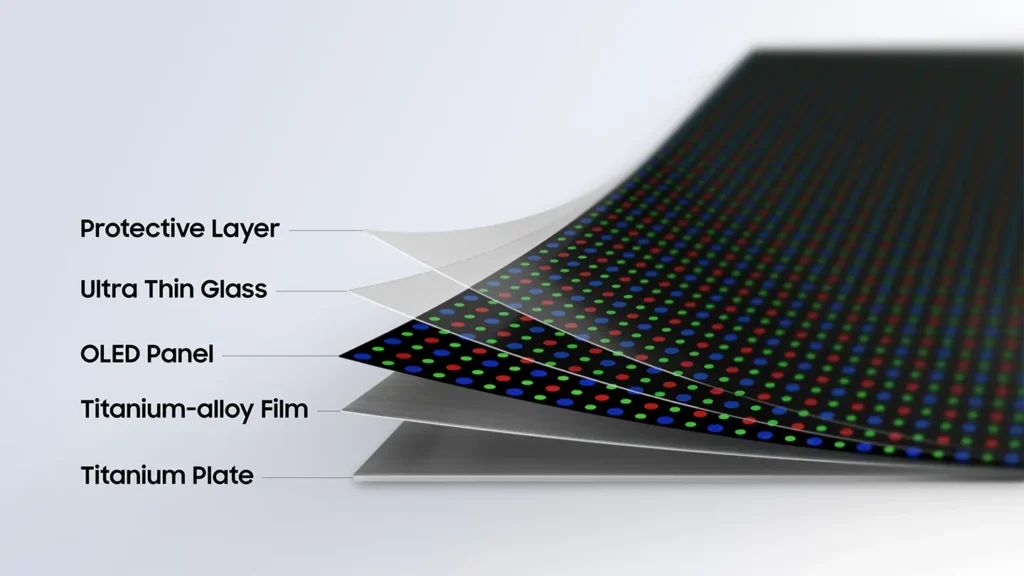
At the heart of Flex Titanium lies an architecture made up of two titanium components, each playing a specific role in the mechanical strength of the display.
The first is a titanium alloy film, placed directly beneath the OLED panel. Samsung claims it offers a rigidity 20 times greater than that of the plastic film used in previous generations, all while being extremely thin—its thickness is about one-third that of a human hair.
Under this film is a titanium plate that supports the entire display module. Samsung explains it has developed a new micro-perforation method to eliminate air pockets between this plate and the adhesive layer, thus improving screen retention when fully deployed without compromising its ability to be folded hundreds of thousands of times.
According to Sunghoon Moon, Executive Vice President of Mobile R&D at Samsung Electronics, this development aims to provide innovations that respond to real-world usage rather than merely serving as marketing gimmicks.
A Direct Response to the Main Flaw of Foldable Smartphones
Despite advancements, book-style smartphones still suffer from a recurring weakness: the central crease, which can be visible from certain angles and sometimes perceptible to the touch. Whether it’s the Galaxy Z Fold, Google Pixel Fold, or OnePlus Open, this mark remains one of the last compromises users must accept in exchange for a flexible screen.
With Flex Titanium, Samsung aims to mitigate this drawback without sacrificing the slimness of its devices or their long-term durability.
While this technology will initially be limited to future Galaxy Folds, its arrival could quickly impact the entire industry. Since Samsung Display remains the world’s leading supplier of foldable OLED panels, its innovations often end up benefiting other manufacturers.
Two Components, Two Functions
The new structure relies on two complementary elements:
- Titanium alloy film: located under the OLED panel, it significantly increases rigidity while maintaining an extremely slim profile.
- Titanium support plate: placed beneath the display module, it employs a micro-perforated structure to strengthen the screen while preserving its flexibility during successive folds.
Samsung also notes that this architecture comes with a new generation of organic materials and a higher-resolution display structure, resulting in improved image quality and reduced power consumption.
A Technical Choice that Raises Questions
The announcement is particularly intriguing given several rumors suggesting that Samsung may simultaneously move away from titanium for some external components of its upcoming Galaxy Z Fold in favor of a carbon fiber-reinforced composite material. In other words, the company appears to be shifting the use of titanium to areas where its benefits are truly pivotal: the internal structure of the screen rather than the chassis.
This approach reflects an evolution in the design of foldable smartphones, where materials are no longer selected solely for their premium look but primarily for their mechanical properties.
Samsung Aims to Maintain Its Lead in Foldable Screens
The impending arrival of the first foldable iPhone and the advancements made by Chinese manufacturers intensify the technological competition. In this context, Samsung seeks to consolidate one of its main competitive advantages: its expertise in flexible screens.
If Flex Titanium lives up to its promises, the reduction of the crease could represent a significant advancement towards making foldable smartphones more mainstream. User experience would then remain closer to that of a traditional smartphone, while still enjoying the benefits of a large display.
It remains to be seen whether the announced improvements will translate into real-world performance. Samsung will officially unveil this new technology during the Galaxy Unpacked event on July 22, where the future Galaxy Z Folds are expected to showcase this new generation of screens.



