

Samsung Galaxy Z TriFold 2: The Secret Hinge That Will Change Everything?
Samsung may not have said its last word on triple folding. Following the introduction of the first Galaxy Z TriFold in late 2025 in a limited number of markets, new rumors suggest a second generation is already in the works, aimed at addressing the main flaw of the original model: its bulkiness when folded.
Galaxy Z TriFold: A Spectacular Concept, Yet Imperfect
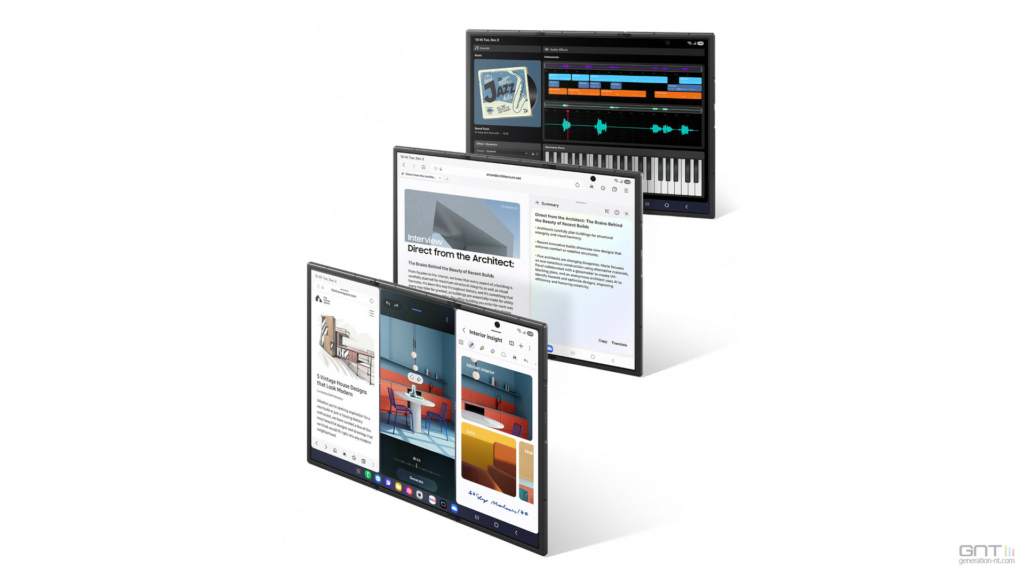
The first Galaxy Z TriFold was not just a whimsical exercise. Samsung officially presented it as a dual-hinge device capable of unfolding a 10-inch main screen, with a thickness of just 3.9mm when opened, and 12.9mm when closed. The manufacturer also highlighted two differently sized hinges and an architecture designed to minimize the gaps between the panels.
Technically, the device was impressive. Practically, it was more challenging to use daily compared to a traditional foldable. This is precisely the aspect the Galaxy Z TriFold 2 aims to improve, according to recent leaks attributed to leaker yeux 1122. Samsung is reportedly working on a redesigned hinge to lighten and slim down the device.
A New Generation Hinge at the Core of the Project
The most credible rumor at this stage does not indicate a total reformatting but rather a targeted improvement. The new hinge mechanism is designed to reduce the overall thickness of the product, potentially serving as a foundation for other future Samsung foldables. While nothing has been confirmed by the brand, multiple reports converge on this direction: less mass, less volume, and more portability.
The comparison with the rest of Samsung’s lineup is quite harsh. The official Galaxy Z Fold 7 folds down to 8.9mm thick, far exceeding the 12.9mm of the first-generation TriFold. This discrepancy alone summarizes the challenge ahead for Samsung.
A Product Still Very Niche, Despite Its Appeal
The first TriFold was never a mass-market product. Samsung planned for a gradual and selective rollout, starting with Korea and expanding to a few other markets, including the United States, with a deliberately limited production run, estimated at 100,000 to 200,000 units.
Nonetheless, there is genuine interest surrounding the format. Stock sold out quickly during restocks, despite a price tag nearing $2,900. However, this success should be viewed with caution: a very limited product can be sold out without becoming a mainstream phenomenon. It signals strong curiosity, but not yet massive adoption.
The True Challenge for Samsung Will Not Just Be Material
Reducing thickness is essential, but it won’t be enough. The initial months of the Galaxy Z TriFold were also marked by several reports of screen malfunctions.
The other limitation lies in software. Samsung has already proven it can create an impressive device; it must further demonstrate that this three-panel format provides sufficiently distinct use cases to convince beyond enthusiasts. Multitasking, productivity, video, AI, and application continuity will determine the credibility of the Galaxy Z TriFold 2.
A Launch Expected in 2027
Currently, the most frequently mentioned timeframe for a second generation is around mid-2027. This remains a rumor, not a confirmed timeline from Samsung. However, if this timeline holds true, it would give the brand adequate time to refine both the mechanics and software experience of a product that still resembles more a showcase of engineering than an announced bestseller.
Thus, the Galaxy Z TriFold 2 might be less of a revolution and more of a corrective measure. Sometimes, in the world of foldables, it is precisely this kind of second attempt that transforms a technical feat into a credible product.



